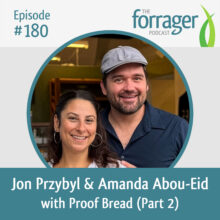
David Crabill: Welcome to the Forrager Podcast, where I talk with cottage food entrepreneurs about their strategies for running a food business from home. I’m David Crabill, and today is part two of my interview with Jon Przybyl and Amanda Abou-Eid. If you haven’t watched part one yet, you should go back to the last episode and check that out.
But before I begin, I want to thank the sponsor of this episode, Cottage CMS. Cottage CMS is a website and business platform built specifically for cottage food entrepreneurs. They now power over 3,000 food business websites and for good reason.
Here’s what makes them different. Most tools in this space gets you started. Cottage CMS is built for what comes next when you’re ready for a full desktop workspace, a robust product catalog, subscriptions, cost tracking, et cetera, the kind of horsepower that turns a side hustle into an actual business.
Their core promise is simple. They help you look established before you feel established. I’ll have more on them later in this episode, along with a special offer for Forrager podcast listeners. Stick around.
All right, so I have Jon and Amanda back on the show today. They live in Mesa, Arizona, and sell sourdough bread and pastries with their bakery, Proof Bread. In the last episode, Jon and Amanda shared how they scaled their cottage food business to about $1 million in annual revenue before being forced by city officials to move into a commercial space.
In this episode, they share how they have grown since the move and the challenges they faced along the way. And with that, let’s jump right into part two of my interview with Jon and Amanda.
[00:01:51] Jon Przybyl: September of 2020 was a absolutely pinnacle moment, climactic moment in this whole journey. We got two life-changing pieces of news in a span of three days. The first one hit like a ton of bricks, and it’s one that would change the course of our whole lives.
On Wednesday, in a week in early September 2020, we got a letter back from the Children Hospital in Phoenix, Phoenix Children’s. We had spent several years trying to figure out why our younger daughter was seemingly, like, tripping more, falling over all the time with increasing frequency.
And, then we sort of added on some other things that were going on for her, where sometimes she had trouble ending words, especially with harder sounds like consonant sounds. And other times in, like, a routine physical exam at the primary care doctor, we actually had uncovered a heart murmur that we had never seen before in tests.
And so all three of these things converged, and years into this discovery process, we went and tested her for a rare genetic disease, and the results came in that Wednesday. We read the results, and it turned out that she was born with a genetic disorder called Friedreich’s ataxia. I had never known anything about this.
I remember reading about the symptoms. I think Amanda had even sent them over first to me in some way. And I just remember reading life expectancy 20 to 35, and that, Keira would lose her ability to walk and, eventually she would lose her ability to talk and, that her brain would kind of stay, perfectly intact the whole time, but kind of her body would fail her.
So we got that news on Wednesday. Two days later, Friday rolls around and we get a knock on our garage door and it’s the vice mayor, our councilman. He’s actually now Mayor Freeman of Mesa. And he had a letter in his hand. The letter said, “You have four months to commercialize your bakery or we’re going to shut it down.” And so that was kind of the weight of the news of the week and, quite a, quite a moment in our lives.
[00:04:38] Amanda Abou-Eid: And I think there was, like, added weight too because Jon knew that we were out of zoning– like, we were violating a zoning ordinance this whole time. And so it was, like, the fruition of his worst fear.
[00:04:51] Jon Przybyl: Yeah. We were now several years into this whole thing, and it– in many ways, we had just finally reached a point of stability within the last year leading up to that point. That doubling that happened during COVID had really rounded our financial corner for us. So now we finally had enough revenue coming in that we could pay the people that we had fairly.
We could pay for equipment when it broke down. We could afford to keep the business moving forward. We could make what we wanted. We could serve the community we wanted to serve. We had a couple days off. We had enough revenue that we could shut down for a week when we needed to and recharge for a vacation between the seasons.
And we could even conceivably start saving again and repaying ourselves after the years of sacrifice. My dad had put in these two additions on the garage. Our space was comfortable. We had enough money to pay off those additions, though we had spent about $100,000 to build them in the first place. And here we are with… I mean, it’s very hard to conflate the two because on the one hand, it’s a literal death sentence for our daughter, and on the other hand, it feels like a death sentence for our livelihood all at the same time.
[00:06:27] David Crabill: It’s interesting when you go back to even just, like, March of 2020, before everything kinda changed, right? Before the pandemic changed, before you were forced out, before you learned this news about your daughter, you mentioned being afraid of brick-and-mortar.
And you said that you were afraid because you thought that it would cause your relationship with your customers to not be as close, and now you’ve gone through multiple expansions. You have five storefronts, and I was just wondering, take…
You can take yourself back to that time of wanting to stay at home. I know that was your intention and, but now you’ve been forced into doing this expansion phase to some degree, and– not as much as you have, but do you feel like those concerns or those fears were founded or not?
[00:07:29] Amanda Abou-Eid: Well, I wanna be clear in that it was never our intention to stay in the garage forever. We would’ve loved to just have at least a year to just recover from all the expansion that we did do within the space that we had, and would have loved to be able to transition on our timeline versus someone else’s timeline.
[00:07:49] Jon Przybyl: Put it this way, we have five storefronts right now, and we’ve built five storefronts in five years, and we have felt that in order to stay true to our original mission, we have had to go that fast, which has basically led to five years of intense blur that could have otherwise happened over 10 or 15 and wouldn’t have required the, just the craziness of that period that was even more tumultuous than the first few years in many ways, but felt very necessary in order to avoid the sort of compromises that we feared.
It’s also because of a bigger thing that we couldn’t have never really visualized in 2020, what it would be like to have 80 to 100 deeply devoted teammates that all add their own energy to the process.
But okay, go from four to 80, and it’s one thing to sort of lead a few people that are working shoulder to shoulder with you. It’s a whole ‘nother thing to build an entire team that is now in a commercial setting that many of which don’t work shoulder to shoulder with us. We can’t be in five places at once.
And we actually have like a sixth place, an office to sort of manage the five places, so certainly can’t be in six places at once. And yet the financial equivalent to the $1 million garage bakery is the bakery that we have today, meaning it’s only after all this time that we have reached a point that the net profitability of our commercial operation can meet or exceed the net profitability of that $1 million garage bakery, and yet we are approaching six times the size that we were.
So it’s kind of interesting to think that we would have to, multiply ourselves sixfold in order to reach the same equivalent profitability level commercially. We– I would’ve never imagined that it was that difficult, even looking at it from 2020. I would’ve imagined maybe double, but I was far underestimating how hard it would be to sustain this commercially.
[00:10:24] Amanda Abou-Eid: And I will say that we have some differing opinions on that because, I mean, I agree with Jon in that that’s the volume that it takes doing our core business, but I think that there are other avenues to explore. So if you’re somebody who is on the precipice of moving out or from your– cottage operation to commercial, or if you’re someone who has just started a commercial, this is the time that you kinda gotta get crafty.
So, like maybe you would diversify into education, or maybe you add some different products to your menu or like there’s many ways to skin the cat.
[00:11:09] David Crabill: Can you clarify this a little bit? Because, I mean, I don’t think many people are gonna understand what you said in that you feel like you had to grow into five locations just to replace that one home one. And I know that one was basically running as a commercial kitchen from your home. You built this humongous addition onto it.
Still obviously relatively small compared to some commercial spaces, but why couldn’t you have just grown that first location and built it up into something that was very profitable? Why do you feel like you had to keep growing, keep expanding, keep ultimately taking on a lot of debt in order to reach a certain profitability point?
[00:11:58] Jon Przybyl: So I think the start to that feeling was the actual investment that it took to build the first Mesa bakery and what that did to our overall balance sheet. Now, we weathered all of that in what seemed like almost a miraculous way. The four months never was four months. It actually took 11 months to build our Mesa bakery, and it was due to a multitude of support from the community at large, not just our local community, but a global community.
[00:12:37] David Crabill: Because of the YouTube channel.
[00:12:39] Jon Przybyl: Yeah, the YouTube channel was definitely a big part of it, and also, more locally probably our actual market participation, our Instagram following. All of it sort of coalesced because we started sharing what was happening. We shared our story online, both on Instagram and YouTube, and people were encouraging us, hey– people that probably had gone through their own kind of difficulties in their life or had sort of latched onto our story the way that I had latched onto Jared’s story, or had already founded new businesses, because of our YouTube work.
In just that few months between May and September, we immediately– people were actually doing something with what we were sharing online. So when we met some adversity, people were saying, “Hey, start a GoFundMe. We wanna contribute. Start a GoFundMe. We wanna contribute.” And there’s a little bit of, like, shame that goes along with all of that.
You sort of feel like if you start a GoFundMe, I mean, something that you sort of have to battle is, like, I failed and now I need a community bailout. But we did it, and–
[00:13:53] David Crabill: Well, hold on. You raised over $100,000 via GoFundMe. Do you have regret doing that?
[00:14:00] Jon Przybyl: No, I think in fact, like is such a beautiful thing that happened. Over 1,000 people representing more than 100 countries, chipped in, and that $100,000 basically cleared the amount that we had spent on our garage addition the year previous because we had really put in this big addition. And so it gave us, let’s say, a level ground as though we hadn’t just put in 100 grand into the space we’re getting kicked out of that we could not take with us.
Of course, it took a lot more than 100 grand to build a bakery.
[00:14:42] Amanda Abou-Eid: Well, and we learned a lot, right? Like, we moved into a space that wasn’t a commercial kitchen before, and so we were building from zero.
[00:14:51] Jon Przybyl: Yeah, and we were building with a knife to our throat with this four-month threat. So, we got that letter, and two weeks later we’re, like, looking at a building, and a week after that we’re signing a lease, and a week after that we’re talking to architects, which that 100 grand helped pay for the architecture.
That was immediately a $20,000 bill.
[00:15:12] Amanda Abou-Eid: But mind you, like we didn’t have these connections before. Like, that was the plan, was like settle into the new footprint in the garage and then start to work on the community connections a little bit, like to deepen them. And so we never really had that luxury, so we were relying on like recommendations from the city or like we didn’t really have any experience in this.
I think Jon felt very alone during this process, and like he kind of alluded to too, is he– well, you said like you felt like you failed. I didn’t feel that way. I felt like I wanna fight. And I think that the GoFundMe was such a beautiful manifestation of what people wish to see in the world.
It’s sort of like a vote with your dollars situation.
[00:16:21] Jon Przybyl: To answer your root question of why the feeling that you have to grow so much to just make up for what you already had at a smaller level. Had we just at that time, with the circumstances that we had and the knowledge that we had, done like a lateral move, meaning moved all the equipment that we had existing into this new space, it would’ve probably cost about a half million dollars to build Mesa out.
We ended up spending 800,000, and in that 800,000 we got some larger ovens, we got some larger mixers, we got some larger– like, we got a larger overall footprint within which we could grow. And we thought that we were building the building blocks of our future that way, where yes, we’re making this big investment, but now we could grow into it.
So we are taking on all this debt, but we would have some headroom and we would have the ability to grow into it. So of course, like the debt is a part of it. The next part of it is, of course, all this new overhead that you’re not accustomed to. You haven’t really necessarily costed in. Of course, there’s the rent, there’s the utilities, there’s all the licensing that comes with a brick and mortar, a commercial operation, things that you would never even dream of, like backflow preventers on equipment that basically prevent the water from going back into the supply line that need to be certified and tested every year.
Fire sprinkler systems. Yeah, the list goes on and on. And then also the standard by which you operate commercially versus in a cottage from an employment perspective, that’s where the real costs start to pile up, where we could run a small crew through our garage for part of the week and get all of our work done.
But then when we attempted to do the same amount of work, even with this new larger equipment, it seemed to take more people more hours, especially when it came to like mopping up the floor at the end of the day and keeping this whole building pristine and clean.
So, the business model that we had built for ourselves in the garage basically wasn’t working at the commercial level.
We had outplayed our hand on Saturday. We had gotten to the point that Saturday, like, filled two truckloads worth of product that we distributed out to the market, and this worked really well in a concentrated home environment. And then when we commercialized and we had a brick-and-mortar that was open more than just Saturdays, now this workflow was very damaging.
And so we needed to figure out how to heal this business model essentially.
[00:19:26] Amanda Abou-Eid: Well, we had also built systems around how we worked and operated in the– in the garage. Moving to a new location, new equipment, new everything, larger footprint, we didn’t really have a chance to fully build and then document those systems. And even in the garage, I don’t know that anything was truly documented, right?
Like, there’s a– when you move to a, like, to– when you move to commercialization, depending on the size of your commercialization, like, there is, there becomes a necessity to, like, document everything that you do so it can become repeatable. And we never really had the luxury to do that because everything was just fully, like, reactionary.
Because again, it wasn’t on our timeline.
[00:20:13] Jon Przybyl: Well, and so you might start seeing the building blocks of why we felt the need that we had to grow so much because Every day was presenting problems at scale that we had never faced before. In the garage, if a piece of equipment broke, we were responsible for its resolution, and it usually costed an amount that we could bear from kind of the profits of the business.
Now we move to this commercial setting, and the problems started to multiply in value. Our wages didn’t move from where they were in the garage. And so now our wages against the problem were smaller, and it was scarier every time something went wrong. So if a walk-in cooler broke, the repair might be $10,000.
So, we went from an environment where for $1,000 or $2,000 we could probably fix most things in the garage. Now even $10,000 seemed like it wasn’t enough. And keep in mind, this entire time, because of how we started, we had never had a period of time where we could accumulate cash. So, we had spent the first few years of our journey buying mixers and buying this oven and buying a dough sheeter and buying some of the things that powered our garage.
And then we get to 2020 and now it’s time to put in half a million, $800,000 to build a bakery. Oh, and by the way, it’s also time to hire more people. And–
[00:21:52] Amanda Abou-Eid: We were also trying to work with the existing infrastructure that we did have.
[00:21:56] Jon Przybyl: Yeah. We weren’t trying to cut the floor any more than we needed to. We weren’t trying to do– Like, we were trying to work with the building as it was to some extent, because it’s not like we had a– a few million dollars to spend on this thing.
When we say we spent 800,000, we spent 800,000 in numerous ways that were thrifty, where we didn’t buy like the most expensive architecture. We didn’t get the most expensive finishes. We still employed all of our kinda DIY, principles that had brought us to that point along the way. So I guess our $800,000 went to power something that would later become a multi-million dollar venture.
But you could easily spend $800,000 on just, façade of what you do, and it’s not so hard to do that. These things cost a lot of money. The sign on your building, the packaging that your bread is going into, the name brand of your furniture that you have. All of this stuff adds up. So my biggest piece of advice is if you do have to commercialize well before that point that we did, try to be humble about it. Understand that, like, you aren’t at a place yet where it’s time to expand there that much further. You gotta kind of find your legs in the commercial setting. So, find the back of a kitchen that you can rent time in, or–
I mean, you can actually open a bakery in an existing restaurant space, and because there’s some existing kitchen infrastructure, you can do it a lot less than what we spent on that bakery.
But, had we not done that, had we not, like, opened in downtown Mesa, maybe the city wouldn’t have given us 11 months of grace to open. So you can say, like, coulda, woulda, shoulda, but things happen for a reason. And, yes, it was a hard time, and yet such a beautiful time as well. The biggest adversities in life often lead to the most significant, changes, the most significant blessings, the most significant opportunities, and that’s what we were going through during that period.
[00:24:18] David Crabill: As I’m listening to this, I’m thinking about, like you’re talking about it as if this was your only option, other than obviously shutting down the business. But obviously, you could have made a much smaller move. A lot of the problems you were talking about, everything gets more expensive in the commercial space.
Any fixes get more expensive. Part of it is because you went really big. I’ve seen the videos. I’ve seen that oven that you got for that first space, and you didn’t have to, right? You could have moved into a non-main street location and just kind of established a commercial kitchen, not a storefront, somewhere that was less expensive and moved your operation over there.
You still would have had to spend a fair amount of money, but you could have gone that route, right? You chose to go big, and you’ve continued to make kind of these growth choices over the years. So walk me through that. What’s motivating you to go big with these transitions instead of trying to be, I don’t know, more sustainable?
[00:25:31] Jon Przybyl: Well, it’s interesting the idea of sustainability, because I’m a little bit more of a long-range thinker. I’ll think about things in timelines that a lot of the people around me are maybe not typically exploring. Like it’s perfectly okay for me to consider what life might be like in five years’ time.
I realize that there’s flaws to this kind of long-range thinking too, especially in a world that’s changing so fast where it’s– you could argue it’s impossible to really predict the future five years away. But I was really thinking about– how can we not get sort of thrown off the horse here?
We’ve built a foundation of something. We already have this team that is helping us along the journey. We’re not having to do all the work ourselves. I didn’t really wanna go backwards into a space where I was basically having to create a set of two full-time jobs for Amanda and I in fulfilling all the baseline work, and I think a lot of commercial operators of food businesses, the way in which our, like, food business economy seems structured is like, yeah, you can have a food business if you’re willing to work 100-hour weeks yourself, do all the work, let every single problem fall on your shoulders.
You can function under a million dollars and survive. And if you want anything different than that, well, you actually need to achieve enough scale in which you can survive all of the bumps along the road that inevitably happen, especially in a, especially in this kind of a sector where the work is very physical.
It relies on physical things that break down. It relies on humans that also are going to break down physically, emotionally, otherwise. And so, yeah, it’s true that we could’ve taken a different brick-and-mortar approach, and at least to my mind, it sort of felt like that’s the city imposing their will on us and kinda snuffing us out and forcing us into a lifetime of having to operate at a certain level of constraint, never really being able to realize our vision.
Like maybe in order to survive under a million, now I have to start buying the conventional wheat. I have to set aside the idea of spending more on flour. Maybe I have to give up the whole sourdough ideal in the first place because here’s the thing. People don’t realize to make a sourdough bakery successful commercially requires more space than making a other kind of bakery work commercially.
When we make our products over the course of multiple days. We need physical space to store those products for multiple days. If I make something with yeast and I mix, shape, bake, and sell, I can get rid of it within hours from the time that I started. If I make something with sourdough, I might need to hold onto it for several days in a physical form, while now I’ve added new production for the next days.
And so I might need a factor of two, three, four times the size in order to accommodate the same amount of production that my yeasted counterparts will. So the other big problem here is commercializing something that basically fell out of favor 200 years ago commercially, meaning we’re competing with a business model that was obsolete over 100 years ago and trying to make it work in a modern world, like revisiting it.
So I would push back on the premise that we could have gone a lot smaller. I don’t believe that we could have gone a lot smaller without changing the business model fundamentally, meaning bringing in, like Amanda said, education or bringing in food service or bringing in other components to the business that had nothing to do with making sourdough pastries and sourdough bread.
And so to me, it was like, well, you’re not allowed to actually do the business you want to do unless you fundamentally uproot it. And I saw it as this is the only way that I can continue doing the business that I want to do, that I set out to do, that I clearly have traction around, that we clearly have a lot of support around.
And from that perspective, I wasn’t wrong, although I will take Amanda’s perspective into heart saying probably the easier way would’ve been more a moderate approach where we would’ve introduced some other diversification at that time and allowed ourselves a little more grace in this, in this growing path.
[00:30:41] Amanda Abou-Eid: I will also say that this was another divergence moment between Jon and I in our frames of thinking, but I also have compassion for what Jon was going through with thinking about the shortened timeline of his, our daughter’s diagnosis and that’s something at the time, like, I could not see.
I was just like, “Why is he making all these decisions in this way?” We were arguing quite a bit at that time. I’m not gonna pretend like it was a walk in the park the whole time and we’ve been walking in tandem. There is a lot of friction that happens along the way. But I think that that was a big part in what was driving him at the time and that maybe he didn’t really recognize either in the time because of all the stress that was going on.
[00:31:39] David Crabill: I was actually wondering that about that, Jon, ’cause I know the situation with your daughter. There’s a lot of parents out there that might have gotten that news, then gotten the news about the city forcing your hand and just decided, “You know what? This bread business is not worth it.
It’s not my priority.” And you could’ve just given up, right? And given up the dream of Proof in that moment. Is that something that you considered in that time?
[00:32:19] Jon Przybyl: I was way too busy running the other direction to even allow the thought to cross, to cross kind of that event horizon. Certainly like that would’ve been in my brain painted as like the fear on the other side of the, on the other side of the aisle, let’s say. And I was very well aware that I couldn’t do much about my daughter’s diagnosis.
In fact, like within a couple months of that date, it seemed like I had done everything I could. I had linked up with the two research facilities in the country, learned about clinical trials, enrolled her in a clinical trial in Philadelphia. There was no cure. I’d like done all the reading that there was to do on research for this disease and recognized I can’t go back to school right now and become like a biomedical scientist, and my best hope for Keira is entrusting all these other people and this like big system of medical development, hoping that something good comes along. Keira’s diagnosis already felt– It’s kinda funny. We’ve done a lot of podcasts in the past, and this like theme of robbery has not come up multiple times in a podcast before. But, that felt like a robbery. Any kind of mental picture that I had made in my brain of being a dad and having a daughter and thinking about her future.
And keep in mind, I’m like this distance thinker, so up until that point, I had visualized things like Keira going off to high school, which she’s in eighth grade right now. She’ll go to high school next year. The picture I’d painted in my brain wasn’t one of her navigating high school in a wheelchair.
So immediately I started thinking about, wow, she’s like walking right now, and she’s gonna lose the ability to walk, and that felt just devastating. I don’t know, I don’t know how to really put it into words what was happening. You– There is this like old thought that I remember even my grandmother saying to me, when I was a little boy, that the worst fear of any parent is to bury your child.
And, she told me that story because she had buried two of her own children and grew up in a time and place where it was more common to lose a child. She lost two. And here I was projecting the same kind of future. So that all felt very existential. And it’s hard to know how much of that feeling was spilling over into proof.
I would say a lot of it where, well, shoot, I have a lot of control over what’s going on here. There’s no way I’m gonna let the city come in here and ruin all this work that we’ve been doing for years. So just sort of thinking about that processing that I was going through with Keira’s diagnosis and applying it to Proof, it felt to me that I could fight on the Proof side of my life, and it felt like I was a bit helpless on the Keira side of my life. And I don’t know, maybe like all of my instincts sort of came back to the way that I was raised and watching my parents and even my earlier life experience.
My parents fought really hard in their life for anything that they accomplished, being immigrants, having to work multiple jobs to make ends meet for a while. And eventually things got a little bit better. But then when my mom got a stage four cancer diagnosis, I was only 13 years old at the time.
She ended up living 25 years thereafter. But when Keira got sick, it was like my mom’s story all over again. I was feeling like, wow, I have this life where there’s people close to me that are dying and it– I can’t seemingly escape this terminal diagnosis in close proximity.
But I think I did what I watched my parents do. When that terminal diagnosis came in, my dad started like flying to the ends of the world to save my mom’s life. And so fast-forward to our situation, 2020, it sort of felt like I also needed to kind of run to the ends of the world to make this situation work.
Just so happened that I was sort of conflating a medical diagnosis and an existential business diagnosis. At least in my brain it was existential and needed to happen a certain way in order to sort of unbury what was going on. And so that’s kind of the path that I was operating from, and I think I was sort of trapped in that type of a mindset for a good year, year and a half, just enough time to have created enough dominoes that it led to the next few years after that.
So, it– I don’t know. I think like looking back, I would just say it’s not– I kind of would take more of a live and let live approach, to, regulation. If somebody’s not truly, like demonstrably doing harm, then I think like, you don’t know what they’re going through. You don’t know like what else is going on in their life.
And I think, at that time Proof was doing something important in the community. We were already feeding 2,000 families a week by the time that we were getting forced out of the garage after that COVID doubling. And, we were making an impact on YouTube, causing people to like take up the torch and, do something in their own communities similar.
I didn’t want any of that to be disrupted. I resented the idea of it, so I just fought back as hard as I possibly could.
[00:39:16] David Crabill: I’m also thinking about your divorce, ’cause that’s obviously a situation where you devote a lot of your life to something you love, and then it ultimately gets ripped away from you. And not only did it, not only is divorce obviously horrible in and of itself, but ultimately it took the business that you’d formed together and your income.
And so I’m wondering about your perspective about that because during the course of trying to research your business, your business trajectory has just… It just stands out. There’s not really any other story like it that I’m aware of. And the question I kept asking myself is, what kind of people would it have to be, would there have to be to make this story possible?
And I like how you’re digging into your past because I think that has a lot to do with it.
[00:40:19] Jon Przybyl: Yeah. I mean, if you were to know me in my early 20s, I think I just went through some forks in the road that were not in my original plan when I was forecasting my life. When I got married at 19, my parents moved away, that year. They moved to Poland.
But my parents had actually, like, bestowed upon me a liability. It was a condo that they said, “Hey, like if you, if you finish school, we’ll put this in your name. But you have to pay for it along the way.” And so, yeah, here I was, like my junior year in college and I’m married. My parents are in Poland. My sister’s this, like, successful attorney in the city, and I basically have, like, no relationship with her at the time ’cause she’s, like, a corporate lawyer. She has no time for me.
She’s also having kids along the way. So I really just felt very alone. I started to fall behind in school. It was really hard to make this $2,000 mortgage payment that we had, especially I was a student athlete, so was my ex-wife. I had to drop out of Wheaton College, so did my ex.
My marriage started to have problems. There was some infidelity and other things that had happened, and I, like, went into this deep depression. And, from that point started my first business venture. It had nothing to do with… I mean, it was a mystery shopping company. And it was just like one thing led to another because it was 2010, there was, like, no jobs in Arizona, and the best thing I could do for myself was, like, going around gas stations all over the Southwest and making surveys and basically collecting $20, $25 for every stop.
So that was my life for seven years, and it took that entire story of, like, then going through divorce, losing my ex, losing my efforts during that time, kind of feeling like we had built something, and then that all getting ripped away, being kind of isolated, alone in the world, feeling like I needed to accomplish something.
All of that was stuff that I was facing before we ever got into Proof. And then we got into Proof and experienced this few years that felt unreal. It– Those few years kind of wiped away everything that had happened before because they were so intense. You’re working so many hours, building such a incredible thing in the community.
Like, I’d never worked with thousands of people before in the community. I’d never done anything in my life that had reached so many others. And so yeah, go to 2020 and now face 2020 with my daughter’s diagnosis, which just resoundingly brought me back to all the memories related to my mom, and then face the idea of having to lose everything that we had worked hard for, and that would be, like, round two for me.
All of that was just inconceivable to not be able to just keep pursuing what we had been building on our own terms.
[00:43:54] David Crabill: How about you, Amanda? Because, you said that during this very challenging time you were like kinda like, “Let’s go for it,” which is interesting because you’re the one that had the, like, stable corporate job for a long time. So where does this entrepreneurial spirit or fight come from?
[00:44:17] Amanda Abou-Eid: I think it just comes from proximity to it. My– growing up, my dad, my mom and dad had that farmers market business. That was sort of like the through line through most of my childhood. Sorry for the barking dog. And my dad, my dad was an engineer, and he… And my mom was just a really great cook and a great mom.
But he also like, I think my dad, my dad did a really good job to keep us close to the lessons that he even was learning in life. And he had also started an– his own firm at one point, and so I remember, like, hanging out with him and helping him, like, write checks when I was a little girl.
And so it didn’t feel, like, too foreign to me. Now, when Jon presented the idea, I didn’t really, like, foresee that I was going to be so implicated. I think, like, for me, it was just like, “Oh, cool.” Like, “This is awesome.” Like, “I can’t wait to share sourdough with my coworkers,” and things like that. But I also knew, like, somewhere inside of me that I was never going to be settled living my life within a cubicle.
I remember, like, sitting down for my first, in my first job in those four walls and thinking, like, “This is not forever.” And so I think that’s, for me, entrepreneurship represents, like, creative expression and, your identity out in the world. I don’t know if that’s making any sense, but yeah. But that’s also, like, it’s a, it’s a very vulnerable place to be, and that’s why I never…
Like, Jon has had this entrepreneurial spirit– and bravery since he was young. I mean, like, I remember on our first dates, like, talking to him about some of his history and him telling me the story of, like, he was really into tennis growing up and that, and he had– His first job was, like, IHOP or something, serving tables.
He earned a little bit of money from that and bought a tennis stringer and then started stringing tennis rackets on the side for extra money. Like, that type of mindset is just, like, so… I don’t know. I just, like, really connected with it, and I love that type of creativity and seeing opportunity where other people don’t see it.
[00:46:58] David Crabill: Hey, real quick, earlier I mentioned our sponsor, Cottage CMS, and I’ll be honest with you, when I first came across this platform, I was pretty skeptical. I have seen dozens of software platforms created for cottage food entrepreneurs over the years, but this one feels different. For one, Drew and his wife Kathleen are successful sourdough bakery owners themselves. I featured their story on episode 165. They built Cottage CMS out of their own sourdough bakery, solving the problems they were facing while running their business.
Drew also has decades of experience building software tools, so this isn’t a side project. This is what he does. As I said at the beginning, Cottage CMS helps cottage food entrepreneurs look established before they feel established. Because here’s the truth, when a potential customer lands on your website, they don’t really care how long you’ve been in business.
What they wanna know is whether they can trust you and your products. That’s what Cottage CMS does. It gives you the professional presentation your product already deserves, whether you’re on day one or year five. I personally set up a site on Cottage CMS for my fudge business in under an hour, and I was impressed.
And clearly, I’m not the only one. Cottage CMS now powers over three thousand food business websites. So I really encourage you to check them out. Now, as I mentioned at the beginning, we do have a special offer for listeners. You can claim that at cottagecms.com/forrager. Again, that’s cottagecms.com/F-O-R-R-A-G-E-R. You can set up a free website that stays free forever or try their premium features risk-free with a 30-day money back guarantee. So again, check them out at cottagecms.com/forrager. Now back to the show.
[00:49:02] David Crabill: Well, we’ve focused so much on kind of like the challenging side of this story, but if we fast-forward to August 2021, you’d built out this incredibly impressive location, and that was really an exciting time. You had this amazing space to work with, and so kind of walk me through what that was like.
What was it like to roll out that first storefront? What was the build-out like? What was the first day like?
[00:49:34] Jon Przybyl: I had oversold to my existing crew that was coming along for the ride at that time what it would be like. And I think what I was envisioning was more like what it’s like today, where today we get to use our spaces to really make the kind of impact we want to in our community.
People come in and have a break from this oppressive reality sometimes of bad news upon bad news upon bad news, and get to enjoy something that was made by hand and made in this kind of ancestral way, and people sort of feel the energy we get to pour into this professionally, and the fact that we’ve established something that, like, has earned the right to put that kind of extra effort and attention into things.
But I thought we had already earned that right. And so by the time we moved into Mesa, I was envisioning classes, and I was envisioning all this like, the fact that we had built this as an open concept bakery, in my mind, people could sit right across the bench from us as we shaped bread, and we could sort of share the behind-the-scenes of what we were doing in this visual way that wouldn’t have been possible in the garage and that it would all be amazing in that regard.
And all of that was one way of looking at it. And it was a valid way. I mean, people came into our new space, and I will never forget the look of curious children that kinda climbed up on the customer side of the counter and looked over the glass and watched us doing their work in total fascination. And we did run some classes. And we had this kind of initial burst of creativity as well from some of the people that were coming along for the ride. I had spent the better part of the last year kinda telling our six or so employees what it would be like. And some of that was occurring, and two of those employees are still with us to this day.
But the others were all gone within a few months of us opening in Mesa.
[00:52:07] Amanda Abou-Eid: Yeah, but as far as that first day, that opening day, it was terrifying and exhilarating, I would say, because terrifying that we were, like, officially starting this, exhilarating that we were finally starting this, and also, like the outpouring of support was really something to witness. Like, we’d never…
You just– you can plan for something all you want, but, like, how that actually plays out on the day of is a totally different thing. And I mean, I saw people that I hadn’t seen in years show up to support, and that was such a beautiful and meaningful thing to me. And not only that, like, there were such cool things happening.
Like, for example, for that opening day, one of the bakers at the time, like, conceptualized and created two pastries, one representing me and my cultural heritage, and one representing Jon and his cultural heritage. And, like, you have to, like, train your mind to, like, amongst all the stress and in some ways the grief that we were dealing with you have to, like, train your mind to see also the good that was happening at the time.
[00:53:25] Jon Przybyl: It really did feel like a huge community win. The way that people showed up to our opening day, especially given many of the people that showed up were also amongst the people that had contributed to that GoFundMe campaign. So opening this bakery up to the public felt more than just two people fulfilling their dream.
It felt like the whole community had joined us for this ride.
[00:53:54] Amanda Abou-Eid: Yeah.
[00:53:56] David Crabill: And that sense of community, I think, is something that you see across the entire spectrum of your business. I mean, you haven’t even talked about the Bakers Exchange concept. You did talk about the Proof Intensive concept that you’ve done this year of bringing people in, teaching them.
You haven’t mentioned that you sent someone over to Tasmania to work in someone else’s bakery. And there’s just obviously trying to support local grain makers, the local economy. It’s something that’s near and dear to your heart. So can you expand on, what has Proof meant to the community, and what has your community meant to you?
[00:54:40] Amanda Abou-Eid: So we have kind of solidif- solidified our purpose statement, and that is unearthing the human spirit through timeless nourishment and tangible hope. And I think that last piece, those two words, tangible hope, is what I’ve seen the community sort of latch onto. Nowadays, in this like, in this day and age of like technology and the so much access to information, it’s overwhelming.
And sometimes it, that information tends to lean negative and demoralizing. And so I think that when people started to like– tune into our YouTube and like that’s kind of what they latched onto, is like seeing people reviving almost the American dream of like building something from nothing.
[00:55:39] Jon Przybyl: Also, I think people started to pick up more and more, and still to this day pick up, like, you can do this type of thing without selling your soul along the way. And a lot of that has to do with creating those, that community web over time. In 2018, in the summer, we were still hand-mixing our dough, but we had gone through a year of really trying to figure out how to bake bread.
We had started playing with local grains. I felt like I had made this major breakthrough in sourdough croissant making in the lamination process, which is the, like, making the 81 layers of dough, butter, dough, butter. I was laminating it by hand on, like, a pasta roller. And Amanda let me go to a grain conference for a weekend while she kind of held down the fort of garage baking.
[00:56:32] Amanda Abou-Eid: I nearly died that weekend is how I felt.
[00:56:36] Jon Przybyl: In that weekend, I was surrounded by bakers, millers, grain researchers from all over the world, and the community was intensely strong. It was like we had all become close friends by the end of the weekend, and stayed in touch with numerous people from that group that attended Grain Gathering at Washington State University that year, that’s where I met Anna, a Ukrainian baker who would later, continue to collaborate with to this day.
In fact, you asked about the GoFundMe, $100,000 raised. And because of that, because we saw the power of that, in early ’22, we launched a GoFundMe, not for ourselves, but rather for the benefit of the Ukrainian people that were facing war. Anna built this incredible bakery in Kyiv, and then she was struck by war. And so we launched a GoFundMe, like six months after we had opened our Mesa bakery, and had this beautiful campaign that raised over $200,000 for them. And we had known what to do because we had just done this. And that $200,000 went to the production of bread, and other, baked goods, that were handed out to people who were afflicted by war.
Hundreds of thousands of items were baked for people a lot of them coming from the front lines. So there’s so much to that story. We built lifelong friendships during that second campaign that, like, changed the fabric of Proof over the course of the next few years, led to some of our best products that we have today.
And it became clear to me then that, wow, the world of artisan baking, whether that world be like a mixture of cottage and commercial operators, it’s rather small and tight-knit. And it’s also oddly isolated, where we’re all kind of in our respective caves, but if we have a chance to get together or interact at all, we’re going to try to support one another to the best of our ability because it’s the best community we could ever have that’s, like, relating to our daily experience.
The world of our customers is kind of, it’s different, but it’s along the same lines where what Amanda was describing of people sort of latching onto something. I think to them, what we do represents a level of tangible bravery that a lot of our customers want to participate in. Some of them maybe wish that they could do something similar in their own, like, craft.
And this way, like, they’re supporting somebody that’s doing it. It’s like the idea of, like, contributing to the fighting the good fight. A year ago, we had a farmer show up at our main bakery on Shea Boulevard. And he said to me, he’s like, “You know, Proof could save our family farm.” That seems like a big thing to say. So I was curious and yeah, it– now that I understand, it makes total sense. We’re part of this whole local supply chain that’s forming and, a lot of this has been in our own self-discovery.
And yeah, I think the moral of the story here is you get into something, you do it more, and you learn about all the problems that exist within the space within which you’re operating, and you get the choice of how are you gonna respond to those problems. The obvious business choice is cut costs, like keep things simple. But the less obvious choice for the future of the community you operate in maybe is, well, take the more expensive approach.
Like figure out how to grow the local supply chain so you don’t have to bring diesel trucks in from North Dakota for your wheat supply. We had to figure out how to mill our own flour starting in 2023, and as a result, we now get to bake bread and make things that we wouldn’t have dreamed of making in our home garage. We’ve really just jumped off the deep end and, when we get to talk to our community about what we do, we can’t help but invite them into all stages of the process. Somebody discovers Proof at the counter, and they think sourdough is one thing, and then a couple months later, after several more trips to the counter, they realize, “Wow, like when I buy this bread, I’m supporting a local farmer, and I’m supporting another craftsman that’s learning how to mill in the back of Proof, and I’m supporting all these other people that are actually building careers here.”
And so, yes, it’s been a crazy journey because at first we were just figuring out our craft. Now we’re figuring out how to make our craft financially viable for other people to participate in so that we can do better than just offering dead-end minimum wage jobs, so that we can actually give opportunity to the people who work for us.
And so now the mission is bigger, but it’s all rooted from the same place, just trying to do the right thing for our community from a cottage setting.
[01:02:01] David Crabill: Yeah, I would definitely agree with your assessment that you have jumped off the deep end. I mean, it’s, it is really crazy to see all the things that you’ve created, the mill and the locations. I have a quote here from you from a while back. You said, “Living life in balance is all I want.” And I wanted to ask if you feel like, that’s where you’ve been in the past few years, because from the outside looking in, it looks kinda crazy.
[01:02:31] Jon Przybyl: I think we’ve been trying to find balance, and with each passing season, we’re getting a little closer. There’s a lot to balance. You gotta balance your ideals. You gotta balance the products you make. You gotta balance your relationship. You gotta balance your free time versus your work time.
You gotta balance the people that you employ and their own, like, sense of personal, professional balance. Financially, you gotta balance the seasons, like when there’s way less people around in the summer versus way more people in the winter. So the whole balancing act is a multi-year journey, and I’d say each year we’re finding our way.
I think this year we’ve made some big breakthroughs. We have enough of a passionate team now that the people we employ are worthy of training entrepreneurs, not just– They’re skilled enough and experienced enough that their skill is deserving of the attention of other people that are building businesses that will benefit from that skill.
And that has afforded us another balancing opportunity where we can take our sort of desolate season in the summer and fill it with a different kind of edifying activity that creates a different kind of ripple effect in the world. So I don’t know. I’d say the best way of looking at this is it is a little crazy what we’ve done, and there was periods of time in the past that were completely out of balance, and now I would say we’re trying to figure out how to make all the puzzle pieces work and finding some success in it.
We don’t wake up to all kinds of fires, and if there are fires that are happening, they’ve kind of been normalized to some extent. Like the walk-in is going to break, the truck is going to have problems, the oven is going to struggle, and now there’s people in our orbit that have faced those problems in the past with us and know how to calmly respond.
And so I think what really we’ve been on a journey of learning is how do you live life very fully and be able to sort of weather what life throws you along the way in such a way that it’s not destabilizing, but rather kind of normal? How do you live like a full range of human experience where yes, you have a lot on your plate, you have a lot to balance, and yet you can point to your work and point to the work of the people that are part of your team, say, “This is worthy work.
This is work that matters. This is work that’s making an impact.” And while it might be challenging, we’re also kind of having a good time for the most part as we go along for the ride, and sharing something that– sharing in something that we truly enjoy.
[01:05:47] Amanda Abou-Eid: And balance is always just sort of like a shifting target too, because with every year comes different challenges or new circumstances. And so balance is just like a– is shifting sands. And so really that balance is like how well do you balance on a surfboard?
[01:06:09] Jon Przybyl: This is sort of a shameless plug too for our educational programming, which is deeply centered around overcoming some of these problems. I would only say, like, if you come to the Proof Intensive or you take our online course at milliondollarbaker.com, you’ll hear these perspectives, and they’re meant to be kind of a fast-forwarding moment in your trajectory where you can now visualize what it’s like to go through several more iterations of development, and you can see and feel what otherwise is still invisible to you.
Nowadays people come to the Proof Intensive, and one of the common themes for, one cohort in particular that we had this summer seemed like four or five of the people that came were already building their commercial bakeries and eagerly sharing their floor plans with me. And honestly, one of my reactions was like, “I wish you guys would’ve come here like six months earlier before you had signed leases and before you had started doing these build-outs.” Because one after the other, everybody was underestimating how much space would be required to do their thing. They were making the exact same mistake that I was making in saying, “Oh, like I have this big space.”
But they didn’t know what it was gonna be like to operate in that bigger space. They didn’t think about all the different things. They were– Their minds were sort of in a tunnel that was based on the experiences that they had up until that point. So I would say like, whether it be from us or whether it be from others, don’t traverse this journey without figuring out some information from people that have already been through it, because it’s not a matter of saving yourself from a $10,000 mistake.
It’s actually far more existential than that from your business perspective because, oddly, 10 years in, there are decisions we can make today to race towards bankruptcy much faster than we ever could have raced towards bankruptcy from the confines of our cottage operation. It’s rather easy to fail dramatically at this, at this particular size. So I would say like if you’re, if you’re taking the leap from cottage to commercial, whether you have $50,000 of sales, 250, or you happen to be in one of those less regulated places and you’ve gotten a little further, seek a lot of advice before you take the next step.
You might have to spend some time or resources getting that advice, but you’ll take a moment to be able to really plan what you want and you won’t then be subjected to all the forces around you that kind of pin you to the wall because you didn’t quite know about this or know about that along the way.
[01:09:18] David Crabill: On this topic of community and education and sharing, I think one of the most relevant examples is the story of Hope. And, I was just wondering if you’d share her story because that to me is just like the concrete evidence of this idealistic approach actually bearing fruit.
[01:09:47] Jon Przybyl: That’s a really interesting story actually. Hope started the same year as us in 2017, and she started in her garage we had gotten to know her kind of in our first year as a cottage operation and even invited her to our garage in 2018. We have photos working with her on a shift. She had just come and kind of tried to learn from our experiences and try to sort of apply that to hers.
And she started her brick-and-mortar also during the COVID era.
And so we just kinda stayed friends and stayed at a little bit of a distance. We sort of just respected one another and didn’t get too competitive with one another or anything like that.
We just wanted to see each other succeed in the marketplace. Well, when she opened up her storefront, things in her life kinda took a turn. She had actually developed kind of an unfortunate reaction to the unbaked flour she was using. So, when she would go into work, she would have an allergic reaction to all the flour.
And she had a plan of wanting to have a baby, and so she decided to take a back seat, it was interesting. We were trying to open up our second and third at the time, and we had taken on quite a bit of debt to do so. Our second location was a production location. It was meant to like make up for the space constraints in Mesa. It’s where our flour mill would end up. It’s now kind of our main production hub.
And the third location was meant to be this tiny little sliver of a storefront that helped fund all of this expansion, except the third one wasn’t materializing. It was in a new build construction, and that new build was not finishing. It was a pre-COVID project, and it was running into all kinds of problems, and it had no end in sight.
So we had no way of even knowing when we would have this third one. But we had borrowed enough money that we needed the revenue from both number two and number three to make it financially work. And that was right around the time that Hope called me out of the blue. Saying, “Hey, would you take over our bakery in a week?” And I guess the moral of the story is we had built some trust up with Hope.
She had been following our journey, and she had seen what we had just gone through, leaving the garage, and she believed in what we were doing and we had stayed like friends and stayed kind of respectful of her the whole time. And, she wanted to pass the torch to people that she felt were, in alignment with her own values.
[01:12:28] Amanda Abou-Eid: As did Jared, I think also throwing, like closing that loop too. I think after– I feel like there was something that happened after Jared met me and fully knew that I was in and behind you, that he kind of like, I could feel like something sort of like loosen up, like, and he made the right decision or it felt like he passed the baton to people that he believed in.
[01:12:54] Jon Przybyl: Well, and so that Hope situation was a very fateful one. We ended up all but inheriting this bakery in the West Valley. We had– we paid for it. We paid more for that location than we paid for Proof by several multiples. But it was still a steal in comparison to the cost of opening up a whole bakery storefront that came with a fully trained crew and passionate people.
And it was really a warm handover from Hope, and we were operating in less than a month from that date.
It’s a testament to you don’t know what the relationships you have today, what they’ll turn into in the future, and how like just inviting somebody over to your garage bakery might lead to a fateful moment later on down the line.
[01:13:47] David Crabill: We barely even talked about the second, third, fourth, fifth locations, and I know you had another sixth one planned that you shut down earlier this year. But these expansions, on the face of it, someone could look at them and go, “Wow, this is amazing. All these amazing locations.
It’s a, an enormously successful business. They must be making so much money.” But obviously, behind all of those is a large amount of debt, and I know you’ve expressed regret about some of that debt that you’ve taken on and folded into long-term debt. So what has that been like over the past few years?
What have you learned about growth and expansion and what do you feel like maybe are mistakes you’ve made or things that you’ve done well?
[01:14:41] Jon Przybyl: Growth can’t just continue forever. Growth definitely– Growth can heal some things, but more than anything else, it amplifies what already is true. So yes, experiencing a certain amount of growth will help, relatively speaking, against a fixed expenses, because a fixed expense then will be proportionally less after growth than it is before the growth.
At the same time, whatever your financial problems are before growth are likely to be amplified after growth. So for instance, one of the obvious ones, one of the ones that I was growing to fix but instead kind of created a growing problem was our slow season. We have an intense seasonal dynamic here.
We’re just– I mean, we’re coming out of what I would consider hell right now. Late September is where we feel the most worn out because we’ve now gone through this since about May, and right around the corner is our busy season that starts in full force with October. Our farmers markets expand. The holidays are right around the corner.
There’s a lot more people in the valley. People are more out and about after kind of hibernating indoors all summer. Well, for a while, I thought, like, surely if the low in my season can exceed the high of previous seasons, we’ll be more comfortable. So we kept reaching up for a higher overall baseline, but the seasonal deficit grows along with that.
So putting that into perspective with numbers, nowadays we, in the busiest part of our year, we spend north of $70,000 a week just to run payroll during the busiest season. Well, imagine in the summer, even right now, our sales can collapse to 70 something thousand a week, which that’s a lot of product to make.
But if your payroll is the same as your sales, that’s a huge problem because you have a lot more expenses than just your payroll. So– well, now what do you do in a situation where that’s your peak payroll, say, in March, and there’s only so much you can lower the payroll dollar in July? And in fact, like every dollar you lower your payroll, you’re having a painful conversation with somebody who is relying on that dollar to pay their bills, and not like icing-on-the-cake dollar.
The people who work for Proof, like it’s their primary income usually. So if I’m gonna lower my payroll in the summer to make up for my much lower sales in the summer season, I have to have a series of very difficult conversations. And moreover, I have to feel a certain way after I’ve had those conversations, like I failed.
I failed the people who rely on me. And so all I’m saying is that that part of it got harder, not easier, ’cause there was a period of time where our payroll amount was low enough that our personal income actually made a dent against it. Today, our personal income is roughly adjusted for inflation the same that we were making when we were in our garage, at the very end.
Really haven’t, like, we have what we need. We have our house. We’re fortunate enough we can even afford a couple cars. We can afford decent food. We don’t have an expansive need for more and more income ourselves, but the business itself now has reached a point where our personal income would be swallowed up in a couple weeks’ worth of its operation.
So against the business costs, there’s only so much we can personally do to back it. So we’ve kinda gone from a point where our personal work could overcome a lot of the challenges that we face in our slowest part of the year to a point where the business better make it or else. Or else, like we could be wiped off the face of the earth as far as our kind of financial assets and whatever else.
Like we don’t have materially a whole lot more than we did when we were in the garage. We do in the form of bakery equipment, bakery assets. But of course, if the bakery can’t support itself, the bank will come for those assets first.
[01:20:06] David Crabill: Well, it’s interesting that you’re saying this ’cause this is something that in the past you said was exactly the situation you did not want to get into. You did not want to have your house as collateral. You did not wanna get into a lot of debt. It’s something that you specifically tried to avoid, and yet here you are.
[01:20:26] Jon Przybyl: Yeah. I almost feel as though the conditions seem to be ripe for those who have already accumulated wealth to be able to get a bargain for the wealth that is being accumulated the hard way by those who do not already have it. But we have a lot going for us now. I mean, yeah, we do have a substantial amount of debt. That debt represents– So roughly one-sixth of our annual revenue is secured debt. Secured debt meaning the kind of debt that everything we own is collateralized against it.
But the benefit of secured debt versus kind of unsecured debt is that we get a better rate on that debt that’s actually reasonable. It’s not like compounding to the degree that we’ll never get out of it. It’s not some sort of like a debt trap. I would say that any more, and we start repeating a very vicious cycle that can’t be easily gotten out of. We have some other examples of that in our community.
There’s a larger bakery in town that filed Chapter 11 bankruptcy a year ago, and they grew to be about twice our size, mostly wholesale. And you can see what caused the Chapter 11, where you have to kind of borrow your way to be able to produce all that bread along the way. Like, eventually, you can no longer borrow easy money that comes with, like, your personal assets.
And so then you, like, start getting into loan shark territory, and one thing can lead to another. We’re lucky that we avoided all of that, but I would say we’re kind of maximally leveraged from a healthy perspective, and that also brings a lot of pressure seasonally. And I can’t wait until we’re on the other side of that.
We’re currently in a trajectory we’ll be, like, debt-free again in the early 2030s, hopefully 2032, 2033. Once we sort of get out of all of that, we’ll have a fair amount of assets that we’ve accumulated in that time, so our balance sheet will be healthier than when we started. But it’s a pretty long journey there, and it’s some pretty careful stewardship along the way.
I think it could have been avoidable had we gone at a much slower pace. If we could have somehow magically stayed in our garage a little longer, maybe that meant fighting back a little harder instead of just succumbing to the letter. It’s interesting. The health department at the time would’ve been more than happy to regulate us.
So from a county perspective, the health department was willing to let us commercialize our garage. So our only real opponent would’ve been the city of Mesa trying to figure out how to make this work. And perhaps we could’ve contracted a little bit and kept some percentage of that million dollars of revenue, but had enough profitability to where we could’ve done some of this commercial build-out in cash.
Or perhaps we could’ve done some amount of equity raising. I had just had some bad experiences because my divorce, where I was terrified of giving up my equity. The last time I had done that led me to getting fired from the business I’d started, so I didn’t really want any equity partners as a result.
But now I think, I think you can kinda get in bed with people that are very well-aligned with what you’re trying to do, people that maybe are further along in their careers. They have made their money and they’re looking to invest their money in purpose-driven projects, and they really believe in some of the things you believe in.
You don’t have to take the journey fully alone. That might mean a, like, bump to your ego where you can no longer say you own the whole thing or anything like that. But, it might be worth it to not have to worry about how you’re gonna overcome a $70,000 per week payroll without a huge cash reserve, let’s say.
So, along the way, I think we’ve had to do things the hard way and we’re making it work and little by little, we’re starting to put ourselves in a better position financially. We could’ve leaned even further into community along the way, and you could, like, recognize that what we’re trying to build really is this community venture through and through.
Maybe it’s not really designed for two people to own their, like, on their own. In fact, like, you asked me about the future of Proof. I think Proof will eventually become an employee-owned company. So we fully expect that one day in the future we’ll form an ESOP with our bakery. And that is along the lines of maybe what we believe, and that’s that, something this big, something this challenging requires a community to steward it to all that it can be.
[01:25:59] David Crabill: I know you said you have you see things into the future a little more than others. I went to school in the St. Louis area, and Bread Co., or the St. Louis Bread Company is something that’s coming to my mind. Eventually it grew into Panera Bread. Do you ever see yourself going down that route of Proof becoming a national thing?
[01:26:21] Jon Przybyl: I’d say like resoundingly no. I think that what we’ve done at Proof, there’s elements of it that are worthy of learning from at the national level. Although the idea of there being kind of a Proof in every community would take away from what makes Proof special in the first place. Meaning there’s some groundedness to what we do that’s built here around our desert community, the grains that we grow, the community relationships that we have, the people that we employ.
Yes, we have some size now, but it’s still possible for us to know the employees that work for us by their first name and to build real relationships with them. And what I’d like to do instead is already sort of being seeded in some of the work that we’re doing. I think Proof itself, if we wish to grow something that doesn’t lose its soul along the way, it needs to have an increasing voice from the people that are working within it, because those people are taking the sacrifices daily to keep practices alive that otherwise a private equity company would say, “What’s the point of that?
Let’s cut that and cut this and cut that, and let’s just make more money.” So why the ESOP idea is attractive to me. But that’s the bakery. I think the way in which we can sort of, let’s say, nationalize without nationalizing Proof is to help sort of some of these lessons both in the form of education and its systems, and we’re doing just that.
So, we’re leaning into education. We have a growing set of programs. We’ve talked about that. But I’m also digging deep into my software past, and for the last three and a half years, we’ve actually been building a bakery operating system. I’m actually interested in giving all the tools to other bakers that are painfully trying to figure out how to systematize their bakery. How do they give their employees something to work off of every day? Like how much bread to mix on a given day, how much bread to bake, where to, where to sort it for the different markets and different types of orders that exist.
How to make a system that is inherently compatible with slower production paths that might be actually radically more complex than a commercial operation faces, where we use the backs of multiple facilities to make our products. And so one location has to understand that another location is kind of getting a handoff in the production rhythm.
So we’ve been building this system for several years and been working off of its prototype since 2024. And as we speak right now, we’re at a stage where our web-based bakery operating system is now mature enough that we’re deploying it internally at Proof. And it offers this opportunity for really anyone at any scale of building a bakery to utilize a lot of the lessons that now are sort of encoded in Proof and apply them to their own operations when it comes to supply chain, when it comes to organizing your workflows, when it comes to actually costing everything you do so you can understand, “Am I actually able to sustainably make this thing that I make, and am I accounting for all the costs that go in?”
So, I think rather than replicating Proof on every corner of the planet, we should instead take the lessons of Proof and hand them to others who can make their own visions come true in their own communities. And hopefully have a little bit of an easier time along the way than we did, because they can sort of benefit from some of the things we’ve systematized along the way.
So don’t franchise. Rather, like break the franchise model by sharing information in a way that others can benefit from.
[01:30:55] David Crabill: How about you, Amanda? What would you like to see as the future of proof?
[01:31:01] Amanda Abou-Eid: I echo some of Jon’s commentary there. It’s like I would rather see if we grew Proof nationally, it dilutes what’s so special about Proof. Like we’re here and we’re uniquely representing our community, and why should I take that opportunity away from other communities where I’m not involved?
Which is like kind of the direction that like we’re seeing all around. When you have this sort of like larger, broader reach, yes, there’s more money to be made, but you sort of take away from the magic of the location, of the space or like it’s easier to feel detached and therefore not really do the most that you can do to cultivate what you’re investing in, if that makes sense.
So like, it’s like, it’s like you sort of evaporate the soul at that level. And like for me, that’s the most important thing is like that we never dilute the soul of Proof. And so kind of going along Jon’s mindset there, it’s like I’d rather, I’d rather share our lessons and our operating system and hand that over to somebody to adapt to their own community and represent their own community in their location.
So I don’t see Proof growing beyond Arizona.
[01:32:39] Jon Przybyl: It’s an incredible privilege actually to work on something that means a whole lot to a lot of people. And thus, like, Proof seems to be this intersection between kind of economic need and community ideals. And it’s very easy for a business that’s growing to drop the economic ideals or, sorry, the community ideals and flatten them into marketing over time.
But actually it’s possible to keep leaning into those ideals and keep solving real problems if you go deep enough. And I don’t know that it’s possible to just keep scaling along the lines of kind of a capitalistic approach while retaining that level of depth. It’s one thing to solve some of the problems we’re solving in our community, to support the farmers we’re supporting, to think about our employees and the relationships with them the way that we do.
But at a certain point of replication, like, this all just flattens out to numbers on a spreadsheet and decisions that are kind of cold-hearted economic decisions. And yet Proof is more than just economics. There’s an economic need to what we do, and yet then there’s the reality that people come to Proof whether to work there or whether to buy bread there, or whether to learn from there for reasons that have little to do with economics and a lot more to do with all the intangible benefits of a business like Proof.
And to me, like that’s the whole soul of what we do. The economics are more the necessity of what we do. Like, I need to be able to pay my bills. I need to be able to put food on the table for my kids. I need to be able to overcome the financial challenges in my life. But, that’s not why we do this, and that’s not why we do it the way in which we do it.
If it was about the money, there would’ve been many different paths that we could have taken that came easier. It’s not really about the money in the end.
[01:34:56] David Crabill: Well, thank you both so much. Now, if somebody would like to learn more about you, where can they find you or how can they reach out?
[01:35:05] Jon Przybyl: Well, so probably the best way to start, if you’re in our community, of course, like come to the bakery and get to know us that way. If you’re a little further away, then probably our YouTube channel is a great starting point. You can go all the way back to when we were still in the garage and kind of follow the story from a different perspective, and take what you will from all of those sharings along the way.
We also have a Instagram account that you can follow that we share kind of our journey through there.
[01:35:41] Amanda Abou-Eid: That’s just @proofbread on Instagram.
[01:35:44] Jon Przybyl: Yeah, and if you search up Proof Bread on YouTube, you’ll find us there as well. Now, if you’re ready to sort of take a deeper dive with us, our website milliondollarbaker.com has different kind of course offerings from which you can learn. We have some sort of smaller mini courses on sourdough and on sourdough croissants in particular.
We have kind of our full online course, which is now up to about 40 hours of content that you invest in once, and we keep adding to the content annually. So, it’s a product that hopefully becomes more valuable to you over time.
And if you in particular resonate with us and you’re at a point where you believe you’d benefit from kind of an in-person experience, we offer community baking classes for the people that are local. And then kind of the ultimate experience is this weekend-long Proof Intensive. In the coming weeks and months, we’ll announce all of our 2027 dates for the Proof Intensive. So hopefully we can keep collaborating with more bakers from around the world.
And we invite you to learn from our story. We invite you to add your own lessons to our story so that the world can be a place that’s more connected to the food that we feed humanity, so we can build stronger, more sovereign local food economies with the work that we do.
[01:37:20] David Crabill: Well, and I will just add on to that although we’ve covered a lot here, there’s a lot more to learn about your story. I will be putting a whole bunch of links in the show notes relevant to that. So anyway, thank you both so much for coming on the show and sharing with us today.
[01:37:38] Amanda Abou-Eid: Thanks for having us. This was, this went a lot deeper than I expected it to, and it was, it was nice.
[01:37:46] Jon Przybyl: Yeah. I hope that people can listen in and take some sort of nuggets of truth. I know we had a long conversation, but it’s still just a few hours that attempt to summarize almost a decade. So hopefully they can be of benefit to someone out there.
[01:38:10] David Crabill: That wraps up another episode of the Forrager Podcast.
For more information about this episode, go to forrager.com/podcast/180.
And if you enjoyed this podcast, I have a favor to ask. If you’re watching this on YouTube, could you please like this video and subscribe to my channel? And if you’re listening to this on a podcast player, if you could leave me a review on Apple Podcasts or a rating on Spotify, anything you can do to help interact with this show will help others like you find this podcast.
And finally, if you are thinking about selling your own homemade food, check out my mini course where I walk you through the steps you need to take to get a cottage food business off the ground. To get the course, go to cottagefoodcourse.com.
Thanks for listening, and I’ll see you in the next episode.