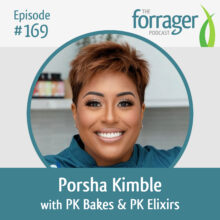
David Crabill: Welcome to the Forrager Podcast, where I talk with cottage food entrepreneurs about their strategies for running a food business from home. I’m David Crabill, and today I am talking with Porsha Kimble. But before we begin, I wanted to thank the sponsor of this episode, Cottage CMS.
Cottage CMS is a newer platform for cottage food entrepreneurs that is growing rapidly. It now hosts well over 1,000 cottage food business websites, and for good reason. I have checked it out myself, and it is very impressive. If you find yourself juggling a lot of different tech tools, Cottage CMS can definitely help. I’ll talk more about them later in this episode, so stay tuned for that and a special offer for Forrager Podcast listeners.
All right, so I have Porsha on the show today. She lives in Dallas, Texas, and currently sells flavorings for baked goods with her food business, PK Elixirs. Over the past five years, it’s become a super successful business and has already generated well over six figures in sales this year alone. But that’s only what Porsha’s been doing recently.
She started selling cakes from home almost 20 years ago and built it up into an extremely successful cottage food business. As she grew a large social media following, she started teaching cake decorating classes around the nation and competed on Cake Wars on the Food Network in 2017. Porsha eventually started teaching cake decorating around the globe, and more recently has been helping entrepreneurs online through her two communities, Beyond the Frosting and The Baker’s Table.
I loved this conversation with Porsha because she is a totally open book, and in this episode, we talk not only about her many successes, but also some of the struggles she’s faced along the way to attain them.
And with that, let’s jump right into this episode. Welcome to the show, Porsha Nice to have you here.
Porsha Kimble: Thank you for having me.
David Crabill: Well, Porsha, you’ve been doing this for a long time now. Can you take me way back to the beginning? How did the whole cake thing get started for you?
Porsha Kimble: Well, I will say I grew up in a household that my grandma cooked everything. She baked, she cooked, she was a cafeteria lady at the school that we all went to school at, her kids and grandkids. And then of course, um, she was an elder in the church that always, you know, cooked or baked when someone passed away.
So food and dessert and baking has really been a very, I would say, a big hand in raising me and, and where I’m from. And so I would say it started there without really knowing that it did. And then as time went on and I moved to Dallas and went to college, I started to cook more and bake more. And then when I got out of college, I was like, “What am I gonna do with my time?”
Because I was so used to working full time, um, and going to school full time, I was bored. And I saw at a local Michaels, they had a Wilton cake decorating class that they offered where you buy the kit for $25 and the class was free And I took all four classes. That’s when, you know, fondant just came out.
That’s what you call it, fondant, fondant, whatever. And, uh, you know, Cake Boss was in, and I was taking… I had just finished taking those Wilton classes, but I hadn’t sold a cake yet, and it was somebody, one of the guys’ birthdays at work.
And one of the ladies said, “Well, you’re taking cake decorating classes. Will you make the cake?” And that was the first time I was gonna make a cake, and they said, “Well, it can look like whatever you want.” And with Wilton, you don’t get that option in the course. You mimic what’s in the book. So I thought, “I don’t know how to decorate a [00:04:00] men’s cake.”
You know? So I just kinda did something, and I took it to work. I didn’t sell. I didn’t charge. I just took it to work. And then from there, people at work were asking me to make cakes. I probably charged, like, 25 bucks at the time. It wasn’t until I got let go from that job is when I started selling cakes.
David Crabill: Yeah because I have in my notes here that you said that cake pulled you out of debt.
Porsha Kimble: It did. So I, at the time, got let go from my job, and my boss, his name is Paul Hayes, at the time we just had Facebook, and I got let go, and he asked me if we could have lunch, like, two weeks later after I got fired. And so we did, and he said, “Facebook is the new wave.” That’s what he said. He was like, “Facebook is the new TV.
People are gonna be looking at their phones and looking at it. You need to get on it. You need to come up with a business name. You need to come up with pricing.” He told me to get a logo. He said, “You need… This is your n- this is your business venture. This is your calling.” That’s what he told me. But it was the fact that he took the time to have lunch with me to tell me that. That is a very pivotal part, I believe, in my, in my journey, ’cause I would have never done it if he, we wouldn’t have had that lunch.
David Crabill: Interesting. And so like, you know, most businesses start pretty slow. What was your business like? Like, once you actually created the Facebook account or started posting things, like What do you remember from those early years? Did you get orders easily or?
Porsha Kimble: got orders a lo- like, very frequently. That’s a really good question. Nobody’s ever asked me that. Um, it did happen quick because I was posting my stuff on Facebook, right? Um, I had to come up with a name, so I came up with Your Cake Diva, and I did an event. They were like, ” Well, we [00:06:00] need your logo,” and I didn’t have one.
So my logo, it’s up here, it’s on a card. It was a high-heel shoe, and the heel was a tiered cake. And I had some business cards made. And I think just from posting, people started ordering. And where I’m, where I live, nobody was kinda doing the things that were different, and I was doing something di- I started out doing sculpted cakes, and that’s kinda what did it for me, and nobody was doing that.
Nobody was doing the number cakes at the time. I was freehanding those. You know, we didn’t have a pan like we do now. And, um, that’s kinda what happened. It, it just literally took off because of Facebook and word of mouth.
David Crabill: Yeah I mean back then you didn’t have to pay as much for Facebook. I
Porsha Kimble: It was free. You just had a pa- you just had another page. It was just a business page. That was it.
David Crabill: Yeah. But back in the early days, right, you just showing up on Facebook, they’d promote you, [00:07:00] right?
Porsha Kimble: Well, you didn’t really have that option. It was the more you posted, the more you promoted. We didn’t have all the analytics and the algorithm. That was not even a talk at the time. When you posted, it just showed up. It wasn’t delayed like it is now. It was real time.
David Crabill: So do you feel like part of your success was ’cause you’re kind of on the cutting edge, right? You’re using Facebook, you were trying new techniques, doing different things. Like,
Porsha Kimble: Yes.
David Crabill: uh, I mean, it sounds like you were trying to be very different and distinct
Porsha Kimble: I wasn’t trying to be, I think I just was.
David Crabill: Now, i mean, y- you’ve gone… Your business has gone crazy, right? You know, you’ve, you’ve shifted, you’ve pivoted over the years. You’ve been on the Food Network. You’ve spoken internationally. You now have a six-figure business selling flavorings. Um, but before we really get into your journey, um, I saw something in my research that I wanted to dig into and ask you [00:08:00] about, just because I, I don’t know, maybe it has something to do with kind of how you’ve grown.
But you mentioned that you were the only person in your school that was a minority. Is that correct?
Porsha Kimble: Yes it is.
David Crabill: And so have you reflected on that? Like, how do you feel like that was at the time for you, and, uh, do you feel like that’s affected your life in any way?
Porsha Kimble: wanna tell you such a great question. What’s interesting about that is my mom is Hispanic, my dad is Black, my stepdad is white. I went to an all-Caucasian school. I’m from a little bitty town in, in West Texas called Forsan, F-O-R-S-A-N. It’s a 2A school. I think I had 41 people in my class. That was like the largest class at the time, and there was no Black people.
I was the only one. Now, there are neighboring oil field towns that are 2A schools. They didn’t have any Black people either. Um, there were some Hispanics, but it was kinda [00:09:00] just like a handful. There wasn’t very many at my school or even at the other schools that we would compete against, so it was just me.
I can honestly say nobody ever made me feel different because of my skin color. Only one person. I never heard the N-word until one person said it, and I didn’t even know what that meant when he called me that. But I think it’s interesting to not have a history with African Americans as someone who’s biracial, and my audience is African American.
I think that’s very strange. I think when I started out, there wasn’t… I didn’t see any Black people like that, like going to the cake shows when they were available or like the Days of Sharing. You didn’t see any Black people. You didn’t see any Asians. You really maybe saw a couple Hispanic people, and that was it.
And I think that’s when I knew that [00:10:00] nobody… I was like, “There’s gotta be other Black people making cakes, but they’re not coming to anything.” I wasn’t seeing them. And so That’s how I ended up having the brown sugar cake or treat. But yeah, I do find it strange that I do not have, I do not have a connection growing up being African American, more Hispanic and Caucasian than anything, to now really be the only African American woman who has a national flavoring line and done all the things that I’ve done.
David Crabill: I mean, it’s really fascinating that you, like now, have done things specifically for minorities. And I, I don’t know if this is still the case, but I saw that, you know, you had a larger following in, uh, in Nigeria than you did even locally, right?
Porsha Kimble: Yes.
David Crabill: Yeah. I what has that been like for you?
Porsha Kimble: think it was when I went to Nigeria. It was a, an experience of a lifetime. [00:11:00] You know, I’m… I mean, over there cake people are like NFL players. They’re celebrities over there. You know, I’d never experienced people wanting to take a picture with me as much as they did, wanna be around me. There’s no concept of personal space there.
But I to go to Nigeria and be asked to come, and be the only person that had been really asked as a African American from here to go over there was really just a bl- it was a honor.
David Crabill: Yeah, w- we’re gonna get a little bit more into how your cake business grew over time, but you mentioned the Brown Sugar Retreat, and I just wanted to ask about that. What is that and, you know, when did you start it?
Porsha Kimble: I started it in 2017. 2016, 2017. Um, because I had been going to these days of sharing. Here in Texas, we have these, they used to be called Days of Sharing. They would have cake clubs, and they would meet every month, and they would have a [00:12:00] day of sharing where they would bring people in that would demo various things.
You ate lunch. It was like 60 bucks. And then they had, like raffles and stuff. It was really just a place to network and meet other bakers from the surrounding areas. And so I remember going, and me and another lady were the only Black people there, and they just didn’t treat us very nice. One, the lady that went with me had won a raffle prize, and they asked her if they could see her ID.
And she was like, “I have my raffle ticket.” And they’re like, “We need to see an ID.” And I’m like, there’s like 40 people in here. They didn’t ask any of the other people. They just asked her. And I was like, there’s gotta be a reason why other people are not coming to these events, or maybe they don’t know about them, or maybe they don’t feel comfortable.
So that’s when I decided I was gonna have the Brown Sugar Cake Retreat. And some people said, “Well, people are gonna think it’s just for Black people.” And I was like, “It’s a baking ingredient. It’s brown sugar.” And I [00:13:00] don’t, I never looked at So Flo or That Takes the Cake as it’s just a white cake show.
Nobody said that about them, so why would you say that about mine? Now, it, not saying it was for just Black people, but it was a place for African Americans or from, for minorities to go if they felt uncomfortable going to the other, other events.
David Crabill: eventually turned out, like in terms of the number of
Porsha Kimble: it was, honey, it was Black folks. We had some white people come. I call them sugar cookies. You know, we’d have a sprinkle of sugar cookies come, but the one thing I think that people were missing is why would you let that… We don’t let it deter us to go anywhere, so why would you let, be like, “Well, it’s really just for Black people”?
No, it’s for people who wanna learn. We ate real good. You got a great swag bag. It was detailed. We have music. Baby, it’s a cookout, okay? But you learning at the same time. And some people said, “I’m going,” and they had a great time, and they would come every year, Black, white, [00:14:00] Hispa- whatever the case may be.
But I just thought it was interesting. I think people don’t look at it as if I see somebody do it that looks like me, I can do it, too. And we didn’t have anybody at the time, so I did it
David Crabill: So you’ve been doing this nine, 10 years or so, and this is your last year, is that right?
Porsha Kimble: I ended it a couple years ago. I kinda had another one. It’s not like it used to be. It’s just kinda small. The one I have coming up is kind of a mix. The Brown Sugar Retreat is just part of the hands-on part mixed with Beyond the Frosting. But it used to be, like, 300, 400 and I would have it in a different state every year, and it would be, like, three days.
So it was, like, learning, hands-on, business conversations. It was a whole weekend event.
David Crabill: So obviously cake has profoundly changed your life. let’s walk through, like, how that all happened. Like, you know, way– going back, what, maybe almost [00:15:00] 20 years ago when you first started to learn about this and, like, y-you said you were getting orders pretty regularly. I mean, this is even predating Texas having a cottage food law.
Maybe you didn’t even know about the, the laws at the time.
Porsha Kimble: did not. Um, I know that the law kicked in in 2012. I do remember that, um, because when we would go to these events, people would be like, “Well, you know the health department came, and she could finish her cakes for the weekend, then she couldn’t bake anymore.” You know, there were these stories that were…
That people would call on other people if they didn’t like their cake, or other bakers were calling on them. They were getting reported, and it was kinda like, you know, doing hair in your home back then. You weren’t supposed to do that. And I didn’t know anything about it till I started hearing the stories.
And then I had some glitter, some… I thought all the glitter was edible. I was moving, and I said, “I’m gonna make some cake pops,” and I put the glitter that I had got from the [00:16:00] cake supply store on the cake pop, and I took a picture of it. I didn’t sell it. I took a picture of it, and somebody reported me to the health department.
So I took my glitter that I bought, and I took it to the health department, and I said, “I want you to tell me what’s wrong with it.” And they said, “Well, one, it’s not edible.” So then I thought, “Why would the cake supply store sell something that’s not edible?”
And that’s kinda how my crosshairs got involved with the cottage law.
David Crabill: did you actually start using it? Did you feel like anything changed in your business at that time?
Porsha Kimble: I think a lot of people didn’t know about the cottage law. And so once I found that out, we had Periscope back then. We didn’t have Live. So I had went on Periscope, and I was like, “This is what happened to me.” And then I was like, “You know, there’s cottage laws.” Of course, some of the states didn’t even have a law, but we did.
And so I think that brought awareness to a lot of people, like what we can and cannot do, and that’s where my… A mix with that and getting sued for a wedding [00:17:00] cake created my baking and business course, where I would talk about the cottage law.
David Crabill: you got sued for a wedding cake. Never heard of this happening before. You need to tell me more about that.
Porsha Kimble: We had a really hot summer here in Texas, per usual, and basically I screwed the money off. I screwed the deposit money off is what happened. And they wanted an all-black cake. We had sat down, done a tasting, but they made all these changes. They had found a picture on Pinterest At the time.
You know, I, I was not as experienced in what they wanted to do, and I should have said no. But I needed the money, so I said yes. So they made all these changes. I had updated my contract before I had met them, um, just because I had had another customer say some things, and I was like, “Let me add this in my contract,” so I did.
And they made changes. I felt like I executed what they changed. There were some things that I [00:18:00] should have done that I didn’t, so that is my fault. And when I got there, the event planner, I think, was shocked that it was a black cake, and she didn’t like that. And so when I left, when I was leaving, she stuck her hand in the elevator door, and she’s like, “You’re gonna be hearing from the couple.”
And I did. Um, they didn’t like it. They hadn’t even seen it. She had just told them that she didn’t like it. So I think it just caused panic with them. Um, but when I looked at the pictures of the cake, ’cause my good friend was, uh, was the photographer of the wedding, they had dismantled the cake and redecorated it themselves.
However, I had the pictures from the wedding from before and after. Um, they just pretty much said they didn’t like the cake. They ate the cake, but they didn’t like it, and so they took me to court, and I got sued for a wedding cake. I won because they got what they paid for, which was a tiered square black cake.
That’s what my contract said, [00:19:00] and that’s what they got, so.
David Crabill: process like?
Porsha Kimble: I mean, they had someone serve me. I literally was at lunch at work. It was my birthday, and they had me served And you basically go, you stand right by them. It’s not like court TV where someone’s on one side. You’re standing right next to them. They do send you pa- the, the court does send you paperwork if you want to basically give evidence prior to the case for the judge to look at.
So it’s like small claims court. So I did submit the pictures. I did submit my contract that they signed. I highlighted where… I had an example that said, “If you give me a picture that you have found and you make changes, it will not look like the photo that you presented due to the changes that you made.”
So I highlighted that, sent the inspiration photos, sent the pictures of what they did before, what it looked like before when I left, and what they did after. I don’t think they were [00:20:00] expecting that. So I did get that option to do that. Um, other than that, that was it, and then we went to court several months later.
David Crabill: Because this is like something that so many bakers are afraid of, right? You know, afraid of getting sued, right? They need liability insurance, they need an LLC and all that stuff. So did you feel like protected that time? Like, did you have any of those things?
Porsha Kimble: didn’t have anything. I di- I had my business name registered, Your Cake Diva, and that was it. I mean, that literally was it. Um, I didn’t know anything about a LLC. I was just doing this on the side of working. That was pretty much it. I mean, I didn’t, I didn’t know anything else. Nobody had ever said, “Oh, you need an LLC.
Oh, you need to protect yourself.” They just took me, Porsha Kimble, to small claims court, and that was it.
David Crabill: Did you feel nervous at the time? Like
Porsha Kimble: Oh, my God, I was like freaking out when they served [00:21:00] me. And so it took months to go to court, like months, and I was working at a different job, and the j- and the lawyer at my job said, “Well, offer them a refund.” And I was like, “No,” because then that would say, to me, that was admitting that I had done something wrong.
And he said, “No, throwing money at the problem can save you time.” So the cake was $550. That was with delivery, okay? I offered them up to about $500. It was $50 delivery, and they would not take it. They did not want $500, and the judge did ask them, “Why didn’t you just take the money?” They said, “She ruined the best day of our lives.”
And I was like, “No, you got married in Mexico the weekend before. That was the best day of your life.” This was the reception, but it still was wrong. I mean, there were some things they wanted on there that I didn’t do. The black wasn’t smooth like they wanted. They wanted fondant. I used [00:22:00] buttercream ’cause I didn’t have any money to buy black fondant, and there was like no black fondant in the city that, for that week.
It was so hot here. People were not ordering ’cause it was like literally melting. So was my fault too.
David Crabill: Hey, real quick. Earlier I mentioned our sponsor of the episode, Cottage CMS, and I’ll be honest with you, when I first came across this platform, I was pretty skeptical. I have seen dozens of software platforms built for cottage food entrepreneurs over the years, but this one feels different. For one, Drew and his wife Kat are actually successful cottage food business owners, and also Drew has a ton of experience building software tools like this. I personally set up a site on Cottage CMS for my fudge business in under an hour, and I was impressed. And clearly I’m not the only one. As I said at the beginning, even though Cottage CMS has only been around for a few months, it already powers well [00:23:00] over 1,000 websites.
So I encourage you to check them out. And also, as I said at the beginning, we do have a special offer for listeners. You can check that out by going to cottagecms.com slash forager. And when you go to sign up, you can set up a totally free website that is forever free. But if you do want to try the premium features, you can try that totally risk-free. Drew offers a 30-day money-back guarantee. And also, if you face any hiccups, incredible support as anyone who uses cottage CMS can attest to. So again, I encourage you to check them out. You can do so by going to cottagecms.com slash forager. Now back to the show.
So during this time as you were growing your business, did you, you know, still have a job, day job this whole time?
Porsha Kimble: Oh, yeah. Mm-hmm.
David Crabill: and how did it grow? Like, I mean, did you feel like [00:24:00] at some point you wanted to take it full-time and, and stop doing a day job?
Porsha Kimble: never thought I, it never crossed my mind to not work and just do cakes. Of course, people would say, “Oh, you should open a bakery.” I’ve never wanted to open a bakery. I, that has never come out of my mouth. Um, I don’t know. I just, it was always just a side thing. Even though I was making more money on cakes than I was at my job, it still, it, it, I think the issue was I didn’t look at it as a job,
like a career.
I didn’t look at… I thought it was, it’s always just something extra to do. I never looked at it as this could be a full-time thing. Even though the money showed it, I didn’t look at it that way.
David Crabill: I mean, d- was your business growing over like, say, you know, from 2011 through
Porsha Kimble: Oh, I was making a lot of money. I mean, at that point I had really [00:25:00] just started doing wedding cakes and doing, like, party cakes, like big events. Um, I wasn’t doing little cakes anymore. In fact, I had made an announcement. I was like, “If your cake isn’t gonna feed 50 or more people, I can’t do it.”
David Crabill: So how were you keeping this all afloat? Because it sounds like the cake thing was kinda taking over your life, but you were also holding a day job at the same time.
Porsha Kimble: Mm-hmm. I’ve heard people say, ask that, and I’m like, “That’s just what you did.” Um, it, it was just, you go home, you change your clothes, and you just do your cakes. And you work on them at night, and then you get back up and you go to work, and you just do it all over again.
There wasn’t a, it was never a question for me. I think that has a lot to do with how you’re raised too. Like, I was making money. I was having a great time, and I don’t have any kids. I didn’t have anything stopping me. So yeah, I just did it
David Crabill: I mean, something’s gotta give, right? I [00:26:00] mean, did, did you give up sleep? Like, did you get very little
Porsha Kimble: Of course.
I mean, I lost a lot of friends. I didn’t get to go to any family events. I never got to go home for anything. I never got to do anything fun. But that’s the part in the business that people pray for. You can’t have everything at one time, so something has to give. Your personal life, your social skills.
Sometimes you would just take off work to fulfill the orders that you needed to get done. I mean, absolutely. There was a big chunk, I feel, of my life that I, I don’t really, didn’t really enjoy because I was working so much in my business. But I can look back at those cakes that I made at that time, and I can tell you exactly what I was going through.
David Crabill: Why do you say that?
Porsha Kimble: Those cakes were reflective of what my life was at that time, you know? So I feel like I was super creative when I was happy. When I would maybe be dating someone, I feel like my [00:27:00] style would be a little bit different. Maybe I was better, like, in a mental head space or I was happy. I would notice that my cakes were a little bit more creative if people let me have creative freedom versus, like, “Here’s a picture, you know, work off of this.”
And I could say, I could see it evolve, I think, when I look at the trend over time, like, from kind of what people wanted to me getting to do what I wanted to do.
David Crabill: When you look back at that time, do you have any regrets? Like, do you wish you had done things differently?
Porsha Kimble: Of course
Of course. I mean, there was… My grandparents have been married this year, is it 72 years? I missed their 65th wedding anniversary. I didn’t get to go on a vacation with my parents. Like, there’s a lot of things that I missed, and Do I regret picking cake money over those moments? Absolutely. Absolutely, because really, what [00:28:00] would, what would one or two cakes, me not doing one or two cakes really do for my business?
It wasn’t gonna do nothing..
David Crabill: Do you feel like you’re making different decisions today because of
Porsha Kimble: Oh, absolutely. I mean, hands down. And I’m older. I don’t have- I’m not working as hard as I did, so I’d rather go do this than go work
David Crabill: Y- y- you still… Let’s just be clear. You still do a lot of stuff with your
Porsha Kimble: I don’t think that I do. People keep saying that, and I think I don’t think I’m as busy because I’m not on a plane like I used to be. So to me, no.
David Crabill: All right. Well, t-t… speaking of being on a plane, that gets us into kinda where things went. It’s the selling cakes led you to do teaching decorating, right? So, what was that? ‘Cause that’s a big part of your story.
Porsha Kimble: When I worked for Mike, who, uh, owned a IT company, we had all these warehouses all across the United States Um, they said, [00:29:00] “Somebody needs to go look at these.” I don’t know anything about IT, but I raised my hand. I said, “I’ll go.” And I took Anis, the guy that does do the computer supplies, the IT supplies, with me. And that’s when I thought… That’s how it started.
I thought, if I can go to these cities off the company that I work for, then I don’t have to pay for the plane ticket. So we would go on Wednesday. We would work the job Thursday and Friday. Friday night, I would take Anis when we were finished and drop him off at the airport, turn the rental car in, get a new rental car for me, not on work, and then teach the class on Saturday and fly back on Sunday.
David Crabill: So what year was this when you were starting to become like nationally or even eventually internationally known?
Porsha Kimble: 2016 is when. We did Cake Wars in 2016. Um, it didn’t… No, we did Cake Wars in 2016. It didn’t air till 2017. So really 2017 is really when I started to travel. A little bit before. 2016 I kinda, you know, went to Atlanta, just dabbled a little bit. But then I knew the show was gonna come out in January, so I had kinda pretty much had planned a whole cake tour before the show aired.
I knew it was coming out in 2017. So it kinda hit early January, and then my tour was already out there. So of course the ticket sales just boosted after that.
David Crabill: So at this point, you already had a pretty significant following. You mentioned you’d been doing Periscope, you’d been doing Facebook,
right? About how big was your following at that time?
Porsha Kimble: I mean, I think I had, like, 20,000 people. You know, that was, that seemed like a lot to me. It doesn’t seem like a lot to people now, but I’ve always had a really good following locally for cakes, but it wasn’t for teaching. Um, the teaching part was more everywhere else but Dallas, you know, because of social media.
But I probably had about, I think, 20,000 followers at the [00:31:00] time on, just on Instagram. Facebook has never been as popular, which is weird, ’cause that’s where I started. But yeah, I’ve always worked both Facebook and Instagram.
David Crabill: Yeah. Well, Instagram’s a bit more national, right? mentioned the Food Network. Um, tell me about that experience.
Porsha Kimble: I didn’t have the best experience with the Food Network. Um, I thought it was interesting how they did it, like, with the theme and telling people at different times what the theme was. Of course, when I look back, I get it. Like, they don’t want everybody to have the same cake, right? You get different, you know, requirements for your cake or whatever.
I’m glad I did it. Um, it was really hard work, you know? We, you’re standing on your feet for 12 to 14 hours. I thought it was weird how they did the taping the day of. Like, making us take pictures that they never used, and just standing [00:32:00] there for hours doing nothing. I thought that was useless. Th- they didn’t really feed us.
It was so weird. Um, I was so ready, I was so glad when it was over with, but I was so glad that I did it.
David Crabill: You say it was a bad
Porsha Kimble: It wasn’t a, it, yeah, I mean, you can have a bad relationship and still be glad you went through the relationship so you learn, you know, the red flags. But I would say I didn’t know what to expect. Um, the experience as far as how they treated us was not good. Let me, that’s probably what it was. Um, but to be watching the Food Network, Carrie Vincent, Bronwyn Webber all those years, you know, Buddy Valastro, to see those people on there.
And then I did not try out, I was asked. I was asked three times to come on the show, and I had turned it down until the third time. They were like, “We’re not gonna ask you again.” So then I went.
David Crabill: So you didn’t even want to be on the show in the first place?
Porsha Kimble: No. They had asked me to do Cupcake Wars. I [00:33:00] turned that down multiple times. They asked me to come on Cake Wars two times and I was like, “No.” And then that third time they were like, “This is the last time we ask you.” So I said, “Okay, I’ll go.”
David Crabill: So what, I mean, what changed about just fear of missing out or something?
Porsha Kimble: The mo- the day that they called me I had moved into a new apartment, so I was like, new energy, new me. That’s kinda how I felt. I was able to afford a two bedroom, two bath town home because I was doing well in cakes. I was like, “You know, my job can pay for this, but the extra money I need to pay for this apartment I can do with my cake business.”
So because of that and really feeling positive, I’ll never forget that day. I was in the kitchen, they called me, and everything had just got moved in, and they were like, “This is it.” And I was like, “You know what? New place, new me. I’m gonna go for it.” So I did.
David Crabill: To, do it in the first place?
Porsha Kimble: I mean, it’s national television, and I don’t, I’m very competitive. I thought, “Well, what if I get eliminated the first round?” Like, no- nobody remembers that person. Like, I didn’t wanna be that. I didn’t wanna do bad, I think is what it was. I didn’t wanna do bad. I didn’t wanna get kicked off the first round.
That was like a nightmare to me. But I also knew that my cake skills were up to par and that I would be okay. It’s just not knowing, you know? That’s the hard part.
David Crabill: I know you got second place, which is obviously very good. Was there any disappointment in not getting that first place win?
Porsha Kimble: No, I was so tired. The other cake, Monica and Louise cake was phenomenal. Like, they were already at another level in their, in their caking, you know what I’m saying? Like, what they brought to the show and what they brought to their piece, I mean, they deserved to get first Hands down. I, I was very happy with getting second.
I think the thing from where I’m from, we don’t see anybody that we know on television. So to me, it was like I’m repping a really small town, and I thought, there’s other Black people, Black women who don’t see a lot of African American women on the Food Network competing. So that was another thing for me.
Um, so that’s why I said I was glad I did it. Absolutely. I don’t regret anything about going.
David Crabill: You said you lined up like a whole class teaching decorating tour. Um, did, did the Food Network help push that forward or help grow it or do you feel like the Food Network changed anything about your business?
Porsha Kimble: my business, no. I was already doing well with cakes, so, like, it didn’t boost anything for me as far as, like, locally, like, “Oh, you’re on the Food Network, I have to get my cake from you.” No. Um, I think for social media it did. Like, absolutely. I think it helped the classes that year when I did the baking and business class and talked about being sued and gave people a con- my contract.
That mixed with the TV, hands down, was what did it for me.
David Crabill: to go around the country and even around the world teaching, right, um, did you slow down the cakes that you were making? Like, take me over through the next few years. I think you said it was 2016 you did the Food Network, then 2017 it aired. What were the few next few years like leading up to the pandemic?
Porsha Kimble: So I stopped making cakes. After 2019, after 2018, like after just, I maybe did a few cakes, I stopped doing them because I was making more money teaching than I was making cakes. What’s weird is I didn’t get rid of a lot of my cake supplies, but I stopped making cakes. I was like, “If it’s not a [00:37:00] wedding cake, I can’t do it,” is kinda where that happened.
So of course you lose a lot of people, right? You lose a lot of clientele because ev- everybody you know is not getting married every year. So that’s kinda what happened in 2018. I really just stopped, and then when the pandemic hit, I picked it back up ’cause all the bakeries were closed.
David Crabill: Yeah, I saw that you- you’ve, uh, picked up doing cakes from home again, right? You were using the cottage food law again fairly recently, but then I think you stopped it again. Is that
Porsha Kimble: Yes. Mm-hmm. So I only did cakes during COVID because it was COVID. That was the only reason. I had stopped making them. I wasn’t doing them. But COVID got me back busy again in a way that it was different. The cake world was different when COVID hit So my design aesthetic was different.
David Crabill: mean, your business has changed so much [00:38:00] over time and, like, you know, it, it’s, it’s good, it’s grown, but also at the same time, like, you know, you clearly love to bake, you love to cook, you love to make cakes. Did you feel like you lost anything when you stopped doing those orders?
Porsha Kimble: Yes. I mean, I feel like a big part of me died because I had been so driven and done that for so long. But at the same time, I replaced it with traveling. So it was kinda like I got, I let go of this, but then I grabbed a hold of this, right? And then when I stopped making the cakes, I had classes and I had the retreat.
Like, it had just started. So it was just really replacing something when I look back at it. But I think the thing is, I, I love to bake, I love to decorate, and that never has to go away. I mean, I think you can brag. If, if you haven’t made a cake in five years and you needed to make one, the fact that you could [00:39:00] make one is a flex to me.
If I need to, if I need some money, I know I can put out there I’m taking cake orders.
David Crabill: it’s interesting though, because you also recently stopped doing teaching,
Porsha Kimble: Yes.
David Crabill: Okay, which leads us into this whole product business, right? take me through how that started. When did that start and, and what is it?
Porsha Kimble: COVID is what did it. I was having a conversation with a friend of mine, and I said, “Listen, I can’t travel.” Most of my revenue, the money I was making, was coming from teaching. So I was like, I don’t… But because I had stopped cakes and started making them during COVID, I was like, “I don’t wanna do this.” Like, I’m getting older, like, I don’t wanna work this hard.
I call it not being in cake shape, by the way. When you haven’t done cakes in a while and then you gotta make some, you know you’re outta cake shape, right? I hadn’t been rolling fondant like [00:40:00] that in a couple years. I was like, “I am outta cake shape.” And he said, “Well, what if you do flavors? Because you always say one teaspoon per batch.”
And I thought, “You know what? Maybe you’re right.” And that’s kinda when the light bulb went off. I never planned for it to get where it was. I was just gonna come out with them first three flavors, and that was gonna be it. Yes.
David Crabill: there was like an actual like scientist that pitched this idea to somebody
Porsha Kimble: So at the time A friend of mine had products himself, and the lady who’s Yum Crumbs, Amanda from Yum Crumbs, she’s the creator of PK Elixirs at the time. Um, he had passed on flavors. They had brought it to him. He had a product out. He didn’t wanna do it. So he said, “Well, why don’t you do it?” So I was like, “Okay.”
So he put me in touch with Amanda, who’s the creator of Yum Crumbs, and that’s where PK Elixir started. she would formulate it and [00:41:00] then send me all the different samples, and then I would say, “Don’t like this, don’t like this. This needs more of this.” So it took several months just to… ‘Cause she would send me sample after sample after sample.
David Crabill: What was that investment like? ‘
Porsha Kimble: At the time, we didn’t talk about the money. Like, I never gave any money, like, “Here’s for testing.” We just, I think we just trusted each other. It was like they were formulating stuff to flavor their crumbs, right? So she already had the liquid base, and then she would send me the samples. And then once we got the flavors, we, we never talked about a price.
I, I don’t even know. When I look back, there was no conversation about what it was gonna cost to produce. And when we finally got all three done, and I got that invoice, that email with that invoice, I [00:42:00] about went to the bathroom in my pants. When I tell you, I was like, “What is this?” It was almost 20,000. It was about $20,000.
And I was like, “I don’t have $20,000.” But I had just left my job. I’d literally just left my job. I was like, “I’m not doing this anymore.” I didn’t have anything, so I cashed out my 401from that IT company that I worked at. It wasn’t a lot. I had a lot of money on my credit cards for other things. So just the liquid itself was about 20K.
If she would’ve told me the price up front, this, PK Elixirs wouldn’t exist. I can, I can confidently say it would’ve never happened. And so that was just liquid. That wasn’t caps, labels, bottles advertisement, the box, like that was nothing. It was just liquid base.
I had $5,000 in my 401. So I sent her I And so she said, “Well, we can do a [00:43:00] pre-sale. So we’ll pre-sale it, and you make the money, and then you pay us before we do it.” And that’s exactly what we did. So we did a two-week pre-sale. I made, when I– The first two days, I ended up making a little over $22,000.
So as soon as I got that money, I sent it to her, then what was left was mine, and I did, I did. That was the most money I had ever made at that time.
David Crabill: I know another entrepreneur that pulled from their 401K to fund a product business and, you know, they got the surprise penalty check at tax time, right? You kn- you knew that was coming, right?
Porsha Kimble: knew, but I didn’t care. I was already too far gone, like… And I don’t know, I’m very cautious about the things I put out, but I just didn’t care. I, I was on a wing and a prayer at that point. I had already yelled it out, out at the rooftops on social media, so I couldn’t go back now. But I mean, when I look back, $5,000 isn’t nothing.
At the time, it seemed like, you know, [00:44:00] $100,000, but I didn’t care about the penalty. It didn’t bother me. That’s just the price of doing business.
David Crabill: the time to you? Like, did it feel like, “Wow, I’m, like, at a point where I might be going under if this doesn’t actually work”?
Porsha Kimble: Mm-mm. I never, I never doubted that it wasn’t gonna be good because I used all those samples and baked everything. Every time I got a sample, I baked a cake. I couldn’t tell you how many cakes I baked until we got it right. So I knew as a baker that it was, it would do well. I never in my mind didn’t think that it wasn’t gonna do well.
David Crabill: Well, it’s interesting that you say that ’cause it’s not like flavorings are a totally novel concept, right? I mean, sure, they’re different. What you do is different than what you’re gonna find in a grocery store, but there are other companies that do flavorings, right?
Porsha Kimble: But I think the difference for me was it was mine, and I didn’t care if anybody [00:45:00] else had it. I just felt like it’s Porcha Kimball’s flavoring. I have an audience. These people are baking with me. They’re baking alongside of me. Why wouldn’t they believe me? And I wouldn’t sell something that I wouldn’t use I, that’s really what it was.
I never thought this isn’t gonna work. And at the time, I think I only bought 1,000 of each. I only had 3,000 flavors. I only had 1,000 of each bottle. That was all I was planning to produce. I wasn’t planning to produce anything else.
David Crabill: lot, 3,000.
Porsha Kimble: it’s a lot. It was 1,000 of each bottle, and when I look back I’m like, “Why did I do so many?” But it had to, it had to make sense for them, right? What money would they make if they didn’t? And I think people don’t know when you buy liquid, you buy so much liquid. You can’t dissect the liquid. You know, it’s like eggs.
You can’t just buy three eggs. That’s not how it works.
David Crabill: [00:46:00] are some mistakes you made in that business that you regret?
Porsha Kimble: kinda have a double-edged sword on this. It’s the glass bottle. I loved the frosted glass bottle. It was like apothecary feel. My market, my degree’s in marketing advertising, so I loved the look. It, it was elevated. I didn’t think about the shipping and the glass just shattering and losing inventory.
Didn’t think of that. Um, didn’t like the label when it came out. I wanted, like, this marbled look. It didn’t translate. So those were some things that I probably regret, but it was so pretty.
But glass is expensive, and I didn’t do my research on flavor preservation. Like, the, the stuff I know now I didn’t know then. Like, brown bottles are gonna consume that flavor longer than a clear bottle’s going to.
David Crabill: It’s interesting because these flavorings, [00:47:00] I mean, they could be cottage food products, right? I mean, it’s a very different business, business model for you. But, um, what did you have to do legally to get that business off the ground?
Porsha Kimble: I mean, I didn’t have to do anything. I already had an LLC.
David Crabill: you get an approval from the health department or anything like that?
Porsha Kimble: no, because my manufacturer’s the one that’s man- they do all of that. So I didn’t, I don’t have a warehouse, so I never have poured anything here to create. That is against the law, so I never did that. Um, once I was with Amanda for a couple of years, I had a few manufacturers reach out saying, “If you can give us the formula, we can produce it for you at a cheaper price.”
Um, and I didn’t want to because I had such a great relationship with Amanda. Um, I just was like, “No, I don’t, I don’t wanna move.” But the price point they were offering me was much lower than what [00:48:00] I was getting, and they couldn’t tell me at the time, but they had just done Shark Tank, but they couldn’t tell anybody.
So I was in a bad personal and financial spot in my personal life, and they had let me know, like, “Hey, if you wanna do a run of these flavors, you’re gonna have to put up the money right now.” And I didn’t have $40,000. I didn’t even have $40. They were like, “In order to do the run later in the fall.” I didn’t have it, so I didn’t have a choice.
So I had to move, I had to move on.
David Crabill: I know you said you’re an open book, so, uh, I don’t feel, uh, awkward asking you this, but, you know, you said that cakes pulled you out of debt, you know, years and years ago, and then yet you’re saying just a few years ago, you’re still kind of, like, had no extra money sitting around. Why is that?
Porsha Kimble: was in a relationship that took a lot of my money. I was helping him with his business, so anything extra I was pouring into [00:49:00] his. And when that didn’t work out, because I found out he was living a double life, I ended up just abruptly leaving that apartment and moving into this one. So I had quit my job February 11th of 2022. I was doing great financially, and then he had a trucking business, and he just kept asking me for help, and I thought it was a forever thing, so I just kept helping him. And then I thought, “I don’t have it,” like for my own business. I was still doing well, but That’s what happened. So when I left in late 2022, in 2023, that’s when they came to me and they’re like, “Hey, we have to move.”
I mean, and I didn’t have $40,000. It didn’t matter, like, how well I was doing. It was like everything I had, I was putting it right back in. I was putting it right back in, and I was pricing it so high to cover my cost and [00:50:00] fulfillment. There still wasn’t really any money left for me. That’s the other thing I can say.
I don’t regret any of that. So when my best friend Nakisha came, she was like… She worked at, she had worked at a grocery store all her life. She was like, “We need to look at your margins.” When I realized some of these flavors I was only making 19 cents a bottle, a dollar a bottle, I was like, “I can’t do this.”
And they weren’t gonna lower the price, so them telling me either I had to move on or give them that money was a blessing in disguise.
David Crabill: ‘ Cause I feel like you had learned about pricing in the process of starting your cake business, right? So
Porsha Kimble: It is, but I think it was a little bit different when it comes to this. Because even though it’s probably to anybody else, like, well, it’s the same, you’re pricing stuff out, I think it was different because you have runs to make. A run is you have to, you have to buy so many bottles of whatever that it is, and so there was fulfillment.
I didn’t know anything about that. So it’s like, oh, I’m having to piece [00:51:00] everything together, like the bottles, the labels, the caps, shipping it there, then buying liquid, then buying all the advertisement and all the packaging. Like, it was all being just pulled together, and I was making it combined. But I never really sat down and was like, “Okay, let me write it out like I did my cake business,” because I didn’t look at it as a cake business.
No,
David Crabill: Yeah, I mean, that’s one of the challenges with a product business like this is that you have to sort of be investing upfront, investing months out in advance, right? I mean, where are you sourcing the, the things, not only the, the liquid itself, but also, like, your packaging everything. You’re having to get stuff from China or
Porsha Kimble: I never did that. The only time I did the China thing was when I did my tablespoons. I literally was getting everything from, like, UPrinting. You know what I’m saying? Like, I never… I, I did not want to… Even though I was betting on myself, I never was like, “Well, let me buy 5,000 of these [00:52:00] boxes.” I am not that person.
I was like, “We gonna do this. We gonna see if it works.” So I did, like, UPrinting. I did another company that did labels, and they did the bottles. I forgot what it was called. So I got all my bottles from them, my caps, and I did that I think for, like, two years. And then when I met Nakisha, she was like, “Do you even know how much you’re making per bottle versus what you’re getting charged?”
And I was like No, and I was charging $18.99 per bottle at the time, $19.99 per bottle, because my cost on some of those flavors, like the red velvet and the cream cheese, was more. So even though I was charging $19.99, it was costing me $9.99 liquid wise. That was nothing else. So by the time we broke it down, I was like, “I’m not making any money.”
David Crabill: like you’re making money now? ‘Cause I know your revenue has grown like crazy recently,
Porsha Kimble: Yes. [00:53:00] Yes. It has. Um, switching over manufacturer at the time, um, I had thought about pulling the plug sooner, but I wasn’t ready, and I do believe timing is everything. Now I’m not paying close to what I was paying before, um, which is just amazing. I mean, it’s gone up since the tariffs, but it’s a better, I think…
M- it was a, it was the best financial move. One of the best financial moves I’ve ever made. Plus, there was room for more product development, and there wasn’t as much room for that early on.
David Crabill: then I know you moved into a shipping facility
Porsha Kimble: Maybe- Yes. right? That’s an investment too though, right? ‘Cause you were working out of your house
I was working out of this room. I moved. Um, that is probably the second. That’s one of… Not maybe the second, but that’s one of the top five best business [00:54:00] decisions I ever made. Um, now I look at it because I have gone through Chapter 7 bankruptcy personally based off of the relationship I was in. Now I know that every dollar is allotted to something, and I didn’t, I don’t think I thought that way before.
I was making such great money when I, I had a six-figure job. I was making six figures in my cakes business, but I didn’t have as much debt at the time either. So once I started getting to the retreats, and you owe the hotel, every time people would pay money, I would pay the hotel. Like, I never tried to dip into my own money.
But as financially things kinda got worse, I didn’t have no choice, which didn’t leave me with anything. So when I switched over to the manufacturer, I was like, “Okay, I can do this.” I don’t think I really started seeing the money until last year. This year will be five years. I don’t think I really saw the amount of money I could make until last year, or really this year.
This year’s been a great year so far.
David Crabill: [00:55:00] six figures already, right?
Porsha Kimble: It was six figure. It’s always been six figures. I will say that since I started. I’ve always hit six figures with PK Elixirs. Um, as of right now, what I made last year for the year, I’ve made, I’ve already almost made
David Crabill: Yeah, and here we are in May, early May talking. So that’s in the first four months of the year you’ve made…
Porsha Kimble: to what I made all year long.
David Crabill: so you’re on track to make three times what you made last
Porsha Kimble: That’s the plan with AI.
David Crabill: What, what’s the difference? Uh, did you do anything differently to help spur that growth?
Porsha Kimble: I lowered… So over time, once I changed manufacturers, I realized, you know, my profit margin could still be really large if I lowered the price. So they became $14.99, some of them $12.99 that weren’t moving as much. Um, so I lowered the, I lowered the price just last [00:56:00] September. I was like, “You know what? I’m just gonna make them…”
‘Cause I think they were $16.99. I was like, “You know, I’m just gonna drop the, just drop the price.” I know that probably sounds crazy to people, like, “Why would you drop the price ’cause people are already paying?” It’s helped me make even more money because I think people would say, “Well, I could probably afford another bottle.”
The other thing is I decided to do free shipping after a certain amount because then people feel like, “Well, I can afford another bottle with the free shipping.” Um, added a couple ambassadors. I think I started really being a little bit more vocal about the flavors on the page. It’s really strange how in the beginning I looked at it like it was a side thing until I really had to sit down and I was like, “This is the one part of my…
This is one of my businesses making me the most money, so I just need to get rid of the teaching and everything else,” ’cause it wasn’t making me any money. But the flavors were, so putting all my time and energy into it this year, like [00:57:00] really just this is it, um, has doubled every month than it was the month before, the year before.
David Crabill: m- as much time packaging, right? Uh,
Porsha Kimble: Yeah, I mean, the fulfillment price at first seemed a little high when I had, when I moved, but it’s the time that I got back. It’s the gas money that I’m not spending. I’m also not going to the storage facility, you know, 10 minutes from me, taking that stuff, bringing it here, unpackaging it, and then shipping it out.
Like, it was just, it was worth it. It was… I mean, I was packaging 500 to 600 packages a month, and then I started making mistakes, and I was like, “I can’t keep do- I can’t keep going like this.” Every day I was going to the post office. Every day I was going to UPS ’cause I don’t want people’s orders to sit here and not do it.
That, that wouldn’t… I couldn’t sleep at night knowing, like, there’s 10 orders in the queue that I [00:58:00] didn’t get out. Like, it would, it would make me anxious
David Crabill: So obviously there have been challenges starting the elixir business. What do you feel like has kept you going?
Porsha Kimble: I just feel like it’s a way of still being in the community, in the baking industry and in the baking community, ’cause I don’t bake for the public anymore, not really. Um, and I’m gonna say not really, I don’t. Um, and I think it’s just the hunger in me to just keep going.
I’m almost done. No, I’m not gonna keep adding a bunch of flavors now. Like, I, I only wanna do the flavors that I know I would use. Like, I think that’s it. I’m very selective of what I wanna put out, and I think it’s just important to me as a person and as a brand. Like, this is what I have, so I wanna give it all that I have, all that I got, ’cause it’s all I got.
David Crabill: you, know, have flavors that are limited, going in stock, going out of stock. Like, is that… Like, I mean, it seems like you could just make [00:59:00] as much as you wanted to. Is that intentional?
Porsha Kimble: No, it’s not intentional. I would love to have them all the time, but I think what has changed is me showing cookies and cake pops then started to bleed into the treat community, which I really was never in. And so now I have a lot of online treat stores who’ve been purchasing from me, which was not on my bingo card.
So they have really consumed a lot of my product, more than I assumed that it would, right? Um, there’s like four stores that are… I mean, they are taking it, taking it, and it’s just not something I was prepared for. I mean, I had them there, but I didn’t know they were gonna order as frequently as they have.
So I have had to increase my run double, even triple on some of the flavors.
David Crabill: you want the want the flavor business to
Porsha Kimble: I think for a long time when I started, the goal was like, “Oh, I wanna be in Hobby Lobby,” you know? “Oh, I wanna be in Michaels.” But over time, and having conversations with other people who have got products in those stores, which is amazing, I think my mindshift, shift changed when I had a conversation with someone in January.
They were like, “Do you really wanna go that route and the discounted rate that you have to give? Like, would it really even be profitable? Why not just really be a great online business with flavors?” And I was like, “You know what? You’re right.
Why not?” So that’s what I’m gonna do. That’s what I’m doing
David Crabill: Well, it’s an amazing business, but it’s not the only thing you do, right? I know you also educate entrepreneurs, which, uh, at one point was something you only did in person. When did you start doing that online?
Porsha Kimble: I just started it last year when I realized that, you know, your phone is very powerful, and because of the phone, people don’t really wanna spend money to get on a plane and come and see you in person when they can see you in person [01:01:00] just like we’re doing right now. So I love teaching people. I love helping other women and men in business, but I thought, why not have some sort of online portal, a, a community where people can connect from all over, um, and still get information at a, at a very reasonable price.
So that’s why I did it.
David Crabill: Well, it’s funny though, because you say you started last year, but I know you had online courses in the past and then you shut those down in favor of in-person stuff. So, like, I feel like you’re almost opposed to the online content in some way.
Porsha Kimble: I was. Well, let me tell you why I didn’t do the online at first. The reason I didn’t wanna do online is because when I had the online courses, I saw a lot of people take the class, and then they copied me. That’s just part of it, and when I look back, it’s no big deal. But then I also thought if I take it offline and you have to do it in person, I would think it would make you hungry or give you some drive to [01:02:00] come and get the information in person.
But when COVID hit, that changed everything. That changed my trajectory of my entire business of in person. I had to go online. And now people work from home, so it’s like, why would they come and see me? Why would they spend all this money to come and see me when they could pay a certain amount and come and see me where you have to pay to see me, I guess, is what I’m
David Crabill: So how has that business been going?
Porsha Kimble: it’s different. It’s different for me, but I would say I love seeing all the people on the screen. I think having the control of it and not having to travel is nice. We have a theme every month. We have a monthly meeting every month where, with a theme of, like, business challenges and people can chime in.
We have other meetings where people come and speak, and I think that’s great because everybody can take what they need, you know, every single month, and you can chat amongst with the other members. It’s not just all on [01:03:00] me. There’s ambassadors in the group, so it’s been nice.
David Crabill: you’re a pretty
Porsha Kimble: No. Not yet
David Crabill: Lay it out for us. What are some of the big mistakes people make? You know, you help home bakers. Like, what, what are the things you see that frustrate you that people are doing that you feel like somebody who’s starting out baking needs to know this?
Porsha Kimble: Okay. The first part of the question, I would say the things that people need to know is, of course when you start something, you, you just take everything you can, right? You’re excited, you wanna do it. You should go through all that. You should make mistakes. You should give free stuff away. You should spon- You should do all of that.
I feel like right now, people that are in any industry, they want everything to be perfect. They don’t want any mistakes. They don’t want to mess up at all, and it’s like the mess-up is the journey. How do you not know to improve or get better if you [01:04:00] don’t mess up? That’s the first thing. The second thing is, a refund isn’t always gonna fix the problem.
The third thing I would say is, you should take a in-person class. I don’t care where it is, you should go take something, period, no matter what it is. You also should go to networking events that don’t have anything to do with your industry. How else do you get clients? I think people think everyone is online, and maybe they are at some capacity, but not everyone has a Instagram page.
It is important to have a website. I think those are foundational basics that people wanna skip over ’cause they think everyone’s online. That’s how I feel about it. So, I would say those are the things. And I tell you what else gets on my nerves. Every time I get on TikTok, these new people, they’re like, “I don’t know if you knew this, but do you know…”
Like it’s new information. I’m like, “Girl, we’ve been doing this.” We’ve been doing this for a long ti- Like, it’s n- Like… [01:05:00] That’s funny to me.
David Crabill: You ever feel like there’s just so much information out there that it’s like limiting your impact and like how many people you can reach?
Porsha Kimble: No, I don’t think that. But what I do think is that my impact has diminished over time because I’m not in that space anymore. You know what I’m saying? I’m not like a it girl. There’s other people that come up that are younger than you that are gonna take that light and show things that they didn’t know before that they show now, ’cause they’ve, they’ve grown, and I was already at that point.
So, I think that way.
David Crabill: Sure you’ve come across a lot of the home bakers that they don’t really want to put themselves out there, right? They, you know, they kind of want to hide and be in their home kitchen and making their product and they want their products to change the world, right? You know, so what do you say to them?
Porsha Kimble: [01:06:00] I mean, I don’t wanna buy from someone that I don’t even know what they look like I can go look at a house, but who’s gonna sell it? You gonna call me? Are we just gonna do email? ‘Cause that’s what it is. I can look at a cake, which is a house, but I still wanna buy it. So what is the communication? Who am I dealing with? Who am I buying from? You don’t have to show your face or have a voice every single time, no.
But people wanna know who they’re buying from. People wanna know who they trust. And if I don’t know what you look like, the couple things is this: either you’re insecure, you don’t look, you don’t like how you look, you don’t like how you sound. If you’re insecure in that, I don’t wanna do business with an insecure business, business owner.
That’s how I look at it. I’m not gonna buy a car from someone who doesn’t, can’t tell me all the things about the car.
David Crabill: you’re clearly a very extroverted person. Like, I’m a very introverted person, right? And I would say, like, an introverted person doesn’t look at themselves that way,
Porsha Kimble: [01:07:00] To me, I don’t look at, like you said, it’s different. Some people just don’t wanna be in the light. It maybe doesn’t have anything to do with their looks. Um, but I don’t know why you wouldn’t wanna show yourself when you’re the one making it. Why wouldn’t you want people to see who’s making their stuff?
David Crabill: think there are some people who feel like if it’s based on just them, they’re gonna limit their business. You know, they want their business to be a brand. You know, ’cause the face of Coca-Cola, right? You know, you know what I’m saying.
Porsha Kimble: But I feel like that’s an issue with LorAnn. They don’t have a face. I’m just trusting a name. But if you look over here, I’m in those groups. I have a name. I’m hitting the shows. I’m there with the people. I think that’s the difference. LorAnn is always gonna be number one. They’re always gonna sell nationally, internet.
They’re, that’s who they are. [01:08:00] But there is something to be said about someone who’s been where you are, who’s doing what you’re doing, who’s there with us too.
David Crabill: Just to be clear, I agree with you completely. I mean, I’ve had to learn how to show up and show my face. Like, here, here we are. We’re talking on this call right now, right? But, um, what, what helps get someone out of that, right? And, you know, I feel like you can say, you know, just show up s- as, you know, only so much, right?
Porsha Kimble: Yes, I agree. I think the way to get yourself out of a box is to do something that you’re not familiar with. I didn’t like my legs for a long time, so I didn’t wear shorts. And one day I said, “I wanna wear shorts. It’s hot. I don’t wanna keep wearing jeans in 110-degree weather.” So I started wearing shorts around the house.
Those were my baby steps. Then I said, “I’m gonna wear shorts when I go to the grocery store.” That was so uncomfortable, to the point it just felt like it was no big deal, like when I put my pants on. So [01:09:00] I would say take that thing you’re uncomfortable with and just take one step at a time. If you don’t wanna show yourself, like as a post, maybe you go in your story because it’s gonna be gone in 24 hours.
Maybe you put that picture on your website. That means you’re being seen there. At least the people that go there can see what you look like. Like, those are the things. Maybe you have a family, maybe you don’t wanna show your kids, but stating, “I’m a mother, I have a family,” is letting people know who you are without showing that per se.
David Crabill: Well, you know, you were always known as the cake person, right? The cake lady. I know you now do cake pops or whatever, but you’ve been doing it for a long time. Like how has the industry itself changed over time?
Porsha Kimble: feel like it’s just a lot of things is a lost art. You know, the cake shows are gone. Um, cake competitions dwindled away. You know, techniques like filigree and a certain level of piping is gone. Everybody just wants to do something easy. I mean, anybody to me can be a cake decorator right now. They can put some buttercream, scrape it off, put a color, scrape it, throw acrylic topper on there, fling some metallic, and they’re, and they’re a cake decorator.
When there’s so much more to it, or there once was, that isn’t really there anymore.
David Crabill: So, I mean, do you feel like it should change? Like, do you feel like there’s… Like, this is a bad thing that’s happened to the cake industry?
Porsha Kimble: No, I just think people have taken the level of artistry of what it takes and they’ve diminished it like it’s nothing.
David Crabill: ‘ Cause I feel like most people talk about how, wow, we can do so much more, you know, like all the technological advancements, and now, like, cakes are, are even more [01:11:00] grandiose than they ever were, you know, 15 years ago.
Porsha Kimble: don’t feel that way. I don’t think they’re as grandiose as they were before COVID. I feel like COVID brought out the Glowforge. We used to have to make those letters. Now you can just print them on an acrylic and just put it on there, you know? I feel like the artistry and the creativity of it is there, but the art just changed.
I feel like it’s kind of in a lazy way. Like people… You know, the trends change of course. But it’s like, okay, we have those heart shaped cakes and the borders. Half of these people don’t even know how to pipe on with all these tips. They just wanna use tip 1A. It’ll be 1M, and they just use that same tip like a shell border and it doesn’t even look good.
Like, there’s a lot of people who don’t know. Do you know there’s a million other tips you could use? You can do this, you can do that. But they’re not. They’re just using the easiest way. And that’s okay because [01:12:00] you might, that just might be the person in you. Maybe you just don’t know there’s other ways.
It’s an easier way. It was harder before. It’s easier now.
David Crabill: You’re kind of an interesting mix, uh, ’cause you, you know, you have this, um, like very traditional side of yourself, right? That’s kind of resistant to new things, but then you also are like very forward-thinking in other things and cutting edge. Um, do you– I, I can see you nodding.
It seems like you agree with that,
Porsha Kimble: do. I think that was a great… That’s why I said that should be like on a dating profile. I think that I’m not afraid to be forward, but I think my tactics are traditional when it comes to selling or looking at things because I grew up in the era of Mary Kay and Rainbow vacuum cleaners and encyclopedias.
Those are the basic foundations of selling and those never go out of style. [01:13:00] People don’t like to cold call. It doesn’t go out of style, right? Reaching out. Um, I am forward in the sense of the marketing or things I need to do, but like you said, more traditional in other ways. I agree with you 1,000%. I feel like you, like you read me.
David Crabill: not gone out of style?
Porsha Kimble: Being who you are, being authentic, telling the good and the bad. I think that’s one thing that always got, that, that people loved about me is I’ve always been honest, maybe too honest. Um, I think showing the good and the bad showing your progression like it’s okay I think that’s what people are afraid of like you always want to be here it’s okay to be down here and go up that’s part of it I think those are things that people don’t want to show but at the same time the foundation of that is this is where I am this is where I am now there’s that’s that’s something you should show your [01:14:00] elevation absolutely that’s that’s something that you should show it’s not bragging it’s not it’s just part of it it’s who you are you should be able to talk about that
David Crabill: Well, before we close this up, I did wanna ask you about how you’ve sort of shifted away from being in your business to sort of being the CEO of your business. Like, that’s been a big shift for you recently, it seems. Would you agree with that?
Porsha Kimble: I would, because I didn’t look at myself
David Crabill: Do you feel like you should have looked at yourself that way earlier than you did?
Porsha Kimble: Yes. I think saying you’re the C- I think as a baker we are always like, “Oh, I just bake cakes. I’m a nurse, but I also bake cakes.” It was never I make cakes and then I’m a nurse, right? Because people don’t, people don’t do it that way. I think I just decided to start saying it because I feel like [01:15:00] when I say it, the more I say it, the more that’s what it is.
I am the CEO. You’re the CEO of your business. Everybody’s the CEO of their business. I don’t know why we don’t say that word more often because that’s what you are. It’s not bragging. It’s not boasting. You created it. It’s your name. It’s your money. You’re the CEO. You’re not just a baker. You’re not someone, oh, I’m someone that talks about the cottage law.
I’m the CEO of the cottage, blah, blah, blah, blah, blah. This is what I do. There’s a difference in the confidence when you say it. And I think the more I told myself to say it, the more and more I felt that way, which helped me in my business. It was like my mindset shifted like this is my business. I’m the CEO of PK Elixirs, which means what would a CEO do of a business?
They would look at their numbers. They would make sure that they had a marketing and advertising budget. They would be on LinkedIn. They would say or post things differently than someone on my personal page. You don’t see me talk about that on my personal page. You see me talk about that in Beyond the Frosting and PK Elixirs.[01:16:00]
So there is a distinction and there is a difference.
David Crabill: Well, it’s, it’s an amazing business journey. It’s taken a lot of different turns. Uh, it’s pretty crazy where you are today and seeing, you know, your, your success with your flavorings business, the elixirs. Also, you know, you have this ki- I guess it’s kind of a new membership thing that’s kind of growing, right?
You’re, you’re building out this community. where, where can we expect to see you grow in the next few years?
Like, what, what’s next for you?
Porsha Kimble: going to come out with maybe two or three more flavors.
Um, that’s it. I think I’m done for a little bit as far as that goes. I don’t really know. I like to keep it open. I think this year was a little different for me than it was last year. I’m trying to keep my schedule open for other things. Um, I would like to be in a [01:17:00] larger retailer. Absolutely. I would love for people to maybe see me more as a business person and not just a cake lady.
I know it kind of comes across a little different, but some people still see me in that versus, wow, she has this elixir business, this product business that’s done X, Y, and Z. I feel like that would be nice in the next few years for people to see that more.
David Crabill: would like to learn more about you, where can they find you or how can they reach out?
reach out? They can go to PKBakes.com. That’ll take you to the flavors and it’ll take you to Beyond the Frosting and things like that. But that’s really the place or Instagram. Of course, it’s always @itsporshakimble or @_BeyondtheFrosting or @PKElixirs. Yes.
Which is a, a good, uh, example of just how many different directions you’ve gone in in right? Always willing to try something new, which is [01:18:00] probably something we should learn from. anyway, thank you so much, Porsha, for coming on the show and sharing with us today
Porsha Kimble: You’re so welcome, and I appreciate you having me on today.
David Crabill: That wraps up another episode of the Forrager Podcast.
For more information about this episode, go to forrager.com/podcast/169. And if you enjoyed this podcast episode, I have a favor to ask you. Could you either leave me a review on Apple Podcasts or a rating on Spotify, or if you’re watching this on YouTube, like the video and follow my channel. Any of those things would be super helpful for helping other people find the show as well.
And finally, if you are thinking about selling your own homemade food, check out my mini course where I walk you through the steps you need to take to get a cottage food business off the ground. To get the course, go to cottagefoodcourse.com.
Thanks for listening, and I’ll see you in the next episode.