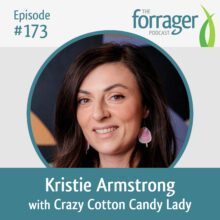
David Crabill: Welcome to The Forrager Podcast, where I talk with cottage food entrepreneurs about their strategies for running a food business from home. I’m David Crabill, and today I am talking with Kristie Armstrong.
But before we begin, I’d like to thank the sponsor of this episode, Cottage CMS. Cottage CMS is a website and business platform built specifically for cottage food entrepreneurs, and as of this month, they’re celebrating their one-year anniversary.
In the past year, they’ve grown to power well over 2,000 cottage food business websites, and for good reason.
The core idea behind the platform is simple. It helps you look established before you feel established, which is exactly the kind of edge a new cottage food business needs. I’ll talk more about Cottage CMS later in this episode, so stay tuned for that, plus a special offer for Forrager podcast listeners.
All right, so I have Kristie on the show today. She lives in Shelburne, Vermont, and sells cotton candy with her food business, Crazy Cotton Candy Lady.
Kristie has been dreaming of starting a cotton candy business since she was a child. In fact, every year she went to the fair and always wanted to be like one of the vendors in particular, and as fate would have it, she ended up selling alongside that same vendor decades later.
During the pandemic, she decided to quit her job and focus on something she was truly passionate about, cotton candy. And as you’ll see, Kristie is crazy passionate about cotton candy. But her business is much more than a simple product. She is also passionate about spreading happiness and uplifting children.
In this episode, you’ll hear how Kristie’s challenging past and unique skills helped make her the successful entrepreneur she is today. And with that, let’s jump right into this episode.
Welcome to the show, Kristie. Nice to have you here.
Kristie Armstrong: Hey, thank you for having me. I’m so excited to be here.
David Crabill: All right, Kristie. Well, you know, normally at the beginning of an episode, I will say, like, take me back to the beginning of your business, but I actually want you to go back farther, ’cause I know this cotton candy thing has been a part of your life for a long time. So take me back to your childhood.
Kristie Armstrong: A long, long time. So I, um, I grew up in Northfield, Vermont, and every year we have a Labor Day parade event, and it’s a weekend-long thing, and we have cotton candy and rainbow ice. So I would save up all my money to spend it on cotton candy and rainbow ice. And there is a woman there who, she’s still around, um, who is the rainbow ice lady, and, um, I was obsessed with her.
She’s a teacher. She’s very kind, amazing woman. And, uh, yeah, so, um, the cotton candy guy was not that amazing. He used to, like, smoke cigarettes and yell at kids, and I would be like, “Here’s my money,” and, “Give me cotton candy.” So when I was young, I was like, “Oh my God,” like, “I wanna be like the rainbow ice lady, but I wanna make cotton candy , and I wanna do, like- People is at the doorbell
crazy flavors of cotton candy and just be so crazy, and it would be amazing, and then I could be, like, selling crazy cotton candy flavors everywhere. And, um, I told, like, one of my friends about it, and he was like, “Ew, you wanna be like a carnie?” And I was like, “Kinda, but I’m gonna shower and not smoke cigarettes, and, and it’ll be, it’ll be better than being, like, a carnie.”
And he was like, “Ugh.” But since then I did, like, all of my, um, my first project, my first school project on cotton candy, um, where I learned to flavor the sugars, and I learned that it was invented by a dentist. Um, and it was a low sugar treat, which is awesome because I wasn’t really allowed to have sugar, which is why I wanted it even more.
And I’ve just kind of always been obsessed with cotton candy since [00:04:00] I was a little, little girl. And it just kind of escalated from there. It was like one little school project and then another school project, and then honestly, like, even all the way through college. And I had cotton candy at my wedding, too, instead of a cake.
So it’s kinda been my whole life.
David Crabill: Uh, yeah, that’s amazing. Like, I, I saw, uh, uh, your wedding, right? You had cotton candy as a decoration. Is that
Kristie Armstrong: did. We did. And I ordered 200 and… It was like 230 bags, ’cause we had like 200 and like 45 guests at our wedding, so it was a pretty big wedding. And I figured, like, not everyone would eat cotton candy. But my husband was like, “We’re not gonna have a cake?” And I was like, “You don’t even like cake.”
Like, “No, we’re not gonna have a cake.” and then I was like, “Well, if other people don’t eat it, then I can have all of this cotton candy to myself.”
So there was like two, um, two like large like, uh, the big storage plastic bins [00:05:00] filled left, so it was probably about, there was probably like 80 bags left, and I, I ate like all of them pretty much. So
David Crabill:</strong> I guess cotton candy cakes had not been invented at that point, or
Kristie Armstrong: They had not, ’cause I absolutely would have had a three-tiered cotton candy cake, which I have done for s- other weddings and been pretty jealous that, like, I didn’t have one for our wedding back in 2016. But it’s okay. It’s still fun to… I got to, um, cut one of the cotton candy cakes that I, uh, had made for a wedding, so that was kinda cool. Like
David Crabill: Man, uh, it’s it’s crazy like that’s been such a big part of your life, like throughout your childhood into adulthood. What took you so long to actually like start it as a business?
Kristie Armstrong: Um, honestly, c- uh, confidence. Uh, confidence and like And I just, I didn’t believe that I could do it, um, or that it was even possible ’cause there was no one like me that, like, kind of [00:06:00] existed yet. And, um, you know, there’s, there’s always, whenever you have a dream, if you tell it… Typically, when you tell it to someone else, they’re like, “Oh my God, you can’t do that.
How are you gonna make money? No one’s gonna care about that. No one’s gonna like that.” And it’s like, it’s like not listening to those people when they tell you that. But, like, when you’re young, like it’s, it’s hard not to, like… You know, it’s hard to think of like all the ways, like… You know, um, I grew up where- in a time where like ADHD like wasn’t really like understood, and, um, I was ADHD, um, have severe dyslexia, so it was like it just seemed really out of reach.
Um, and like I could never own my own business. I could never do this. Like, you know? ‘Cause like, it’s like you can’t even finish this assignment, how… You couldn’t own your own, you know? So it’s like, it was like that struggle of like getting confidence in all of the things that I am good at because, um, the biggest thing is, is like realizing your strengths [00:07:00] and like what you are actually good at.
Like, and being dyslexic, I am extremely good at patterns and noticing things that other people don’t notice, and, um, solving problems really easily where other people really struggle. So like being a small business owner and like experiencing those, those difficult moments where like some people would just kind of be overwhelmed and quit or expect someone else to do it for them, that’s kind of just like not how my brain works.
I’m like, “Oh, easy breezy. I’ll figure this right out.” And, um, so the things that I always thought would hold me back are honestly the things that made me better at being an entrepreneur, which I would have never… No one told me that, so it would’ve been cool to, if, um… It would’ve been cool if I had someone like me to talk to me when I was young,
Cause then I could’ve started sooner. I could’ve been like, “Oh my God, I can use my study halls and like this to do market research. Um, I could design my branding and like, you know, local targeting, and, you know, [00:08:00] figure that out on the back end, like before I stepped out in the public instead of doing it so later on in life.” And it was honestly the pandemic that like pushed me to do it, ’cause it was really hard. All of my friends were like, they’re all like laid off and furloughed and like, like discovering new hobbies, and I was working like 80-hour weeks and had a baby, and my hair was falling out, and my skin was kind of turning gray- And I was not eating properly, and I was just like stressed to the max.
And I was like, “I wish, I wish I could just make cotton candy for the rest of my life.” And it was kinda like, my husband was like, “Well, you can’t. Like, this is our life right now. Like, we just gotta survive this pandemic.” And, and it was kinda like that, that realization of like, oh, I could be stuck in this like terrible cycle if I don’t do something to change it So I started building this before I had quit. Um, but slowly. Um, I [00:09:00] was just doing market research in my f- my, my spare time.
and designing and figuring out, um, like events and clientele and would I need a storefront?
Kristie Armstrong: Could I do it without a storefront? Costs of this, costs of that and that versus this, and just like back and forth of like- the most efficient and effective way to start a business with little money for max value. So it was like just using resources that were there. And now there’s ChatGPT, which is like, man, that could have helped so much.
David Crabill: So it, it, it took you a while to get to the point where you actually felt ready to start this business, but what, what was your background? What, what did you do for your career beforehand?
Kristie Armstrong: Yes. Um, so I went to school for graphic design. Um, in school, high school and elementary school, I was always good at art, always good at creating and being creative and building and big concepts and all sorts of stuff. So I wanted to go to school for something that would [00:10:00] highlight my strengths, make me a good, a good living, and, um, something I would, like, enjoy and not be, like, miserable.
And now I get to be happy every day because I get to make cotton candy. And, um, you can’t see it from just the background, but my workshop is, like, a pretty happy place. So, like, even when it’s nasty and raining outside, it’s still, like, pink and bright and happy in here, and your environment matters, just like the people who you surround yourself with.
So
it’s all important you can turn the, the camera around. So I mean, I think it’s a pretty impressive space. Do you use this workshop for classes?
I do not,
David Crabill: So this is just for you, like you just have it that way ’cause you wanna be in that environment
Kristie Armstrong: Yes, exactly. And like I create content here, not always a lot of content, but, um, I just, I, I think sometimes people forget that like their surroundings, how they affect them. Um, c- and, you know, their mindset, how it affects them. Um, how you look and view the [00:11:00] world affects you, ’cause if you see everything in a negative light, then you’re probably gonna be a little bit more down.
But if you’re surrounded by like things that make you happy, even when you’re kind of in a, like a not great mood… ‘Cause don’t get me wrong, like I’m still a human. I might, like even though I might y- you know, through social media and stuff seem happy all the time, it’s like I, I’m a real person, so of course I have like sad days.
Or like when it’s dark out too many days in a row, you’re like, “Oh my God, I should just sleep for a full day.” Like, you’re not sad, but you’re just like tired from the weather. Like, you’re like, “Let’s, let’s just take a nap for four days till the sun comes back out.” But it’s like if I just come down here, it’s like, it’s pink and sunny and bright and happy.
So it’s kinda, it’s kinda nice to change your environment, change your attitude.
David Crabill: You know, with this, Uh, you know, your, your workshop space and, you know, everything’s a b- kind of leads us into talking about your brand. You know, your brand is just so, like, positive and pink and, and joyful. [00:12:00] Um, and I notice you’ve been branded from the very beginning, which I guess no surprise, you’re a graphic designer, right?
But can you talk a little bit about your brand and, and what you wanted to do with it?
Kristie Armstrong: Yeah, so when I first, um, designed, like, my, my brand and stuff, I wanted it to stand out from, like, other companies and, like, also be cartoon-like, and, um, very kid-friendly, ’cause that is, that is kind of my main target, um, audience.
Um, It was important to me to keep with the, the colors and stuff that I love.
Um, my favorite colors are pink, purple, yellow, and green. Green has always been my color, and so, and so has been pink. and it was just important for me for like brand recognition too. Like when people kinda see my colors and see that they associate it with me. So it’s like, um, it builds trust within your community too.
Like, “Oh, I know that person. I know who that company is. Like she has really great cotton candy. I know that she’s a local woman and from around here.” So I just wanted to also build like, um, a safe place, or like when [00:13:00] people come see me and they recognize my colors and like my, my aesthetic, they know that this is a place for everyone. And this is a happy and safe place, and to be kind to each other, and especially children, ’cause I feel like as adults, we, we forget what it was like to be a kid. So many adults forget what it was like to be a kid and how hard it is to be a kid, because you have so many big emotions that you can’t really express.
And adults kind of like, there’s like that, um, you know, they like kids, but they want them to be quiet and not heard. So sometimes when parents come over to me and their kid is just being like, “Blah, blah, blah, blah, blah,” they’re like, “Oh, I’m so sorry.” And I’m like, “Don’t ever apologize for that. Like, I want your child to talk to me.
I want your child to be that excited about cotton candy and about talking to me as they wanna be.”
David Crabill: It, it’s pretty cool to see, I mean, obviously your brand, your business is highly targeted towards kids, but,
you know, it’s much more than just, like, a cotton candy business [00:14:00] to you, clearly, right? It’s, It’s, like, almost like, an advocacy platform it sounds like
Kristie Armstrong: Yeah, to be yourself and to, and to be the chatty kid and to be the, the shy kid if you want, just to be the way that you are and, like, that’s okay. ‘Cause like, you know, people are gonna judge you no matter what you do, so you might as well do the things that you wanna do and find the people who make you feel safe.
and to let them embrace you instead of trying to cling onto people who are like, “Wow, you’re too much. You’re too loud. You’re too this. You’re too that.” And it’s like, “Yeah, I do talk too much. I am too loud sometimes. I am this.” Like, but like, that’s okay. You’re not my people and I’m not your people.
It doesn’t make you a bad person, but it also doesn’t make me a bad person for being different from you. So it’s like finding the people who see the value in what you bring to the table, because not everyone will see your value, and not everyone will like you or like your product, and, like, that’s okay. Like, but sometimes, sometimes you can change people’s minds. Um, there was a [00:15:00] guy, a pretty grumpy guy. I didn’t have, um, I didn’t have anyone at my booth, and he kinda came over at a quiet time and kind of was, like, looking at my stuff. And I was like, “Hey, how’s it going? Like, can I help you with anything?”
He’s like, “Oh, no. I hate cotton candy.” And I’m like, “Oh, no. You hate happiness? That’s so terrible. Are you okay?” And he was like, “Uh, uh.” I think he wanted a different reaction from me, which is fine, but I wasn’t gonna give him, like, a, “Oh my God, I know. I’m the worst.” Like, you know what I mean? Like… And so I was like…
And he was like, “I’m not… I don’t hate happiness.” And I was like, “Do you wanna… Like, when was the last time you had cotton candy? Like, when was the last time you, like, enjoyed yourself, like, at a market instead of coming up to a stranger and saying you hate what they have?” And he was like, “Oh, I, I, I don’t know.”
And I was like, “Well,” I was like, “I don’t wanna judge or anything, but I feel like you would like, um, my pineapple jalapeño cotton candy.” And he was like, “I do like…” You know, I kinda, like, could see him kinda thinking about it. And I was like, “Hey, worst case scenario, your opinion about cotton candy is still 100% [00:16:00] correct, but best case scenario, you’re like, ‘Wow, this is actually amazing, and I’m having a way better day than when I first came over here.'” And he, um, he was surprised. And, like, he was like… His demeanor changed. His attitude changed. He had a, he had a taste, and he was like, “This is amazing. Pineapple jalapeño is amazing.” He’s like, “I’ve never had anything like this.” Like, like, “What made you think of this?” And then we got to, like, a more positive discussion.
So it was like he came over expecting a negative reaction, and I didn’t give him one. And then I ended up changing his mind, and he placed an order for, uh- For a custom, custom order of pineapple jalapeno
David Crabill: Yeah, you know, that’s one thing that’s like, I think amazing about you is just like, you are so authentic, right? Like, everything about you, it’s just like, it’s this, this cotton candy thing. I know you sell it, but it’s, it’s just like a part of who you are.
You’re, you know, always wanting to make people happy, and I’m sure just that authenticity [00:17:00] is a big part of your success
Kristie Armstrong: I feel like it is. Um, I, I got humbled by cotton candy vendor. Um, it was a guy who had kind of seen me and seen what I was doing and was like, “I could do that. That looks amazing.” Um, and I was like, dang, like someone else is coming in at me. And then I was like, whatever, like, it’s fine. Um, um, he’s doing his thing the way he wants, and I’m doing my thing the way that I want, and there’s plenty of cotton candy for everyone.
Um, and then, uh, , I ran into him at an event. He came up to see me, and I was like… He was like, “Hey, like you probably don’t know who I am.” And I was like, “I know who you are. Um, of course I know who you are. Like I pay attention to local people all the time.” And he was like, “Yeah.” He’s like, “I just wanted to say like, um, that I really admire what you do.”
And I was like, “Well, how’s things going? Like what have you been up to?” And he was like, “Um, I’m not doing it anymore.” I was like, “What do you mean you’re not doing it anymore?” He was like, “Um, you made it [00:18:00] look really super easy, and it was not easy. It was a lot, and it’s a lot of dealing with people. It’s a lot of like being on.
It’s a lot of, um, communicating. It’s a lot of getting feedback that, back that you weren’t expecting.” And, um, he was like, “And I also like don’t even like cotton candy.” And I was like, “What?” I was like, “You don’t even like cotton candy? Then why did you do this?” And he was like, “I don’t… I, I just thought it would be easier than it was.”
and I kind of like, I, I don’t remember exactly what I said to him, but I kind of hope that I left him with the message of like, “I hope the next adventure you go on, you dive into like what you care about.” Because I love cotton candy, it, which is the only reason I, I do feel I’ve been able to be successful in it.
Um, and I care about people, and I love what I do, and I’m happy doing what I do. And so if you’re not happy, like, and you don’t like love the thing that you, like are in, it’s really hard to like sell it [00:19:00] like you love it.
David Crabill: So I, I know that you’ve made it look easy, but I know it’s not always easy, right? What’s been challenging for you personally?
Kristie Armstrong: For me personally, um, so all of the creative stuff like website designing, and logos, and creating custom stickers, and like designing my van, and just doing all like the creative stuff, and coming up with flavors, and how to market, and, um, that stuff’s all easy breezy to me. Like, but to other people, that’s an absolute nightmare.
Um, but the things that I struggle with are, um, like I’m not an Excel sh- Excel sheet girly, like a numbers person. Like, I do math, but am I the best at it? Absolutely not. Um, and in certain things, because of my dys- dyslexia and, um, some of the struggles I face with learning stuff, I, um, I struggle really hard with like, doing like taxes stuff.
But like, you know, I can hi- I- we [00:20:00] have, me and my husband, who is also a small business, Tyler Armstrong Masonry, we have people who do our taxes for us. So like, I’m not amazing at numbers, but you know, I know how to keep track of everything, and I’m organized, and I’m on top of it because I am hypervigi- vigilant because I know I have a really bad short-term memory.
So I’m like, “All right. I gotta get these ducks in a row”, and I have all of these cheat codes for my ADHD stuff, and things are color-coded, and I do little things to make my everyday tasks easier to like kinda keep me in line. So something that I used to like… I still kind of struggle with it, it’s, um, paperwork in general overwhelms me and I hate it. Um, so like filling out vendor forms, which by the way, are easy to fill out, I just hate it, and that’s not like a, it’s just a thing that will always be a thing that I just don’t love, but it’s like part of the game.
So you just get used to having to do things that, some things that you don’t like. And, I’m grateful for my skills that I’ve had as a business owner, [00:21:00] ’cause, um, being creative and, um, artistic is not something that can kind of be like learned, learned. You kind of either, like, have it or you’re like a numbers person. It’s like you, there’s, it’s very rare that you find someone who’s just like well-rounded with everything.
David Crabill: Hey, real quick, earlier I mentioned our sponsor, Cottage CMS, and I’ll be honest with you, when I first came across this platform, I was skeptical. Over the years, I have seen dozens of software platforms built for cottage food entrepreneurs, but this one feels different. For one, Drew and his wife, Kathleen, are actually successful cottage food business owners.
I featured their story on episode one sixty-five. They built Cottage CMS out of their own bakery, solving the problems they were facing while running their business. Drew also has decades of experience building software [00:22:00] tools, so this isn’t a side project. This is what he does. As I said at the beginning, Cottage CMS helps cottage food entrepreneurs look established before they feel established.
Because here’s the truth, when a potential customer lands on your website, they don’t really care how long you’ve been in business. What they want to know is whether they can trust you and your products. That’s what Cottage CMS does. It gives you the professional presentation your product already deserves, whether you’re on day one or year five.
I personally set up a site on Cottage CMS for my fudge business in under an hour, and I was impressed. And clearly I’m not the only one. In its first year alone, Cottage CMS has grown to power well over 2,000 cottage food business websites. So I really encourage you to check them out. Now, as I mentioned at the beginning, we do have a special offer for Forrager Podcast listeners.
You can claim it at [00:23:00] cottagecms.com/forrager. Again, that’s cottagecms.com/F-O-R-R-A-G-E-R. When you go to sign up, you can set up a totally free website that is free forever. And if you wanna try the premium features, you can do that completely risk-free.
Drew offers a 30-day money back guarantee and his support is incredible. Anyone who uses Cottage CMS will tell you that. So again, check them out by going to cottagecms.com/forrager.
Now back to the show.
David Crabill: So I did want to ask about, like, your, your choice in going with your brand, your business name, like Crazy Cotton Candy Lady. I mean, that’s a very unique business name and a very unique choice.
Why’d you try- decide to go in that direction?
Kristie Armstrong: Because I wanted to stay true to like my [00:24:00] original, um, my original thought process as a child. Um, and that’s literally what I said I wanted to be when I was a little girl. So when I was seven, I was like, “When I grow up, I wanna be a crazy cotton candy lady. I wanna make crazy flavors of cotton candy. I want it to be like just really crazy, like no one’s ever seen it before.”
And so when I was trying to like think of like a business name, I was like, “Oh, fluffy cotton candy, cotton candy clouds, floof, puffy, puffer, puff, cloud.” Like, you know what I mean? Like just going through writing it all out and just like being like, “I hate this. This exists. I don’t love that. I don’t see the vision.”
And then I was finally like, Why am I overthinking this?”, Like, I want to be a crazy cotton candy lady. I am gonna be a crazy cotton candy lady. Why am I gonna call myself Cloud Cotton Candy when I am gonna be a crazy lady? Like a crazy cotton candy lady.
David Crabill: But What did that process look like when you [00:25:00] actually, like, started the business? You know, you created the branding and all that. I know that’s easy for you, but, like, what were the early days like?
Did you start at an event? Like, how did you get this off the ground?
Kristie Armstrong: So I started, again, like researching, okay, how do you open a business? LLC? Got it. Okay, we can do that. Um, let’s get a website domain. Let’s do that. I’m all in on Crazy Con Candy Lady. That’s what my name is. Um, let’s look at Vermont health licensing. What do we need for that? What do we need to get up and running?
And, um, what would my, my setup look like if I wanted to go somewhere to an event? Um, what would that be like? Would I get a tent? Would I have a, just a table? Would I have a truck? Would I have a bus? Would I have a storefront? Like, you know what I mean? It was like breaking down what would be… ‘Cause I didn’t have, like, a million dollars.
I had $4,000, um, that I had saved up specifically for vacations, and, you know, pandemic, [00:26:00] no one was going anywhere. Um, so I was like, “You know what? Perfect. I have this money that I am unable to go on a vacation or do that what I want to with. What if I invest it in myself?” Um, that way we’re not using, like, our, like, family money to do this.
it would just-
David Crabill: So did you not even have like a cotton candy machine at this time?
Kristie Armstrong: Didn’t even have a concane
David Crabill: How is that possible? Like, I feel like you would’ve had at least, uh, like one of those cheap cotton candy
Kristie Armstrong: I did when I was little. I d- I had a, I had a small one when I was little, like a at home one that I would always make such a mess with. My mom would be like, “You need to bring that outside.” Um, but other than that, I didn’t, like, have one. And that one, that one broke pretty quick. But, like, yeah. So I didn’t even have it ’cause I…
It didn’t really matter that I didn’t have it right away when I was build- building my site. Like, I had such, like, naive blind faith, was like, “This is what I’m doing.” And I’m, I’m kinda like one of those people, like, when I say that I’m gonna [00:27:00] do something, I’m doing it. Like, I’m not being, like, wishy-washy of, like, “Well, what if I can’t?”
And it’s like, well, I said that I was gonna do that, so I’m gonna do that, even if it fails. Um, but I was trying to, like… The way that my brain works too is, like, I am able to see bigger pictures instead of being like, “Oh, let me try this and see if it works or not.” I can kind of work a lot of things out already in my head, which is pretty nice.
So it’s like I can do, like, trial and error in my head before I kind of, like, buy the thing, just by, like, looking up the information on it. I’d be like, “Ooh, well, that one looks like, looks like you can’t do this with it. You can’t, it doesn’t run that many hours. This one’s a better price and has, like, these things, so that’s the better, better option to go with.
So if I buy that, but I also buy it along with this, like, I still have enough money to financially buy, like, at least 200 pounds of sugar. But if I do this also, and, like, look for deals,” and just, like… So before I even actually spent any money, I did all of the [00:28:00] marketing research on the back end so that when I did, I would be putting my best foot forward financially, so I wouldn’t be getting myself stuck in a situation where it’s like, “Oh, I bought this thing, but I’m actually not even gonna use it ’cause I realized that I kinda needed this thing instead.”
David Crabill: So which, uh, machine or, you know, cotton candy machine, what, like, piece of equipment did you end up going with?
Kristie Armstrong: So I So I bought a VIVO cotton candy machine first, and, um, ’cause there’s Carnival King, there’s VEVORE, there’s, there’s a million of them. But price point, information, um, customer service, and, um, reliability, and all these things. ‘Cause these are simple machines. They all, they all break down, and you have to become a cotton candy machine mechanic.
So reading the, reading the manuals before I even got the machine, like, to see, like, okay, what is, like, figuring out, like, all right, which company r- seems more reliable? Like, you know what I mean? ‘Cause that’s important, too, ’cause it’s like I want someone who [00:29:00] also stands behind their product the way that I do.
‘Cause I don’t wanna get into, like, a, um, a situation where, like, I need them because th- such and such happened, which actually ended up happening recently. Um, I had been approached being like, “Oh, your cotton candy machines, like, they have a flame, and you need an extinguisher, and this needs to happen.” And I was like, “No, like, they’re meant for indoor use,” and which items with, that are he- related items, like it’s an electrical unit meant for indoor use, like regulations and standards are actually higher than for outdoor use.
So, like, I, I mean, I could still bring a fire extinguisher obviously, but, um, it’s not something that just, like, starts fires. There’s no open flame. And so, like, VIVO was able to be like, “We got you, girl. Here is, like, here are all the third-party companies we tested. Here are all of our certifications. Here is this and this.”
And I’m like, ” Cool, thank you.” So I was easily able to just call them, whereas, like some other companies, they’d be like, “I don’t know,” [00:30:00] like, “Just leave a message and we might get back to you.” So it’s like it was nice to have something reliable. Um, and so I bought a cotton candy machine. I bought sugar, and then the first flavor I actually created was, um, lavender because it was like…
Remember back when, like, lavender was just, like, popping? It was everywhere. Everyone was, like, just loving on lavender. Lavender lemonades, lavender lattes, lavender just, like, all the things. And I was like, “Oh my God, lavender cotton candy would be, like, so amazing.” Um, and it is. Uh, but it’s like a learning curve, too, ’cause each flavor, um, requires, like, a different, different ratios of ingredients.
So lavender’s very strong, and I, when I first, the first, like, kinda taste test round, I was like, “Wow, this tastes like soap.” While soap is amazing and does, has its place in the world, it is not in cotton candy. Um, so, like, figuring out that, like, ratio. Like lavender and rose, those flavors, they have the least [00:31:00] amount of, um, essence and, and, like, real lavender, um, in them, it’s,
David Crabill: But wait, hold on. Uh, uh, the fact that you’re even making the flavor, right? Because most people, if they’re gonna start a cotton candy business, are gonna buy cotton candy sugar, right? So, like, why did you decide to, to actually create the flavors yourself?
Kristie Armstrong: Um, because there was flavors that I wanted that I couldn’t get. And I learned how to flavor the sugar, flavor sugar when I was young, ’cause this was like in my head for so long. So I was like, I was like, “Oh, I’ll just, I’ll just figure it out.” And it is very ch- it’s way cheaper to buy the pre-made stuff, and now the larger companies are making a broader spectrum of flavors, but it’s still, it’s still nice to be like, “Oh, well I have ketchup cotton candy.
I have maple bacon cotton candy. I have lavender cotton candy.” You know, I have all these, you know, peach mango and peach ginger and rose and strawberry rose. I have all these flavors [00:32:00] that don’t exist like most places, and, um, dill pickle, which is still my son’s favorite. But it’s, I… It takes more time and, um, That is like the one thing I kind of didn’t account for is h- is how much time it takes to make the sugar and to process it and cure it and kind of just like mix it every day and kind of, it’s like always on your mind of like, “All right, next week’s flavors will be… I gotta make sure I have like the rainbow, so let’s make this, and like we’ll do this, and like start this, and stir this.”
So it’s like constantly… It takes a lot of time, but it’s worth it because it’s, A, delicious, and it’s, I enjoy it, and it’s, and it’s nice to have different flavors
David Crabill: Yeah, I mean, it’s also very unique, right? But is that something you would recommend to somebody who’s starting out a cotton candy business? I do recommend that they actually make their own
Kristie Armstrong: No, buy the flavors. Buy the flavors. Less messy, less stressful. You can buy it in bulk and they’re packaged [00:33:00] differently, and then you don’t have to worry about sugar prices going up and down, and up and down. And, uh, with larger manufacturers, it kind of stays consistent,
David Crabill: So
why don’t you buy certain flavors?
Kristie Armstrong: Um, because I want everything to be what I made because I said that I make my flavors so I’m not buying anyone else’s flavors. It’s only mine.
David Crabill: Hmm.
Kristie Armstrong: And, um, and like, I don’t know, the… Also the large manufacturers, there is chemical preservatives in them, um, that is kind of scary, and you have to like, you just have to remember like do you wanna be around those chemicals?
‘Cause I did look into like, okay, do I need to put chemical preservatives in my cotton candy to like keep them shelf stable for a week, a month, a year, a day? Um, ’cause like standard cotton candy sugar is like it’s 10 years, and, um, mine is up to a year, which I never have it that long. I, if I’m… I’m lucky if I have it for like a month honestly.
Um, sometimes I’ll [00:34:00] make a flavor like specifically for myself that I might have for like six months, but then it’s gone, um, ’cause I just make it in such small batches that, you know, ’cause I wanna, I wanna go through the flavors quicker so that I can move on to the next flavor, you know, to not have any flavors in rotation for too long.
But I do usually have like, like birthday cake and stuff in stock always and typically like watermelon just because birthday cake’s my top seller, and it’s blue so that’s important. And like I still have like blue razz and stuff, but like those are kind of like my like pink, classic pink and blue razz, they’re kind of like my least, least favorite.
But some people, some people that’s what they grew up with and that’s what they know, so sometimes they don’t wanna try new things. But I always try to encourage people to try new cotton candy and new things because like if there’s anything safe to try something new of it’s, it’s cotton candy because it…
You, you can’t go wrong. It’s all delicious. It’s [00:35:00] just, you know, it’s just kind of hoping to help people keep an open mind ’cause you c- you came to the Crazy Cotton Candy Lady for a reason. It wasn’t because I am a normal cotton candy lady, you know, with the normal flavors. I’m crazy and have the crazy flavors, so don’t know. I would
David Crabill: It is Amazing how many flavors you create. I mean, do you know how many you’ve created?
Kristie Armstrong: It’s 200 plus. I, I kinda sat down one time and like, like counted them, but then I was like, “Oh, well this one’s not on there.” And then I like added, and then I was like, “Oh, shoot, this one’s not on there either.” Like, and so I… And you know, the more I experience the world and try new things, like I want more flavors or, ooh, you know what?
Like, like Shirley Temple, like I don’t have that. And so now I’ve like tried that and I’m like, “Mm, that’s so good.” But it’s like, you know, like you think you have a lot, but then there’s always, you know, there’s always something new that comes up and you’re like, “Oh, I didn’t even think of that.” ‘Cause like, like I’ve had, I have maple and I have black raspberry, but [00:36:00] like maple black raspberry creamies are such a thing.
I’m like, “Why haven’t I always had this flavor?” You know what I mean? So it’s like sometimes it’s like, duh, like why don’t I make that? It’s… So I feel like I’m always coming up with new flavors, like even still, and then like forgetting, being like, “Oh yeah, I forgot I had that flavor.” You know? So it’s, it’s, it’s a lot, but it’s a lot of fun.
Like pumpkin spice latte, like now that Starbucks lattes have like all those terrible chemicals in ’em, it’s like still a way to get your pumpkin spice latte. Like, so it’s just, it’s fun. But yeah, going back to like would you recommend doing it this way for other people, like I, I still come back to recommending what you’re good at and what you care about, because that…
Like if you’re, if you’re not good at being creative with like new flavors and stuff, but you still love making cotton candy or love cotton candy, then like buying the pre-made sugars, or if you just like you have, um, a full-time job already and you’re just doing this on weekends, like [00:37:00] buying pre-made sugars would be more beneficial to someone who’s looking to do that.
So it’s like, it just depends on what you want
David Crabill: So y- y- you decide to start this, you invested in the machine. I know you spent, like, $4,000 to get this off the ground, and then what actually happened? Like, did you start going to events? Was it automatically popular?
Kristie Armstrong: yeah, so as soon as I launched my website, I got my first order literally five minutes within launching my website, which was crazy, blown away, made me feel like, “Yep, this is exactly what I’m supposed to be doing with my life. I made the right choice.” And so I asked the guy, I was like, “Hey, like, how did you find me?”
Like, and he was like, “Oh, like, I just Googled.” And I was like, “Just so you’re aware, I literally just launched my website five minutes ago.” And he was like, “Oh, I just looked like two minutes ago and I found you.” And I was like, “Oh my God, like, thank you so much for being my first customer. This is amazing.”
David Crabill: Okay, this is not typical, just so everyone knows. Like so that, like, never happens. It must’ve
Kristie Armstrong: I know.
David Crabill: from [00:38:00] the
Kristie Armstrong: I know. And that’s, like, exactly how I took it, ’cause I was like, “There’s no way.” I thought it was, like, a fake… I thought it was a bot at first, and he was like, “I’m from Warren, Vermont,” blah, blah, blah. Like, “My wife loves cotton candy.” And he’s ordered again as well for his wife, um, which is, like, really sweet, and it’s like every time I see that, see that from Warren, I’m like, “Oh my God, Warren, Vermont.”
Like, that’s him. Like, he still loves me, or his wife still loves me, so thank you. Um, but yeah, I knew that that was not typical. And, um, my first big order… ‘Cause this is all, remind you, like, before I even went out into the public at all. Like, I was k- just soft launching. I hadn’t even made the cotton candy yet before it went live on my site.
I had the stuff to do it, packaging, design, ready to go, but I didn’t
David Crabill: wait, you hadn’t even like experimented with ma- using
Kristie Armstrong: hadn’t even, like, packed it in a container to, like, ship it out. Like, I had all of the shipping and all of the [00:39:00] containers that fit perfectly, but, like, I was also eating so much cotton candy too, so it wasn’t staying in the container.
Like, I had the containers. I could have put them in the containers, but I was just eating it. Like, I knew how much fit in a container and how much it would take, but I didn’t have any made because I’d been eating everything.
David Crabill: So was this your concept from the beginning is that I’m gonna have a website and I’m gonna be shipping my product? Like, w- did that… Is that how you thought your business was gonna go?
Kristie Armstrong: Which it, how I planned everything out is exactly how it’s been going. So I planned it, I planned, I planned to do live events, so when I set my business up, it was like hire me, custom favors, my shop, and all of those things. And so the guy had went to my shop, ordered it, but I still had my custom favors thing that’s, like, still…
I haven’t really made many changes to my website. It’s on my to-do list. I’ve made a couple tweaks here and there, like, as I’ve gone, but I haven’t really changed much because I genuinely was like, “I need to put my absolute best foot forward before I step [00:40:00] into the public, because I’m gonna be way too busy.”
Which is, like, my delusional part of my mindset of being like, “I’m gonna be so popular. It’s gonna be amazing. You got it, girl. You can do this,” ’cause, like As an ADHD kid, you have to learn to be your biggest hype man because there’s so much negativity that comes at you when you have ADHD. Like, “Don’t do this.
You’re talking too much. You’re doing that. You need to stop.” That you have to have, like, a really good internal monologue of being like, “Girl, that was a hard day, but you got it.” Like, “They said you weren’t great, but you can do this.” Like, “Everything’s awesome and it’ll wor- will work out.” So you have to, like, you do have to learn to spin how you think.
And so I was like, “I got this. I can do this.” Like, “I’m gonna go out into the public. I’m gonna be way too busy.” Like, I need to make sure all my ducks in a row so that when someone goes to my website, they’re like, “Oh, this girl’s got it. And, um, this is where she gonna be next, and this is, like, I could order if I don’t wanna go see her this day.”
And so I just wanted to make sure all of my ducks were in a row before I even stepped out into the public, which is typically not the order in which people do. Typically they’re like, [00:41:00] “Let me step out first to see if I enjoy it, to see if I even like it.” And I was like, “Oh, I know I love cotton candy. I know that I love making it.
I’ve already eaten so much. I could… Probably am gonna puke soon.” Um, and I just, I just had a lot of faith in myself when I think, I think, um, the people around me definitely didn’t. And, um, most people don’t. I just did, and I’m grateful for kind of how my brain works and how I am because I feel like that was able…
I was able to be pretty successful because of that,
David Crabill: So you really went all in on this, right? I mean, it was kind of risky. It was kind of risky, but, you know, you launched it. Did it actually, like, meet your expectations? Was it, like, super popular, or did it take some time? Like, when did it feel like it was really starting to take off?
Kristie Armstrong: see again, I think the way that I look at things is very different from other people. So I think, I think if I was someone else, I would’ve maybe thought that it wasn’t [00:42:00] that amazing as I thought it was. Um, but Every little interaction I had with customers and kids, they’re like, “You’re amazing. This is amazing.”
So it’s like, okay, I didn’t make $20,000. Just kidding. I’ve never, like, made that at an event. But, um, just because I didn’t make thousands and thousands right away, like, I didn’t see it as failure. ‘Cause sometimes people, people tend to look at, like, exact dollar amounts and they have this unrealistic expectation in their head of like, “If for me to be successful, I have to make this.”
And so my mindset was just a little bit different. I was like, for me to be successful, I have to feel like I, A, made an impact. Um, my customers enjoyed their experience. Um, they wanna come back and see me again. Um, I made enough money to cover my vendor cost and my fee, and it always exceeded my expectation.
I set my expectations low and realistic so that if you set them too high, you’re, like, obviously gonna fail, and then what are you gonna do? Be like, “I’m the worst.” Like, “I failed.” It’s like, yeah, girl, you failed because you [00:43:00] set our expectations up here. They weren’t even in the middle. Like, so I just… I looked at success is very, it’s very relative.
Like, people, some people view success as certain things, like I needed to make this amount of money for me to be successful today. Um, but when I first started, like, success changes. You know what I mean? So it’s like when I very first started, me getting out in the public and making connections, meeting people, like, just having good energy and spreading the word that, hey, I exist, I’m here, cotton candy is delicious, cotton candy is less sugar than you would think.
I feel like, I had to, like, re-educate the public ’cause my generation, I am almost 40. Uh, I’ll be 40 this August 4th. Um, but my generation, we were told like, “Oh, like, cotton candy is too much sugar. Like, you can’t, you can’t eat that. Like, we can’t get cotton candy. We’ll, we’ll get a candy apple. We’ll get this.
We’ll get ice cream.” But it’s like that was such a, a failure on all those parents’ part because cotton… What the machine [00:44:00] actually does is take a small amount of sugar and it, it stretches the sugar molecule. So very, like a tablespoon of sugar is a big, giant cotton candy cone. So like, again, invented by a dentist as a low sugar treat, as an alternative to, like, other fair treats because it has less sugar.
Um, just had to re-educate the public about it and be like, “It’s actually not that much sugar. It’s actually less sugar than you would think.” Like, if you would allow your kid one Oreo, a Double Stuf Oreo, you could have two cotton candy cones instead of one Oreo, and what kind of psychopath eats one Oreo?
Um, I’m eating, like, a sleeve minimum. So it’s like, you know what I mean? Like, we forget that sugar’s in every treat. Sugar is in every treat, and if it doesn’t have sugar in it, then it’s not a treat. It’s a savory item. So I don’t know. And, like, drinks. Like, people are okay with drinking, like, lemonade from a, a farm stand, and that’s, like, between a half a cup of sugar and a full cup of sugar in each one of those big lemonades.
But like that’s okay, but a tablespoon of sugar’s not okay because it’s a big [00:45:00] fluffy… I don’t know. It’s like just changing, again, it’s like back to changing your mindset of like your perception of what things really are
David Crabill: You know, I, I think not even just for the health reasons or whatever, I think it’s great that you position it that way ’cause,
you know, you make good points. But I noticed there was a big shift towards cotton candy during the pandemic. Maybe this was just a fortuitous thing, but like, you know, there’s like the cotton candy cake TikTok thing, right, that exploded, right?
Like did you notice that, that this just like it’s kinda come back. It’s kinda come back for adults too. For
Kristie Armstrong: really has, and I think it’s because, I think because it’s the women typically that are doing this, and, and men too. I’m not saying there’s no men, but, um, on average the people who are doing it are, like, around my age or a little older or a little younger. They wanted to have that cotton candy experience and, like, didn’t get it, and it was, like, so rare to be able to allowed to get cotton candy so that they’re like, “Oh my God.”
Like, it’s what… [00:46:00] Like, it’s also what it’s associated with cotton candy. Like, you ex- like, associate, like, well at least for me and I think a lot of people, is, like, happiness, nostalgia, joy. Um, like, when you take that first bite you’re like, “Mm.” Like, it’s just like a, it’s a happy treat. It really just genuinely is.
Like, not that, like, pie’s not a happy treat, but it’s like, “Oh, Thanksgiving again.” Like, I do love my pie, but I don’t know, it’s just something about cotton candy that’s, uh, it’s ki- it’s magical. It’s magical to be watch it made. Um, I enjoy that I make it the old way. Um, is it better and more profitable and faster to make it in bags and have them all pre-made?
Absolutely. But again, that’s back to how you want your business to be. Uh, for me it takes longer and is, it’s, it’s more magical to make it fresh spun on the cone. It’s… Like, even just the static from the bag will shrink the air within the cotton candy just, you know, just because. So, like, when you make it fresh on the cone, it is as big and as most air that you [00:47:00] can have in it.
And as soon as you put it in a bag it kind of condenses it a little bit. Like, it’s, there’s still air in it, but it’s just not as, it’s not as magical.
David Crabill: Wait, wait. I actually would think that it would be the opposite. Like, I would think that cotton candy businesses work the best when you’re making them live at events, because then you can, like, charge accordingly for it. I would actually think that it would be less profitable to sell it prepackaged, which is oftentimes what cottage food laws require, because, like, you can’t make it live at an event, right, under the cottage food law.
So but you, you feel like it’s actually more profitable to sell it prepackaged?
Kristie Armstrong: Um, just because, um, at an event you can, you can make a bunch ahead of time, and the interactions are quick. So, like, each interaction with me is, it’s not extremely slow, but, like, to be really profitable, you wanna be quick. Like, keep your interactions, like, if you can keep them at 30 seconds, that’s perfect.
You know, “Here’s, here’s cotton candy. Here’s mon- Take- I’ll [00:48:00] take your money. Cotton candy, money. Cotton candy, money.” Whereas, like me, like I’m saying, “Hello. How’s your day today?” You know, as I’m spinning, I’m like, “How’s school? Are you still loving it? Are you ready to be done and, like, get out of here?” And, you know, I’m still spinning it.
I’m like, “All right, do you want one flavor or two flavors?” And then they, you know, they’re like, “Oh, yeah, I, I also want a bubblegum on top.” I’m like, “Perfect.” And then, you know, I’m able to have, like… It’s like a one to two-minute conversation. Sometimes three, depending, like, on the temperature in the air and the color of the cotton candy.
Um, this little nine-year-old girl informed me, ’cause, like, I knew that different flavors and colors spin differently, but I didn’t know it was because the color molecule of red is heavier than the color molecule of purple, and that’s why purple spins bigger. But white spins the biggest because there’s no color molecule.
And this little girl was like, “There’s a scientific term for it,” but I don’t remember all the details that she said. Um, and whoever that little girl is, she is going to be an astrophysicist. And also, she said she was working on some sort of new discr- discovery. [00:49:00] I believe everything she said. She was very, very smart, and I was like, “Oh my God, everything you’re saying tracks along with all of the colors,” because red does spin the smallest, but it’s the heaviest color molecule.
Um, but it’s like, it just… Stuff like that. That was an interaction I was able to have because of how long it takes to spin a cotton candy cone. So my interactions are, like, between two and three minutes max, which is a long time, and that’s, um, as someone who’s just looking purely for profit, it’s… That’s too long.
That’s too long. Um, which is why I don’t, like, do fairs and big events. It’s why I do, like… It’s why I wanna do, like, weddings and birthday parties. It’s, it’s more of, like, for me, it’s, like, the experience. Like, I wanna bring you back to, like, happiness and being like, “Here’s a magical treat.” And you know what I mean, so.
David Crabill: so, so do you feel like that’s the direction you want your business to go in? Like, do you wanna do more private events? Like, would you like to, like, get rid of the public events just ’cause it’s not as profitable?
Kristie Armstrong: No, there’s… It’s not that there’s [00:50:00] no profit in it. There definitely is. It’s, both are profitable, and I do both. Um, so I do corporate events and private events. Like, I do weddings and birthdays. I love all of them. Um, but, but sometimes the vendor fees are just, like, way too unrealistic as a dessert vendor.
They’ll be like, “Hey, it’s a three-hour event, and we need you to pay $350.” And it’s like, “Oh, listen, I’m not gonna make… I don’t… My price points are low.” Like, I don’t, I don’t make same-same as a food vendor, because here’s the breakdown of that. Like, everyone who’s coming to an event, especially if it’s around dinner time or lunchtime, they’re getting food.
But about half to a quarter of those people are getting dessert because they’re like, “Oh, we’re full. That’s too much sugar,” or, “I’m just, like, not a dessert person.” So it’s like, it’s the, the vendor fees… And some, some, some places, they get it. They’re like, “Yeah, obviously you don’t pay the same price as a food vendor.
You’re a dessert vendor. You’re not the same. Your pro- [00:51:00] your margins are lower. Um, your prices are lower. Like, it’s just you’re different.” And it’s like, “Exactly. Thanks for noticing.” But other places are like, “Well, why don’t you sell other items?” And I was like, “Oh, ’cause I, like, literally don’t care about other items.”
And I like, for me to, like, do it, I would have to care about it, at least, like, enough, like, to, to want to hire people to make that food, ’cause I’m not, like, a chef or anything. You know? I’m just a… I was just a little girl who was obsessed with cotton candy and wanted to make it for the rest of my life, and that was…
That’s it. I, I didn’t wanna make croissants and bagels. You know what I mean? Like, I cook. I’m a good cook at home, but I don’t want to be a cook in a food truck, and there’s nothing wrong with the people that do. Those are my people. But I just like cotton candy. Again, you have to do what you like,
David Crabill: so as you look ahead, where would you like this to go? You know, you’re doing your dream, right?
W- what, what’s next for [00:52:00] you?
Kristie Armstrong: I would eventually like to have some employees. Not right now, not while Kip is young. Um, I do… My goal is to have him be my first employee, ’cause I, for one, I want to say that he was my first employee.
He’s the most important person in my life, so I definitely wanna make sure that he gets that title. And, um That I kinda keep growing and that eventually we are able to either do it together for a little bit, ’cause, um, it’s fun to have that, like, family, like, bonding dynamic. And while I don’t mind doing this by myself, it would be nice to do it with the person I love the most, um, and have them just experience kinda life and working, and set an example of like, “Hey, this, you can do this.”
Give him guidance and, and, um, all the good things. But we shall see if he continues to show interest, um, which I think he will. But, um, I would like to keep growing, but I also just [00:53:00] wanna kinda keep doing what I’m doing. I wanna keep my online sales. I wanna keep making custom cakes, cotton candy cakes, and custom favors, and being a part of, like, kids’ birthdays and weddings.
I love weddings. Some people hate weddings. I love weddings. Weddin- weddings are like… Especially the time that I arrive is, like, that sweet spot. It’s like dessert time, so people are, like, feeling the love, but, like, not, ugh, like crazy, crazy yet. So everyone’s just happy and in love and enjoying each other.
So it’s like weddings are fun. Weddings are… I love weddings. And, um, I love public events. I love farmers markets. Farmers markets are kinda my favorite. It’s, uh, it’s just that they’re good people. Like, I love the Shelburne Farmers Mar- Market and the Richmond Farmers Market. I love, I love seeing the same kids year after year, and new kids coming through, and, um, and all the in between.
So it’s like I, I’m definitely gonna keep where I’m at, because again, success is, like, what, what you think success is. [00:54:00] Um, other people might think that I should open a storefront or do all these things, or a franchise or whatever. I’m not saying no to those things, but I, I do… Like, what is important to me is not important to everyone, and it is important to me that I stay happy and I continue to enjoy doing something that I love.
And I just don’t ever wanna, like, turn it into something where I’m like, “Oh my God,” like, “I have to, like, deal with this person and this, and, like, make sure the storefront’s open,” and like, like turn it into something that I’m like, “Oh my God, I hate this. I can’t wait to retire, wait to leave this.” You know what I mean?
Like, I wanna keep it, I wanna keep it the way that I wanna keep it. I wanna stay happy.
David Crabill: Well, thank you so much, Kristie. Now, if someone would like to learn more about your work and they find you, or how can they reach out?
Kristie Armstrong: Yeah, absolutely. So you can go to crazycottoncandylady.com Um, and there’s a list of events, um, Vermont local events that I will be at. And, yeah, my website is definitely the best place to get it. And also, like, it’s a great, like, gift, [00:55:00] too. So yeah, you can find me at crazycottoncandylady.com.
you so much for Awesome. Thank you
David Crabill: so much for coming on the show and sharing with us today
Kristie Armstrong: Thanks for having me.
David Crabill: That wraps up another episode of the Forrager Podcast.
For more information about this episode, go to forrager.com/podcast/173.
And if you enjoyed this episode, I have a favor to ask you. If you’re watching this on YouTube, could you subscribe to my channel and also like this video? And if you’re listening to this on a podcast player, if you could leave me a review on Apple Podcasts or a rating on Spotify, any of those things would truly help other people like you find the show as well.
And finally, if you’re thinking about selling your own homemade food, check out my mini course where I walk you through the steps you need to take to get a cottage food business off the ground. To get the course, go to cottagefoodcourse.com.
Thanks for listening, and I’ll see you in the next episode.