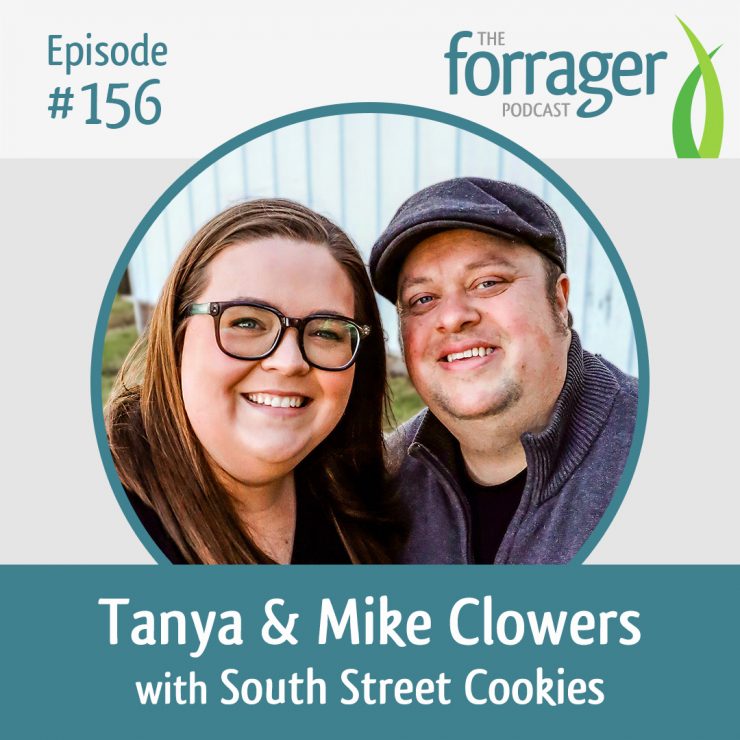
David Crabill: Welcome to the Forrager Podcast, where I talk with cottage food entrepreneurs about their strategies for running a food business from home. I’m David Crabill, and today I’m talking with Tanya and Mike Clowers.
But first, if you’re feeling stuck or looking to grow your cottage food business, you should check out my new Cottage Food Pro membership.
One of the benefits of Cottage Food Pro is our monthly group calls, which are a great opportunity to get personalized feedback directly from me and other members in addition to our monthly calls.
Cottage Food Pro also contains tutorials that are designed to boost your business without breaking the bank. To learn more about my new membership, go to cottagefoodpro.com.
Alright, so I have Tanya and Mike on the show today. They live in Williamsburg, Iowa, and sell custom decorated cookies and other baked goods with their cottage food business South Street Cookies.
Tanya and Mike’s cottage food story has truly humble beginnings. Just a few years ago, Mike became very ill and lost his job leading them to rely on a local food bank to get by. While Tanya worked four different part-time jobs, but as their cottage bakery became more successful, she was able to quit her other jobs and focus on this business full-time.
Tanya has now grown not only a strong customer base, but also a huge social media presence. She now has over 100,000 subscribers on her YouTube channel. And in this episode we discuss how to use YouTube to boost a cottage food business.
Tanya and Mike’s journey is quite remarkable and is a great example of how a cottage food business can literally be a life-changing opportunity. And with that, let’s jump right into this episode.
Welcome to the show, Tanya and Mike. Nice to have you here.
[00:01:53] Tanya Clowers: Hi. Thanks for having us.
[00:01:55] David Crabill: Well, Can you take me back to how this all got started?
[00:02:00] Tanya Clowers: Well, I was a wedding photographer for about 10 years when I had my son in 2018, I sold my business to my former partner. And then I was a little lost and I started obsessively watching Instagram videos, a cookie decorating. And I had never baked or decorated prior to that. And then after watching videos for a few months, I decided to give it a try.
And that was in July of 2019. And then within a few months people wanted to place orders because I was posting, photos on Facebook, and then it just turned into a business in October of that year.
[00:02:35] David Crabill: Yeah, I mean, I saw somewhere that you said you had a lifelong love of art, so you know, can you share a little bit about your art background?
[00:02:45] Tanya Clowers: Yeah. So growing up, my brother and I were always really into drawing. And then I got more into art in high school and photography. And then when I went to college at the University of Iowa, I ended up getting an art degree. And so I found photography there and I have a BFA in Photography.
And so I’ve just always gravitated towards doing creative things.
[00:03:05] David Crabill: And part of the reason I ask is because you said you started cookie decorating in July of 2019, and at least by like October you were a pretty good decorator. So it definitely seemed like you had some kind of art background. How do you feel like you picked it up so quickly?
[00:03:25] Tanya Clowers: I was just obsessively watching videos and so I was watching like YouTube tutorials and Instagram and just, I got into it. I don’t even know. I was just decorating all the time. As soon as I started.
[00:03:36] Mike Clowers: I’m always surprised because the fact that you had your carpal tunnel surgeries.
[00:03:39] Tanya Clowers: Yeah, so I had, um, carpal tunnel syndrome and I had surgery on both my hands in 2018. And so that does have some restrictions for like how much I can decorate, which plays into like why our business structure is the way it is and like why we do different things.
But I found that royal icing isn’t too hard on my hands versus like buttercream where like it’s a thicker consistency.
[00:04:02] David Crabill: And I know like you said, you went to school for photography and you had a photography business. Can you tell me a little bit about your photography business?
[00:04:13] Tanya Clowers: I started on my own right out of college. I had a photography internship with a wedding photographer in 2010. I learned so much from him, and that’s where I got into wedding photography. And so I started by doing the backend, I would edit the photos from weddings for him.
And so I learned about like the business structure of being a wedding photographer first and then the next summer. I second shot for him that year. So I shot weddings with him as an assistant. And at that time I was starting to build my own business. And, taken on more weddings on my own in like 2012.
So I kind of like gradually went into it. And then a friend of mine that I knew from college reached out ’cause she wanted to get into wedding photography as well. And we just started working together. And so by 2013 we decided to officially become a business together. And we did that for five years as a partnership.
And it was a successful business. We had a team of photographers that would work with us for weddings. But I could never make it a full-time thing. And I think a big part of it was that it was a partnership and we had assistants working for us.
Like the income was just being split too many ways. And so we moved to Williamsburg. All my business was still with, with photography clients in Iowa City. And so I just kind of got burnt out of driving back and forth so much.
Not so much for weddings, but for like meetings and engagement sessions and stuff like that. Another big part was once we had Conrad, our son that was kind of like, not the breaking point, but like the decision of like, you know, we can’t do this anymore.
’cause we were. Having to juggle, you know, one of us always watching him, another one being at work and it was really difficult to schedule for clients amongst all of that.
[00:05:50] David Crabill: Okay. So it sounds like you could have made the photography business work, but you just didn’t want to be spending as much time outside of the house.
[00:05:59] Tanya Clowers: Yeah. That was a big part of it.
[00:06:01] David Crabill: And how old was your son when you started selling cookies?
[00:06:05] Tanya Clowers: About one.
[00:06:07] David Crabill: So how did you find so much time to decorate all these cookies?
[00:06:12] Tanya Clowers: That’s a great question.
[00:06:14] Mike Clowers: A lot of late nights.
[00:06:15] Tanya Clowers: Yeah. Late nights. I’m a night owl, and we never did daycare. We couldn’t afford it. And so at the time, we both were working at the same grocery store, and that’s where I worked off and on, like my entire adult life. And so, you know, Michael worked in the morning, he’d come home and then I would go to work in the evening, and then I would get home and then stay up until, I mean, who knows what hour decorating cookies.
[00:06:35] David Crabill: I think one of the things that was most fascinating to me as I was looking into your business was seeing that. You know? Yeah. You did have the photography business, and then you started this cookie business, but you also were working at two other part-time jobs, so you were essentially holding four jobs at once. Is that right?
[00:06:56] Tanya Clowers: That is accurate. Yeah, because the photography business overlapped with the cookie business a little bit. So I sold the photography business to my partner, but I stayed on as a wedding photographer only. At the time, I had planned to do that indefinitely. That was before South Street Cookies started.
And so I had agreed to just shoot weddings and nothing else. So none of the meetings, none of the editing, But then COVID happened, but then COVID happened, in 2020, and weddings kept getting postponed. And pushed back. And so I ended up shooting weddings through October of 2021, where I had intended to be done in like the spring of 2020 sort of deal. but yeah, it was just juggling a lot of different jobs because, we just had to make ends meet. And at the time, Mike also was going through some health things in 2020, so he went from being like our, you know, full-time income to, for three months not working at all. And so I was just doing whatever I could to keep us aflo.
[00:07:51] Mike Clowers: I always tell people this, I, me, with all the sincerity in the world where, she saved us, the cookie business, her working, all those jobs saved us. Like Tanya’s my hero, if it wasn’t for her, like we wouldn’t still have her house, we wouldn’t have her cars. she, She picked up all the slack when I couldn’t and that’s why I love her so much.
[00:08:08] Tanya Clowers: Very sweet.
[00:08:10] David Crabill: Yeah and I know Tanya, you told me about how you relied on a food bank at one point.
[00:08:17] Tanya Clowers: Yeah, so income wise, we qualified for SNAP benefits, but the problem was I couldn’t predict my income. So like they wanted to know a hard cutoff date for my last wedding when I’d be done with the wedding photography.
And I couldn’t tell ’em that because, everything just kept getting rescheduled. And then they wanted to know, okay, then what can you predict your income will be with the cookie business? And I was like, I don’t know, it’s too new. So they’re like, okay, well come back in a year when you have better records of what your income is.
And so we’re like, okay. What do we do now?
[00:08:47] Mike Clowers: We, we were very lucky, but also very. On the food bank. But it’s also one of those things where it’s almost a blessing in disguise where now the church, where the food bank is Tanya has been able to give back.
Mm-hmm. By donating her time.
[00:09:02] Tanya Clowers: Yeah. So for the last two years I’ve been volunteering at that food bank you know, I was just, I was so appreciative because I had never in my life been in that position where there was like food insecurity and there was also like the, irony of like us struggling to feed ourselves, but then I was making desserts for other people like that always felt a little, off.
And now I, um, I’m pretty food know just having a different perspective like, there’s a lot like stereotypes that aren’t accurate. Now that we’ve in
[00:09:32] David Crabill: Well, Tanya, what did it feel like in that moment? Did you foresee or hope like this cookie business was gonna take off? Did you consider like just quitting all the part-time jobs, trying to get a more secure job?
[00:09:47] Tanya Clowers: The catch was that we couldn’t afford daycare, and so it was hard to figure out a full-time job that would work. Opposite of Mike’s. Job, when he was working. I looked into going full-time at the grocery store, but that didn’t work out. and so then I was just kind of doing whatever I could to keep a afloat without like a really clear plan.
Like it was just like survival mode, you know, just trying to, to keep going. Um, I don’t know, when we realized that the cookie business was going to be successful and we kind of like went all in.
I don’t know when that turning point was.
[00:10:19] Mike Clowers: I’d probably say it was When you decide not to stop bartending at the golf course.
[00:10:22] Tanya Clowers: Yeah. Yeah, One of my jobs was bartending at a golf course clubhouse. that was actually huge as far as becoming integrated into Williamsburg.
We’re not from here and it’s a small town. There’s probably 3,300 is the population.
[00:10:36] Mike Clowers: I’ve always had the ability to. talk to anybody and make friends with anybody. And that’s not necessarily Tanya’s strong suit. Mm-hmm. But the bartending really, really helped with, her making small talk with people.
[00:10:49] David Crabill: so, what sort of things are you in charge of, Mike, and what are you in charge of? Tanya?
[00:10:55] Tanya Clowers: So I solely pulled Mike into the business. He started with just farmer’s markets. So he would help package the cookies or put the labels on the cookies. And then as we got busier, I would be busy doing orders. So I was like, “Hey, can you actually go work at the market for me?”
And then eventually I was like, “Hey, I’m gonna teach you how to bake the basic drop cookies.” And so now it’s just evolved. So what Mike does is he bakes, so at farmer’s markets we have drop cookies, cookie cakes bronuts, the brownie donuts and. Cake slices and basic like banana breads, Mike bakes all of those.
And then he works our Saturday morning market consistently. And then everything else of the business I do. So like the decorated cookies, the custom orders, the communications, social media, administrative stuff like the rest of like the businessy end things is me.
[00:11:44] David Crabill: Yeah, I noticed that you, you have all these kind of cookie related. Products, and I mean, you have drop cookies, you have cookie cakes, you do have some breads and bro nuts and stuff. But I was curious as to why you haven’t like just gone all in with the decorated cookies
[00:12:03] Tanya Clowers: So that comes down to my hands because of the carpal tunnel syndrome. So I had surgery for it, but I still have symptoms of carpal tunnel syndrome. And so when I overwork my hands and take on too many orders or around the holiday season, I’ll. Start to get the pain and the numbness again.
And so, you know, we had decided pretty early on that the decorating can’t be the main part of the business. You know, We had to have other ways to supplement it so that I wasn’t going to destroy my hands. And also at markets, we found that for us, at least for our, our clientele the custom cookies or the, decorated cookies are not our top sellers at farmer’s markets.
And so it doesn’t make sense for us to have that be like the only thing we bring to markets too.
[00:12:44] Mike Clowers: I definitely found with the markets having a little more diversity with the product helps, but then also I can make this, that and the other and it’s not gonna hurt me by any means like, Physically. But also like, it’s one of those things too where like, I like being creative with fry new flavors and, doing seasonal recipes and, I don’t know, just, people like the same old, but they also like a variety of new things, especially when it comes to seasonal items.
[00:13:07] Tanya Clowers: This is one area where we don’t totally see eye to eye. I have to reign Mike in. I’m like, we don’t need six different types of drop cookies. Like let’s do two. So that’s one area where it’s like we would like to pare down the menu a little bit, but then both of us are not willing to let go of certain items.
[00:13:22] David Crabill: So that’s interesting. So you’re saying that the decorated cookies don’t sell all that well at markets.
[00:13:28] Tanya Clowers: Yeah. I mean, they, They do okay, but if we had only decorated cookies, we wouldn’t, I mean, I don’t think that it would go over as well.
[00:13:35] Mike Clowers: I almost feel like the decorated cookies are like a way to draw people in.
[00:13:39] Tanya Clowers: Yeah. It’s like people come and look at them, but then, but then they buy something else. Like a lot of times they’ll comment on it and then I feel like they feel guilty about buying something so pretty just to eat.
And so then they buy like a chocolate chip cookie instead.
[00:13:52] David Crabill: So do you feel like a lot of your custom orders come from people who find you at markets?
[00:13:59] Tanya Clowers: Yes.
[00:13:59] Mike Clowers: I, I am the king of hand out business cards and explaining to people that, the biggest thing with our business is with her decorating. You know, We do custom orders for birthdays, holidays, parties, and that kinds of a, a way to bring them Yeah. So, I have on my like intake form, but when people fill out a form to, you know, place an order on the bottom, I ask where they found us. And a lot of it is from either like markets or like they live here in town. I have a lot of word of mouth business.
[00:14:31] David Crabill: So I did see in one of your pictures you had a $5 mystery bag, and I wanna know what the mystery is.
[00:14:38] Tanya Clowers: This is Mike’s deal.
[00:14:39] Mike Clowers: Okay. So my thing is, so I love to go online and look for recipes or clever ideas to bring people in. ’cause you know, people like games, people like something that’s gonna incentivize them buying something. Anyway, where, I wanna say it was on Google, probably where I saw somebody I think it’s someone in South Carolina where they had.
[00:15:00] Mystery bags, or is this a way of getting rid of their items at the end of their markets? We started doing that over the summer and it was our biggest
[00:15:08] Tanya Clowers: Yeah it, it like gamified their purchase and so like people will come over and just be excited to buy something that they don’t know what it is. And so it’s what we have in the bag. So it’s $5 and it’s two items. So either like a bread and a cookie or two cookies.
The value is around like seven or $8.
it definitely draws people in and they get like weirdly excited about it.
[00:15:30] Mike Clowers: I usually sign up, so there’s about anywhere from six to nine bags, seven at a time, and someone’s like a claw machine thing where I’m like, this pick went out.
And everyone’s like, Ooh, is that a good one? I’m like, ah, you’re cold. You’re cold.
[00:15:41] Tanya Clowers: Yeah, it’s fun.
[00:15:44] David Crabill: So do you do that at every market?
[00:15:48] Tanya Clowers: We do it just at our Saturday market. So we have three events a week. Thursday night is a small live music event at like a wedding venue. It’s an outdoor event. And that’s just a food truck, us a bar and music. We don’t do the mystery bags for that. And then Friday night is our Williamsburg Farmer’s Market.
We don’t do the mystery bags for that, but we do it Saturday morning at Iowa City Farmer’s Market, which is our biggest market. We’ll have ’em there and it’s also like a way, to try to get rid of stuff that isn’t moving as well as everything else.
[00:16:22] David Crabill: So I, I know you, you do a lot of business from these markets, but then I also saw the porch fridge, which I thought was pretty cool. can you talk about how you came up with that idea?
[00:16:35] Tanya Clowers: Well, It was just a way for us, we started this last year to just try to have our leftovers from our markets, like another chance for it to sell before we froze it till the next week So the fridge is a mini fridge from when I was in college that has just been living in our garage.
It is my beer fridge. It doesn’t work. If you plug it in, it becomes a freezer, So the fridge is actually off on our porch. It’s just like a container so that you know, everything [00:17:00] stays safe from the elements. And it actually, I mean, it insulates pretty well, like even on the hottest days during the summer, like nothing was like melty or hot inside the fridge.
So we just we fill it on Sundays and then I’ll make a post on Facebook or Instagram or like in the stories, a picture or video of what’s in it. put a sign out, like a chalkboard sign one by our house with the prices. Another one at the end of our driveway.
Sometimes we’ll put a sign down like at the end of the road and just people come and help themselves so they can either pay with Venmo or they can leave money in a mailboxes hanging by our front door. We honestly don’t get a lot of business. From it. It’s really interesting because like people get really excited about it and people around town they’ll mention it and they’ll say how it’s such a cool idea, but then we’ll, have like maybe two or three people will stop by.
So we don’t make a whole lot of sales off of it, but I’m hoping that like if we continue doing it and have it like a consistent thing, it will become more popular.
[00:17:52] David Crabill: I thought it was interesting that I saw it said pay what you can model.
[00:17:57] Tanya Clowers: Yeah. We started that, it was like suggested prices mostly because it’s like, it’s leftover things and so we’re just seeing if we can get anything out of it before we end up giving it away we haven’t had any problems, like we haven’t had anything go missing or people not pay or anything like that.
[00:18:13] Mike Clowers: I will say the thing I have noticed with the people who have gotten stuff from the fridge are the same people who, if I talk to them, they can’t make it to our markets or they can’t make it to our popups, but they still want our products. Mm-hmm. And so it’s another way for us to reach people that we normally wouldn’t get to sell to.
[00:18:31] David Crabill: If something doesn’t get sold out of the fridge, then what happens to it?
[00:18:37] Tanya Clowers: Some stuff we freeze until the next week. So we have a freezer in the garage. If it’s already been frozen once before then we just give it away. So we’ll give cookies to small businesses on the town square here, and we have gotten business from doing that. It’s like another way of marketing.
We’ll take it to church or give it to friends or families. Our neighbors had to tell us to stop cause our neighbor’s on the caveman diet, so we had to stop giving cookies to them. But Mike will also take it to work. So we, we do give away a fair amount of things as well. The goal is just to get outta the house so we don’t just eat it ourselves.
[00:19:13] David Crabill: I mean, Do you feel like you have a pretty good sense for how much is gonna sell at a given market? Like how many leftovers do you often have?
[00:19:22] Tanya Clowers: We’ve gotten better at figuring out how much to make.
[00:19:25] Mike Clowers: It’s definitely been a process of just paring down, but also just really what the expectation for what, each market’s gonna be and just not trying to over make.
[00:19:34] David Crabill: Do you ever sell out at markets?
[00:19:37] Tanya Clowers: Very rarely. I don’t know that we’ve ever sold everything but we’ve gotten close a couple of times. But yeah we, we usually have leftovers. It also depends if it’s a, like a farmer’s market as opposed to like a holiday popup kind of thing. Where like the holiday popups that we do at the uh, coffee shop here in town, we’ll usually get pretty close to selling out. Yeah. Those ’cause they’re a little more uh, a little more traffic when it comes to that.
[00:20:00] David Crabill: And what kind of revenue numbers are you looking at for a farmer’s market versus a local event popup?
[00:20:09] Tanya Clowers: It depends. So we know like, there’s like a curve for the year. So at the beginning of the year like in Iowa City, you know, We’ll make maybe like $500 on a Saturday for the first like month or so of the season, but then it goes down from there.
So we’re happy with anything between like. two to three 50 is like a happy amount per event. And then we know that by week, the time we get into this time of year like after, basically once school starts, so like September, October the sales start to get really sad. So then we’re looking at maybe a hundred dollars for a Friday night.
So it just kind of depends on the time of year versus like a vendor event. We’re looking more like $700 up to $1,000? For our vendor event or like one of our like holiday popups that we do on our own at the coffee shop here in town.
[00:20:55] David Crabill: Yeah. Well Those are pretty good numbers. Do you continue to do the farmer’s markets later in the year, even if it’s only gonna get you a hundred dollars of revenue.
[00:21:06] Mike Clowers: So this year we made the conscious decision to pull back from the farmer’s markets a little bit more towards the end of the season. It’s because we had other venues we could do, and so we, we did the thing at Harper with the um, yeah, railroad trip.
[00:21:19] Tanya Clowers: so the Iowa City Farmer’s Market goes through the end of October, and we’re not gonna be there for the last three weeks. Because we have other fall show opportunities instead. And so as long as they know ahead of time, like they want us to let them know at least a week ahead, they don’t mind if we’re not gonna be there.
’cause then they’ll find another vendor to fill our spot. So this year we did pull back more towards the end of the season because we had other opportunities pop up.
[00:21:43] David Crabill: And how much of your business would you say is markets first? Like custom orders?
[00:21:51] Tanya Clowers: For farmer’s markets, that’s about 33% of our business, and then custom orders is about 31%. And then we do popup and vendor events like holiday events and whatnot. That is 7%. And then in-person cookie decorating classes is 17%. Online classes. I sell an online class on Etsy. That’s just 2%. And then the rest is what I make off of social media. So about 10% off of like TikTok and YouTube and Facebook, like what those, actual platforms pay me,
[00:22:19] David Crabill: Wow. I’ve never had anyone had that. those numbers so perfectly lined up. I mean, you get, definitely get the award for like most organized finances. Like what do you do is to keep track of it all. that End of things I would like to improve upon. I just have spreadsheets and then I work with an accountant for my taxes once a year.
[00:22:41] Mike Clowers: Know, the thing I would think is fascinating about Tanya is like a lot of people who are in a creative field tend to be a little more flaky and unorganized and like, just, I don’t know, a little more um, scatterbrained, Tanya on the other hand is super organized where I could ask her a question and she’ll figure out a way to get the answer right away ’cause she has everything so organized.
[00:23:01] Tanya Clowers: But I’m like, not with the times. Like I prefer to have everything like on paper. So like, I can’t depend on like a digital calendar. I have like a paper calendar for everything and like I print off my orders and I like check ’em off, like physically, like as I go.
[00:23:16] David Crabill: What about pricing for your decorated cookies versus that you sell at the markets?
[00:23:25] Tanya Clowers: So for custom orders I start at $56 a dozen. And that goes up to $68 a dozen. And then for farmer’s markets, we sell decorated cookies. Usually they’re $4 each, so it’s a little less than what it would be for a custom order. And then our drop cookies are all $4. And everything else kind of varies a little bit.
So our market prices are lower than what our custom orders are, but that’s also about the, how much time you have to spend at things and how many colors you have. Yeah, I definitely make the cookies for events and markets a lot simpler and I crank them out a lot faster and I’m not like, as worried about them being like perfect as I do for custom orders.
[00:24:04] David Crabill: I was surprised to hear you say that you do $56 a dozen for custom orders and it can go up to $68 a dozen. That seems like a very small spread there. Like, I would expect you to be able to sell certain things for a lot more. Just have a bigger spread than that.
[00:24:26] Tanya Clowers: Yeah, no, you’re right. It’s pricing that I’m comfortable with even though I know it could go higher.
[00:24:33] Mike Clowers: I know I’ve definitely told her that she could probably have the high end, and I think people, if they really, really want a certain thing, they’ll be willing to pay that. Yeah.
[00:24:42] David Crabill: I mean, Tanya, your skills are, are really like off the charts. I mean, I would say from looking at your social media, you know, you are really good within like even six months of starting decorating and then like, probably within a year and a half or two years you were like exceptional at decorating cookies. So I would think that you could probably price as high as anyone in your area.
[00:25:08] Tanya Clowers: Yeah. It’s, it’s hard. I look at, you know, pay attention to our business. I don’t like stress too much about other people charge, but I do look at other cookers around me, and I’m, I’m about where everyone else is, and that’s part of the reason why I haven’t, and also knowing that like, I’m not. Overflowing with orders. I have a comfortable amount of orders and I worry that like if I raise my prices more, I wouldn’t get as many. and so, The demand doesn’t seem high enough to be raising and potentially like, missing out on orders.
[00:25:39] David Crabill: Sometimes it’s the opposite, though. Sometimes, especially if you price certain things higher. If you stick with your $56 a dozen, right? But then you have an option for something that’s $80 a dozen. Like sometimes people will go with a higher price just ’cause they want something really special.
So it’s kind of interesting how, sometimes pricing things higher can actually help sales.
[00:26:06] Tanya Clowers: Yeah, no. Yeah, I have heard that.
[00:26:09] Mike Clowers: But at the same time that there has been orders you’ve taken where they wanted to add another thing or add another color where you’ve increased the price. Yeah. So it’s been more to in that 68.
[00:26:18] Tanya Clowers: think the highest I ever charged was like 72. But I do also do, a rush fee, if, they’re placed within two weeks of pickup. I do often get tips like, pretty consistently, which then makes me wonder if I’m not charging enough because that’s such a consistent, like add-on to their payment.
[00:26:34] David Crabill: As we’ve said, you have an am amazing cookie decorating skills, and that’s a big part of the reason why your social media has blown up and you have over a hundred thousand followers on YouTube, which is just like a mind boggling number. So, I wanna really dig into this. ’cause I haven’t had anyone on the podcast really talk that much about YouTube and it’s become a really big thing.
And I think for the longest time people thought it was just for online video creators, but now it can be used for cottage food businesses too. So, like, how do you feel like YouTube has influenced or helped your cottage food business?
[00:27:19] Tanya Clowers: Well, As far as like how it affects the business, I do get customers from YouTube and that surprised me. And I’ll get custom orders from. YouTube, but more so my cookie decorating classes. A lot of people find me for my classes on YouTube and then sign up for a local class and people will come from, all over the state for my classes because they follow me on YouTube and I’m like within a, you know, a decent, couple hour drive of them
[00:27:45] Mike Clowers: You had that one class where you had people literally from all across the United States where they happen to be visiting. People here in Iowa where you had someone from South Carolina. Oh yeah. And you had people from California happened to be here at the same time. So really you had anybody from, yeah.
[00:27:59] Tanya Clowers: [00:28:00] across United States. And I’ve had people come from Illinois a couple times too, ’cause they followed me on YouTube. So yeah, I mean I, I definitely get like actual, like, tangible business from YouTube. And I do think I mentioned this in the hundred 50th episode, but, youTube does a really good job, which surprised me of uh, targeting people in your area because when you upload a video, you can add your city and state in like the metadata. And I think that that, really helps more than what you would think.
[00:28:28] David Crabill: I’ve always thought that YouTube was more of like a national type of way to market yourself. So it’s really cool to hear that it’s working well for local orders sometimes, you know, the local cookie decorating classes. Do you feel like it’s the YouTube shorts that help with the attention? Or do you think that it would be the same if you just didn’t do shorts and did the full videos?
[00:28:53] Tanya Clowers: yeah, my channel is mostly shorts. I tried to do some long form, but it just wasn’t taken off for me. And so I’ve kind of abandoned that a [00:29:00] little bit and I would like to go back to doing those. But it’s, it’s interesting ’cause like YouTube shorts versus the long form, like horizontal videos or like completely different strategies for how to get them to take off.
I think that if you’re looking to grow your account and like reach a lot of people, YouTube shorts is like the quicker way to do that.
[00:29:18] David Crabill: and YouTube shorts is kind of a relatively new thing. I’ve been hearing a lot about it. I haven’t personally experimented with it, but everyone’s saying like, you gotta get on the YouTube shorts train. So, I think YouTube is really pushing them right now a lot, you know, kind of the way that. Instagram used to push certain things, or way back in the day, Facebook used to push certain things. So like right now it’s, YouTube short. So, What are some of your strategies for creating a video that gets uh, shared and, featured on YouTube?
[00:29:50] Tanya Clowers: I do mostly just cookie decorating tutorials and then also like, to music, like relaxing videos or like, as like visual ASMR sort of stuff. But I think just [00:30:00] you know, like any social media, like just, posting consistently and then also interacting with the people who follow you.
I aim to post a video every day. Right now I’m kind of, pulling back a little bit at the moment, but sometimes I’ll post a few videos in a day. But like When I’m looking to build a lot of content, I just record the orders that I’m doing and so, you know, if I have an order with, four or six designs, like that’s four or six videos right there.
I don’t see it as like that much extra work to do, like to actually create the video
[00:30:30] David Crabill: And like, are you recording on one day? Watching and then creating a lot of videos for a week. Are you like creating videos almost every day
[00:30:42] Tanya Clowers: So I usually have orders picked up on Fridays and Saturdays, and so I have a, like a schedule for like, when I am actually decorating and so I’ll record like while decorating. So it’s like not an extra step or anything, but ideally, I would like to batch edit and then be able to just post them throughout the week, but I just haven’t been able to get to that point, and so I just edit the video right before I post it.
So I’ll edit video like every day sort of thing.
[00:31:09] David Crabill: And we should cover what a YouTube short is. Like how is it different from like a regular horizontal YouTube video?
[00:31:18] Tanya Clowers: So it’s comparable to like TikTok videos or Instagram reels or Facebook reels. So it’s a vertical short video. It used to be capped at 60 seconds, but now it can be up to three minutes. And it has a similar algorithm to like TikTok where, you know, if you watch YouTube shorts from like a certain creator and you’re going through like, the YouTube shorts feed, it’ll show you a lot of videos from that creator.
Like, I think it’s different than like Instagram and all the other ones. like if you start watching someone, it’s going to show you a lot of their content.
[00:31:52] David Crabill: And do you cross post? Like, do you use the same content? Put it on Instagram and TikTok?
[00:32:01] Tanya Clowers: I cross post between Instagram and Facebook, and then I cross post between YouTube and TikTok. So I don’t ever post the same thing on all four platforms, and that’s intentional. I don’t really do a lot of video content on the meta side of things on Facebook and Instagram. and now I get paid for Facebook, but I didn’t before.
it was like a twofold thing. It’s like on one side it’s like I wanted to like direct people. If they’re gonna watch my videos, I want them to watch it on the platform game paid for. So I didn’t post them on Facebook or Instagram, but also. I wanted to initially keep Facebook and Instagram more like hyperlocal.
I didn’t want those to blow up and become large. And so I know like, like reels is being pushed right now on Facebook, and so like I mean, I don’t know how easy it’s, but it’s easier now to grow your account on Facebook than in the past. So I pull back from posting videos on Facebook because I don’t necessarily want to have a huge following over there because I don’t wanna dilute like my local customers.
[00:32:57] David Crabill: I’ve never heard of anyone saying like they didn’t want to have a large following. Right, like,
[00:33:01] Tanya Clowers: I know. Yeah. And, and I, I’m torn because now I do get paid from Facebook, so I, I go back and forth between being like, okay, do I wanna keep it small or do I want to go all in and just like, post the videos that, you know, have done well and will most likely like, you know, grow my account. Like for the longest time on Facebook, I had just a couple thousand followers and I was happy with that ’cause it was mostly local customers.
And then I started posting a few videos and then now it’s at over 20,000 followers on Facebook. And I’m like, oh, this is good. Like, It’s exciting, but it’s not what I necessarily had a goal to do over there.
[00:33:37] David Crabill: So you’re saying you’re getting paid by Facebook now, like how does that work?
[00:33:43] Tanya Clowers: It’s the same as like, you know, TikTok and YouTube where you get paid per view. And also not even just videos, like Facebook pays for everything. So you’ll get, paid for static posts like photos, stories just text. But the videos is what pays the most. And it’s not, I mean, [00:34:00] it’s not that much, but, I haven’t fully leaned into that.
[00:34:04] David Crabill: if you post a video, how much do you actually get paid from that?
[00:34:09] Tanya Clowers: I don’t know. I’d have to look, but like, usually Facebook, I’ll make a hundred dollars in a month. Like, It’s not like crazy money or anything, but I only post, a handful of videos. I’m not posting videos every day. So there’s like potential there to make more. And so, like I said, like I’m torn between whether I want to, lean into that or try to keep it more local.
[00:34:28] David Crabill: And obviously one of the big appeals of YouTube is, you know, people are like, oh, you can make, money on YouTube, and now you have over 114,000 subscribers on YouTube. So is that actually making a substantial amount of money now?
[00:34:43] Tanya Clowers: No, you are so bad at selling yourself. The, the reason, the reason why is because YouTube shorts pays different than long form YouTube shorts pays a fraction of what the long form videos do. And so it’s like nice, side income, but again, like it’s not, reliable. And it really varies on like, you know, how much you post and how well those videos perform.
So like it’s just kinda like bonus money, but it’s not, you know, you can make a really good income if you are doing the horizontal long form videos and having those take off.
[00:35:17] David Crabill: I know some of your videos have gone viral, millions of views, but those just aren’t generating much money ’cause they’re short form.
[00:35:26] Tanya Clowers: Yeah. Yeah.
[00:35:27] David Crabill: Interesting. But you said you’re hesitant to. Head back into the long form content.
Why is that?
[00:35:35] Tanya Clowers: A part of, I just got kind of frustrated because it was more work and they weren’t performing well. Like it would get like a couple hundred views. whereas, you know, you need like thousands for it to actually like be worth the time. And also a part of it was limitations with my phone. So I just got a new phone, but I used to have, Uh, budget iPhone from 2020. and that’s what I reported all my videos on. And the video quality was fine, but I was always fighting for space on my phone. And so when I did long form videos, it was just like challenging to actually edit and export them. I just got a new phone that should help, but I’ve also considered like getting, a camera and an editing software and like all that, like specific for YouTube. But I haven’t gone into that yet.
[00:36:18] David Crabill: Well, Just looking at your account, you’ve got over 80. Regular long form videos and you have over 600 shorts and some of these shorts, you know, like maybe a dozen have gone viral, have over a million views. And then you do have some of your long form content, or most of it at least has over a thousand.
And sometimes, you know, you have one video that’s over 10,000 views. So I’m curious do you know if that long form content makes more money than the shorts
[00:36:52] Tanya Clowers: For what I’ve made personally or like a
[00:36:55] David Crabill: what you’ve made? Yeah.
[00:36:57] Tanya Clowers: No, Uhuh. Um, and I think a part of that is I think the longer videos are more of like a slow burn, like where it, they grow views over time. Whereas the shorts just take off right away. And that also affects how you get paid because you know, the RPM varies and a part of that is like how quickly videos are viewed.
And so the faster it takes off, the more you get paid for it, the slower it grows, like the less you get paid for it, at least from my understanding. so I, I really haven’t benefited a whole lot from the longer ones.
[00:37:29] David Crabill: Okay, so the majority of your income from YouTube is coming from shorts, even though it’s not that much compared to how many views you’re getting. Are you willing to share how much you actually make on YouTube?
[00:37:43] Tanya Clowers: Yeah. Between two to $700 a month. You’ve had some months where we made quite a bit, right? Yeah, it varies. So you can’t depend on it, like it’s nice when it, you know, is a couple hundred dollars there are some months where you have to make at least a hundred dollars for it to pay out.
And I’ve had some months where I don’t even hit that. Like last month I really didn’t post a whole lot, so I made $29 and then this month I made like 150. So then my next paycheck, like they’re gonna be like combined together.
[00:38:11] David Crabill: Okay, well, I mean, that’s not bad, that’s, a few thousand, maybe even approaching $10,000 maybe for the whole year. So it’s a pretty good little extra amount of money and. I assume it continues to grow.
[00:38:26] Tanya Clowers: Yeah, that’s the idea at least.
[00:38:28] David Crabill: Yeah. I know you’ve been doing the YouTube thing for only two years. How has it grown over that time? Did your channel take a long time to take off? Did it take off right away? what does that two years kind of look like on your ascent? Up to a hundred thousand?
[00:38:46] Tanya Clowers: it took about a year and a half to get a hundred thousand subscribers. The first couple of months it was you know, steady growth, but nothing too crazy. once we hit June is when it really took off. And a part of that was because it was Pride Month. And I post a lot of pride videos and those unfortunately can be controversial.
And so the more comments you get, the more the, you know, views you get. And so, I think that’s part of why it, I had a really upward trajectory in June of the first year I did this, and then just kept going from there. once I found out I could get a silver play button plaque I had my eyes on the prize.
I wanted that award. And so once I knew I could get an award for having a hundred thousand subscribers, I was like, okay, I’m going all in. I’m gonna hit this. And so that was like my motivation to, keep going with it.
[00:39:34] David Crabill: Yeah, I know it. It’s, It’s really hard to get that award. And then do you have your eyes on another prize? Now it’s, what’s the next level? A million. I don’t know.
[00:39:47] Tanya Clowers: Well, Yeah. A million’s. The next one my son, so he’s seven. He tells me that we need to get that gold play button. He’s all about it. I don’t know. I mean, I, That’d be fun, but that’s a ways away. I think it’d be cool, but I don’t know, like realistically like how long that would take or if we will get to there.
[00:40:05] David Crabill: And what have you learned about creating a, videos that do well on YouTube?
[00:40:12] Tanya Clowers: For me, usually my videos perform better when I have a voiceover. If I do video to just music, they don’t perform as well. For whatever reason, when I show my face, I talk to the camera like a talking head sort of video. Those don’t do very well at all. I just really lean into the tutorial based videos.
[00:40:32] David Crabill: And I know with regular long form content, YouTube thumbnails is a big part of the equation. Does that matter with shorts?
[00:40:43] Tanya Clowers: I don’t know. So for me I feel like it must to a certain extent. So what I do for all my videos is they’re about a minute long, because when I cross post to TikTok, they have to be a minute and one second at least for me to make income off of it. So I edit the same video, and then I cut a second off for when I post it on YouTube.
when I post videos on YouTube, I always have, the first 57 seconds are the actual decorating in the last, like two to three seconds is like my professional quote unquote photo of the cookie set. And so I always make my thumbnail, the picture of the cookie that shows at the very end of the video.
And so when you go to my page, I feel like it looks like a pretty like, curated feed where it all looks nice and bright and professional when you’re going to like, pick which video you’re gonna watch. So I feel like the thumbnail plays a part, but I really don’t know if it does or not.
[00:41:38] David Crabill: And do you feel like it’s important to have a hook in like the first three seconds?
[00:41:44] Tanya Clowers: It definitely helps. I found that when I have a video that had a hook, it’s usually unintentional. And then I’m like, oh yeah, that’s why that video took off. But that’s not a strong, area for me to like plan that out.
[00:41:55] David Crabill: Can you identify why some videos have gone viral?
[00:41:59] Tanya Clowers: Yes. So the one I always go back to is on TikTok. The first video I had go viral in 2023 has 16.6 million views. And that went viral because I was gluing together a broken cookie. And I was doing a tutorial about how to fix a cookie. And surprisingly that was very controversial. People had a lot of opinions on that.
And there are people arguing. I mean Hundreds of people arguing in the comments about how I was deceiving my customers and selling them like a subpar product or lying to them or, whatever you wanna say. If there’s something that is, controversial, then it’ll take off.
Even as silly as like the controversy might be. Otherwise, cookie videos that do well are the ones where it’s like a cookie flip. And so if I start the video by being like, you can make this cupcake cookie actually Santa’s face, people like are like, they’re all in and they’re so their mind, yeah, they lose their minds over those things.
So I always do every year, like the gingerbread man flipped upside down is Rudolph. And that always does really well because people find it really interesting that you can take the same shape and do different designs with it.
[00:43:05] David Crabill: You mentioned TikTok and I saw you achieved over a hundred thousand followers within a single year. So what have you learned about, I don’t know how to, how to, how to grow on TikTok or, I mean, that just seems like an astonishing amount of followers to achieve within just a single year of starting.
[00:43:29] Tanya Clowers: Yeah, that, that took off really quickly and that was in 2021. When? When I did TikTok And I just posted consistently. And TikTok has changed a lot since then. I don’t know what the best tricks are or like, methods for getting your account to grow, because right now the TikTok shop is like king.
Like That’s what everyone’s doing. so I don’t do any of that. But when my account was growing, I was posting at first it started with just one video every day, like consistently and then once it started to take off, then I upped it to between two to five videos every day.
And I did that for about three months straight. When I did that many videos posting every single day, that’s when my account just like skyrocketed. And then I would go through like maintenance mode where I would just go back to doing a few videos, one a day or whatever. And then when I wanted growth again, I would amp it up again and do several in a day.
So at least with TikTok, the more videos you post, the more it’s gonna push it out.
[00:44:23] David Crabill: Well, One of the things with growing accounts so big is, you know, sometimes it leads to some problems, and I saw that you have had some people steal your content or create duplicate pages. So what has been your experience with that?
[00:44:40] Tanya Clowers: He gets really mad. I get really mad. It’s very frustrating and it’s really disheartening. So I have, I think last I counted, it was at least 12 or 15 pages that say it’s South Street Cookies and some iteration with my profile picture, like a picture of me. And then it’s videos that have been stolen from, I assume from TikTok.
[00:45:00] There’s one that’s really big that I think it has close to 30,000 followers. I’ve tried reporting the page A of people who message me and be like, Hey, is this yours? And I’m like, no, that’s not me. Like I’m aware of it. If you wanna report. It, go for it. And so I’ve had other people report the page and nothing’s come of it.
So it’s one of those things where it’s like, I just, I think it unfortunately just comes with the territory and I try not to dwell on it too much.
[00:45:23] David Crabill: is it mostly TikTok? That’s a problem.
[00:45:27] Tanya Clowers: I think so. ’cause I think that TikTok makes it really easy to download the photos and then, there’s a site where you can use it to remove the watermark. So I think that the photos are coming from TikTok, but then they’re being uploaded on fake Facebook pages. that was the reason why I decided to do the meta verified on Facebook. So I paid for the little blue check mark every month. But that way at least I can tell people when you’re looking for me, like that’s how you know it’s the correct page.
[00:45:54] David Crabill: And another thing with growing is you do have to deal with the haters. So, what has that been like?
[00:46:02] Tanya Clowers: I handle it much better now than what I did in the beginning. When I first started growing on TikTok when that first video really blew up, it was alarming. The things people will comment and I, at the time four years ago, I get really defensive and really worked up over it.
and now I, I don’t like, I honestly laugh at some of the comments we’ll make. And I actually, I have an album on my phone of, screenshots from YouTube comments that I’ve considered doing something with, like making, cookies of the comments that I’ve gotten that are just like, so out of pocket.
But for a while on YouTube I screened every comment before it was left, on YouTube you can set it to hold comments until they’re approved. And so I did that for, I mean, a year, year and a half. So every comment, I would only see it before it was, public.
And that was a way to control leaving the hate off of the page because hate just brings more hate. Like, It just kinda like spirals. And so I felt like if I just nipped it in the bud, then I’d get less of it. And I think that was successful. And now, like on YouTube, I don’t scream my comments.
And most of ’em are positive now. So I do think it kind of helped like veer the videos to like the correct, audience.
[00:47:12] David Crabill: Where do you think your business would be today if you had never hopped on TikTok or YouTube?
[00:47:19] Tanya Clowers: I think it’d be a very different landscape ‘ cause so much of what I do is like tutorial video based stuff and that’s what people find me. not sure. Perhaps less cookie classes. I think that would definitely be less of that. ’cause like I said, a lot of people will find me there.
[00:47:36] David Crabill: Yeah, I noticed that you do a lot of cookie decorating classes and then you have these online classes too. So, What have you found works well with the classes?
[00:47:47] Tanya Clowers: So for the online classes that happened, because my followers on YouTube were really pushing for it. They really wanted to come to my in-person classes but couldn’t because of where they were. And so they, kept asking for online classes. and I wanted to, I kind of do it in an unusual way, so I wanted to have it like, like a set it and forget it sort of model.
I didn’t want to have to maintain the online classes. So like, I don’t use like, Teachable or, any of those sites where you’d have to have like a monthly subscription sort of deal. so what I ended up doing was I have a PDF for each class, and then that links to private YouTube videos that you can only view through the link on the PDF.
And so when someone buys it on Etsy, they buy the PDF, and then they can just go from there.
[00:48:34] Mike Clowers: Now with the local classes, we’ve been lucky enough to have a couple businesses really take to us. Yeah. And so we have the uh, coffee shop here in town, And then also there’s a really nice winery that’s down the road from us, like 10 minutes from us And so they’ve been really great with us doing that.
[00:48:48] Tanya Clowers: definitely have our, like usual go-tos for classes, and then we’ll be invited to other venues. It’ll go to, uh, less frequently or just like a one-off thing.
[00:48:57] David Crabill: Mike, I, I wanted to get your perspective on the whole social media, YouTube, TikTok thing because I don’t know if you’re involved at all there, or if you’re just on the sidelines watching Tanya become like a, a, an influencer or YouTube influencer. What’s your take on it all?
[00:49:16] Mike Clowers: I prefer the term social media darling. And she hates it. I always tell people that my wife is a social media darling when I hand out the business cards and they explain that she has this main followers on this platform, For me, I’m an old man at heart.
If it was up to me, I’d still be using a VCR. So the whole social media thing’s, all her, I just try to push it as much as I can when I can.
[00:49:37] Tanya Clowers: I will say he’s not directly involved, but he’s very supportive in that regard.
[00:49:42] David Crabill: Why do you feel like you got started, really into social media stuff in the first place? Because Tanya, you said that you too are, more of a traditional person, like to have things on paper. So why do you feel like you really dug in.
[00:49:57] Tanya Clowers: It’s always been a part of like my professional life. So like we had the photography business of course, and my partner at the time, she did most of the social media for that. But, I learned a lot there. And then my first big kid job, I was a photographer for a ceramics gallery and I managed our social media there.
And then I worked at an interior design firm for a couple years, and I did the social media for that, business. And so it’s just always been like a part of whatever work I’m doing and I, I really enjoy photos and taking photos and sharing photos. Even like personally, like I was always really into Facebook and like, you know, posting a lot on my personal page.
So I’ve always enjoyed social media and it’s always been a part of what I’ve done.
[00:50:39] David Crabill: Because you’re so into photography and photos, I would’ve expected you to like really lean into Instagram, but you’ve really leaned into video, which is surprising.
[00:50:50] Tanya Clowers: It is surprising. I only started TikTok because I had a couple of friends really pushing me to do it. I had never done anything video before that, and it was really daunting at first, but it ended up just doing well.
[00:51:04] David Crabill: Looking back, you know, hindsight 2020, like it, you kind of were really well set up for it. You had this big time interest in art and then you had the photography obviously aspect of it. You had social media experience. So, you kind of had a lot of the elements that most people have to learn when they start their cottage food business.
Do you feel like there’s anything else that really helped you be successful with this business?
[00:51:36] Tanya Clowers: I don’t know. I mean, we, We often reflect on how I had all these different like, pieces of the puzzle, like building, upon each other. Like with my previous jobs, I think it’s a combination of being consistent, but also having talent. Because if she didn’t have the talent, it wouldn’t matter if you’re consistent because,
if somebody would’ve told us five years ago, six years ago, this is what we’d be doing I would’ve said, she doesn’t even bake. Yeah. I think it’s just I’m very stubborn and I don’t like to quit things, and so like if I, if I start a hobby or I start something like I am kind of like all in.
So I think that’s a big part of my personality that probably works well for this sort of thing.
[00:52:15] David Crabill: But Tanya, you didn’t have any baking experience before this, so did you feel like you were talented right off the bat?
[00:52:24] Tanya Clowers: no. I mean, It definitely takes a lot of work and I actually, I was a, a musician growing up. I was really into piano and violin, and I actually originally thought I was gonna be a piano teacher. That was my direct, my original like, goal in life. But I’ve always disliked it when someone gives you the compliment that like, oh, you’re so talented.
Because I feel like it dismisses all the work that goes into it. so it definitely, I, I do think with cookie decorating, like it, I did pick it up quicker than, some might, but there’s a lot, there’s a, a lot of work and knowledge and practice that goes into it.
[00:52:56] David Crabill: Well, given your photography background obviously it’s a big part of what’s helped you grow on social media. So do you have any photography tips for those of us who maybe don’t have a degree in it?
[00:53:10] Tanya Clowers: So I personally use like a professional camera, but I don’t think that’s necessary. I think the simpler your setup is, the better. the biggest thing is natural light.
And so, if you’re taking pictures of your baked goods or whatever you sell, just like, you know, on the kitchen counter at night with the yellow light from your kitchen, like that’s not going to translate well. the biggest thing is just taking pictures of you know, your products by a large window with soft, natural light, And then the big thing that I think people don’t know about is using a reflector. I just use a big poster board. I keep it simple. So like, using a poster board or something white that’s large, right up next to your setup so that it bounces a light from the window back onto your display to fill in any shadows and make the photo brighter.
[00:53:59] David Crabill: So you’re. Like a $2 poster board from Walmart.
[00:54:02] Tanya Clowers: That’s literally what I use. Yep. I use like a foam board, so it like stands up on its own instead of buying, you know, like a legitimate reflector. Can you have all that stuff? I have all that stuff. I have reflectors, I have, lights. I have all the things, but I just keep it really simple with just natural light and a poster board.
We do have very large windows, which does help,
[00:54:22] David Crabill: and you mentioned you used soft light. Are there certain times of the day that you don’t photograph?
[00:54:29] Tanya Clowers: At least in our house. In the morning, the light is not as pretty, it’s a little harsher. I think evening, afternoon, evening light is the best. It depends on what you’re going for, but generally speaking, if you want just a very, neutral photo indirect light is what’s best.
’cause then it doesn’t have the harsh shadows and highlights and whatnot.
[00:54:49] David Crabill: And Tanya, you said you’re a night owl, so are there times where you’ve finished a set at night and you just don’t have time to get it at like an ideal time of the day? Do you use artificial light sometimes?
[00:55:03] Tanya Clowers: No. So what I used to do is I used to always take when I had a set, I would always make one extra of each design and then I would keep those cookies. So I would keep, like two to six cookies from each set. And then I would take pictures of ’em, at any point. Then because they weren’t being delivered to the customer.
I did that for several years and that way there was like less pressure to try to get, a picture at the right time of day if I couldn’t like on that, day. Now I usually plan ahead well enough now that I, I can take a picture of the whole set and sometimes it is in the morning, and that’s fine.
I make it work. It’s just not like the most ideal setup.
[00:55:39] David Crabill: And what about props? Like I know some people do use backdrops and backgrounds and stuff.
[00:55:49] Tanya Clowers: My backdrop is just a cheap rollout piece of paper that looks like a marble countertop that I got off Amazon. I’ve used that for years. And then I do have a tote full of different props with cutting boards and T towels and you know, the beads and all the things, the pretties, the, yeah, the pretty things. I don’t use those as much. Now, this whole year I’ve just been using just a white, like cookie sheet, like a baking tray, and I just put like a dozen cookies on the tray and I take a picture. I think I just, I got bored of all my props and I didn’t want to replace ’em all, so I just have gravitated back towards like taking like a larger group shot. But if you look at any photos prior to this year, most of ’em I did use props.
[00:56:29] David Crabill: Well, It’s pretty cool to hear how your business has transitioned from very humble beginnings into what it is today. As you look ahead, where would you like to go in the future?
[00:56:43] Tanya Clowers: We don’t know. So a part of it is, we are pretty spread thin right now with all the different facets of the business and I’ve been just waiting for one of those areas to just like take off. And it’s been. Fairly evenly spread out and, you know, went over the numbers earlier. But we’ve considered opening a storefront.
We have a really nice town square here in Williamsburg with a very supportive community, but we haven’t gone all in with that. Partially ’cause we don’t really wanna have our traditional bakery model, so we just need to figure out like what we want to do. And so a part of it, we’ve talked about maybe having like a storefront and having it be a space more for just like classes. Not so much like a come in and, buy baked goods. So we don’t know. We’re still figuring it out.
[00:57:27] Mike Clowers: But also part of that is the idea that, you know, we wanna be home. Yeah. We don’t wanna be stuck in a space all of. Time
[00:57:32] Tanya Clowers: yeah, that’s where we’re torn. It’s like we really, we really like the model of working from our home, but there are limitations to what we can do while we’re still in our home kitchen.
[00:57:41] Mike Clowers: For me personally, I like the idea of working from home just because I do have a chronic illness. I have Crohn’s disease and so from day to day it kind of varies to how I’m feeling. So it’s nice to know that if I’m having a bad flareup day, that I can just take it easy and not do as much. Or if I need to go rest, I can go do that kind of deal as opposed to being stuck somewhere.
[00:58:05] David Crabill: Well, as you think back on the last few years, what has this cottage food business meant to you?
[00:58:13] Tanya Clowers: I just, I enjoy being self-employed. I’ve always wanted that and it was, disappointing that I couldn’t make that work with photography. And, so I’m just, I’m very glad that, you know, I found it here and I, I enjoy being able to work for myself and work from home and just, you know, just kind of do what I wanna do. Well,
[00:58:32] David Crabill: Thank you both so much for coming on now, if someone would like to learn more about you, where can they find you or how can they reach out?
[00:58:42] Tanya Clowers: I am South Street Cookies on all platforms. So Facebook, Instagram, TikTok, and YouTube. The only thing is that on Facebook, the South Street Cookies, my page is one with the blue check mark ’cause there’s about a dozen pages at steal my work. So that’s something to keep in mind when you’re looking for me.
And then our websites, southstreetcookies.com and yeah, I think I’m pretty easy to find in that regard.
[00:59:05] David Crabill: Thank you so much for coming on the show and sharing with us today.
[00:59:08] Tanya Clowers: Yeah. Thank you. Yeah, really No problem.
[00:59:10] Mike Clowers: Thank you. Appreciate it.
[00:59:14] David Crabill: That wraps up another episode of the Forrager Podcast.
For more information about this episode, go to forrager.com/podcast/156.
And if you feel like you’ve gotten a lot of value from this podcast, I have a favor to ask you. Could you take a quick moment right now and leave me either a view on Apple Podcasts or a rating on Spotify? It’s truly the best way to support the show and will help others like you find this podcast.
And finally, if you’re thinking about selling your own homemade food, check out my free mini course where I walk you through the steps you need to take to get a cottage food business off the ground to get the course. Go to cottagefoodcourse.com.
Thanks for listening, and I’ll see you in the next episode.