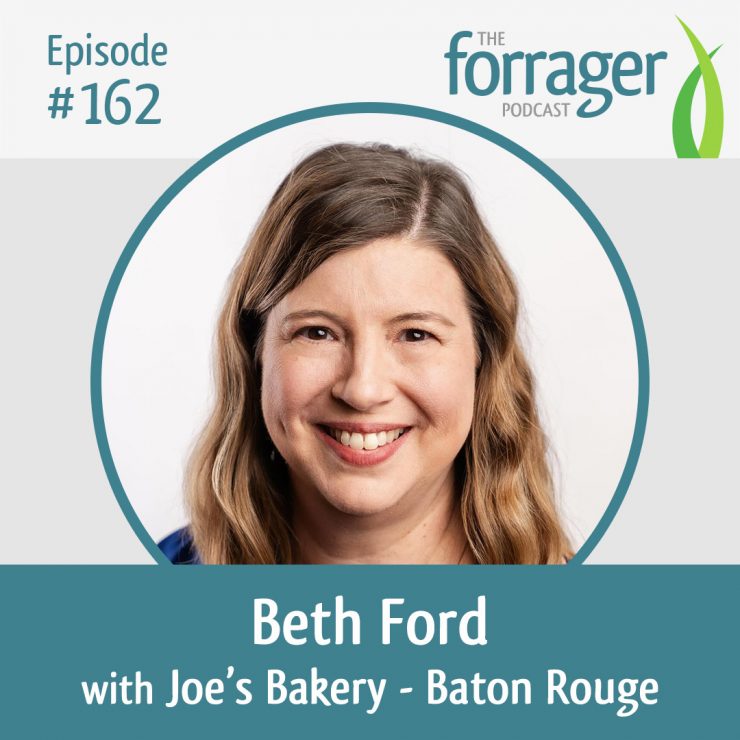
David Crabill: Welcome to the Forrager Podcast, where I talk with cottage food entrepreneurs about their strategies for running a food business from home. I’m David Crabill, and today I am talking with Beth Ford.
But first, we need to talk about email, and especially email marketing. If you are not sending emails to your customers on a consistent basis, then I think you are missing a big opportunity for sales.
I really love using Kit to manage email for my fudge business, and they recently introduced the best free tier that I’ve ever seen in an email marketing platform, which allows you to send emails to up to 10,000 subscribers for free. So if you still haven’t hopped on the email marketing bandwagon, now is a great time to do so. To get started and learn more, you can watch my free email marketing tutorial at forrager.com/email.
All right, so I have Beth on the show today. She lives in Baton Rouge, Louisiana, and sells pies, cinnamon rolls, and other baked goods with her cottage food business. Joe’s Bakery Baton Rouge. Beth always wanted to start a bakery, but it was actually her daughter who who inspired her to finally do it.
She started her business in the fall of 2020 and slowly built it with her daughter’s help. Last year she was able to quit her job in order to pursue the business fulltime. And although it’s been very successful, Beth’s business has been much more than just a way to make money. Her business journey has been deeply personal in helping her overcome grief, find peace, and invest in herself.
This episode really touched me and I know it’ll touch you too. So with that, let’s jump right in.
Welcome to the show, Beth. Nice to have you here.
[00:01:46] Beth Ford: Thank you, David. I appreciate it.
[00:01:49] David Crabill: Alright, Beth, can you take me back? How did this journey get started for you?
[00:01:54] Beth Ford: It goes back to COVID year of 2020. Still railing from the death of my father in 2018. The grief was compounded in 2020. My only child was to graduate high school that year. And, sorry, it just still gets me a little in the fields because I was gonna miss out on her graduating.
And she was not only trying to finish up on all of her high school courses and projects and last minute things ‘ cause everything shut down here in Louisiana March 13th like it did everywhere. In the country and she never went back to school. But anyway, she was trying to find outlets to help deal with her grief, still getting over the grief of my dad’s passing her grandfather.
’cause they were very close and she kept saying, mom, you love to bake. Why don’t we open a bakery? And I was still working full-time took a 30% pay cut just to keep the roof over our heads. And I, I just kept putting her off and by September of that year, I was getting frustrated and I needed a more of an outlet because I was just still so upset by how everything was playing out. With COVID and everything that she had missed. She was starting her freshman year of college remotely, which to me was I, I couldn’t wrap my head around that either. But finally she said, mom, just look at what I’m, I’ve been talking about. She did. She had been talking to me about it since probably May of that year.
And I finally sat down and I said, yeah, let’s do it. So she said, I have the perfect name. I wanna name it after papa, and I wanna name it Joe’s Bakery, which brought immediate tears to my eyes. And I said he would love that he was always the beneficiary of our sweets. when we would bake every holiday season and, he was our taste tester. He, He loved it. So I thought it was perfect. It was quite fitting, and I know he would be very proud of, that. So I, told her, yeah let’s pull the trigger on it and get going. And within by the end of October, I had everything set up, business license the name, everything, our LLC. It was quite an undertaking, but it came together so fast, and that’s just when you know it’s right.
[00:04:12] David Crabill: I know that it was your daughter, Kayla, who really inspired you to start it. Why do you think she was so driven to start this? Did she have any entrepreneurial background or anything? I mean, it’s not typical for a high school graduate to be encouraging their mom to start a business.
[00:04:33] Beth Ford: At the time she was going to be a, business major and she was like, I think this is the perfect thing. She had so many ideas and so that’s what helped spawn. It was just her business acumen and her taste of, wanting to see what entrepreneurial life is really about.
[00:04:51] David Crabill: I noticed that you mentioned you’ve always dreamed of opening a bakery, so this was not a new idea per se, right.
[00:05:00] Beth Ford: Correct. No it’s a dream from long ago. Even as a young adult, I had gotten married and I started baking a lot and I thought, I just wanna do this. But life gets in the way and as it usually does, and dreams get pushed to the side just for sake of you know, staying alive and, paying the bills. But I actually come from a baking background, even though I was not directly tied to it. My mother’s biological father was a baker and owned a bakery in the New Orleans area. I remember going to his bakery as a little girl and just remember how it smelled, you know, how it smells. Just bring you back to memories.
And I, I loved it, but I was never a part of it. I, I didn’t see him much, but I guess it’s, as they say in the blood in a roundabout way, it got passed down to me, I guess
[00:05:51] David Crabill: Why do you feel like it took you so long to actually commit to starting this and fulfilling your lifelong dream?
[00:06:01] Beth Ford: Self-doubt the need to succeed and pay the bills. I went through a divorce where I lost my marital home, and I know what that’s like, but I now have, a home of my own for the past 10 years, and it was always, I need to provide for myself and need to look at it for myself make sure you make enough money to pay the bills.
But just recently, last year in July, I quit my full-time job and have been focused on the bakery full-time. And it’s been life-changing to be able to put 100% of my efforts into me and my dreams and my goals for the bakery. So it was a bit of hesitation I guess it was, you could say it’s the sheer sake of security and now just taking the chance on myself is more important than anything else now at this time in my life.
[00:06:52] David Crabill: Well, it’s a little ironic that you started it in October of 2020 at time when possibly things were as insecure as possible. You had mentioned you took a 30% pay cut from your job, so you didn’t even have a total full-time income and obviously we’re in the middle of the pandemic and there was a lot of uncertainty in the fall of 2020.
Why did you choose that time? I mean, it sounds like it was just your daughter, right? Your daughters encouragement. I mean, that seems like probably one of the times when you’d have been least likely to start the business from a standpoint of what feels the most secure.
[00:07:27] Beth Ford: It was. It was due to her encouragement and she always has a positive outlook on things, whereas I’m more cynical. I guess that’s the age difference is showing. But I needed an outlet. 2020 was so heavy the past two years of my life up to then had been so heavy. And I needed an outlet, something that would soothe my soul, that would give me some sort of peace. And, you know, after talking to her in September of that year, I thought truly, there’s no time like the present, and you’ll never know unless you try. So that’s why I did it then. it was, it was a total leap of faith. And like you said, it’s one of the worst economic times that we’ve had in our nation. But I have stuck to it and I’m so happy with that. I did, and I’m happy that I took the chance even though I did need some prodding from her.
[00:08:17] David Crabill: Well, I know you’re a single mom, right? And you know, obviously you started this when she was going to college. I mean, Not in person, right? ’cause it was a pandemic, but still, she’s an independent adult by this time, right? That you’re starting. So certainly understand why you might not have started it sooner, but do you ever look back and think, man, what if I had started this business years ago?
[00:08:43] Beth Ford: Yes. Actually, I think what would’ve happened if I just started it earlier in 2020? Where would I be then? But I, you know, I can’t unring that bell. I can’t go back and, think about that. Uh, I can only push forward. I’ve had other dreams along the way that I’ve you know, checked off off my list.
And this was one of them that I’m glad I took the chance to and see if I could succeed at it. And so far, so good.
[00:09:06] David Crabill: Well, I’m just thinking about the people listening who, they have their own self-doubt. They’ve been thinking about starting a business for a long time. What do you think it was that allowed you to be successful?
[00:09:19] Beth Ford: There’s still a lot of self-doubt. A lot of people suffer with imposter syndrome where they think, I’m a fraud. I don’t, deserve this. I don’t you know, think I’m worthy enough to have this. But it’s, you truly have to push through all of the self doubt that you have and just focus on the hard work.
It’s not easy being an entrepreneur by any stretch of the imagination. Social media makes it look like you’re an overnight success. That rarely happens. There’s a lot of blood, sweat, and tears that goes into being an entrepreneur, but it’s all about believing in yourself and wanting to take a chance and succeeding.
There’s so much to be said, to work on something that’s solely your own. You have a sense of pride working for other people and the goals that you accomplish for another company. But when you accomplish those goals for yourself and for your own company, it’s a totally different feeling and a totally different sense of accomplishment.
[00:10:19] David Crabill: You say that it’s not easy, and I know it is not easy to start a business, but I also saw that you said that baking never feels like work to you.
[00:10:29] Beth Ford: It doesn’t, I could bake all day from early in the morning till late at night, and it never like, I’m, exhausted by the end of the day, but um, it’s not a drudgery, it’s not Good, Lord, when is this gonna be over? It’s always, I’m tired, but it’s a good tired, tired and look at everything that I created with my two hands. Just so people can enjoy. But it has never felt like work. They always say, find something that you love and you’ll never work a day in your life. And it that it’s the truth. And I never did understand that comment before or that statement, but I do now.
[00:11:04] David Crabill: It’s a good indication that you’re in the right field. So what is your. A background in, you know, ’cause you obviously have had another career up until, a year ago when you were able to quit and focus on this full time. You know, You had a whole other background. Right. So what’s your background in,
[00:11:22] Beth Ford: Uh,
I have a degree in mass communications and I’ve worn many hats throughout the years. I was a what’s called a pre-press operator. I was able to dissect graphic files and get them prepared for the, printing on the press. And from there I launched into graphic design and, wound up being the director of communications for a nonprofit organization, and I was there for 18 years.
[00:11:49] David Crabill: Do you feel like there was anything in your previous career that helped you start this venture?
[00:11:57] Beth Ford: Yeah. Being my own boss being able to achieve my own goals.
[00:12:01] David Crabill: You mean you like had a certain level of autonomy in your, previous career?
[00:12:06] Beth Ford: Right, you know, I ran the bakery was my side hustle for four and a half years. And sometimes it took the back burner to the full-time job and it did it a disservice. And uh, that part I’m, disappointed in, but, like I said earlier, you have to do what you have to do to get the bills paid. Now Kayla has gone on to living her own life as a functional, successful 23-year-old. And it’s time, to focus on me and my goals for the bakery. And I’m sad that I didn’t take the chance earlier, but I was in a position where I couldn’t.
[00:12:41] David Crabill: So let’s step back to the beginning of your business. You know, the fall of 2020. I know Kayla had this whole business plan that she pitched you, and you said it came together pretty quickly. So what did you actually do to get your business off the ground?
[00:12:57] Beth Ford: So I had to apply with our Secretary of State’s office. Started an LLC, started with the IRS, applied for our tax ID. I developed our, logo. So my graphic design background helped in that regard. I have a vision of how I wanted things to look. Brown boxes. Blue is our main color. It started out as Joe’s Bakery established 2020 as our name. I rebranded in February of 2024 to be Joe’s Bakery Baton Rouge. It’s more noticeable, less cumbersome.
[00:13:30] David Crabill: Can we talk about that real quickly? Because I did notice that you changed your business name and your initial business name was Joe’s Bakery established 2020 I mean, I don’t know any other business that put, established in the year they were established in their business name. Why’d you decide to do that?
[00:13:49] Beth Ford: We wanted to tie the two together, that we did start the business in 2020. We thought that was important, especially at that time.
[00:13:56] David Crabill: I thought maybe it was just ’cause Joe’s Bakery is such a generic name that there might’ve been some legal concerns with calling it just Joe’s Bakery. You know, like that name might’ve been not available in Louisiana.
[00:14:10] Beth Ford: There is, there is another, Joe’s Bakery that is quite popular in another state. we did not want to compete with them or like have trouble finding a domain name for when we started with our website. So, we did start with the Joe’s Bakery established 2020. but like I said, it just became cumbersome to use, especially to give out on, commercials or publications.
[00:14:36] David Crabill: Had you ever thought about just having, the official business name, the LLC, be Joe’s Bakery established 2020, but then just referring to yourself as Joe’s Bakery in publications.
[00:14:49] Beth Ford: Right now I have it as a doing business as, so I have, I Joe’s Bakery Baton Rouge falling under our LLC umbrella to also afford me the opportunity to branch into other forms of business. I just recently started a digital products part of Joe’s Bakery. It’s not yet under a different name just yet.
I’m waiting to see if it takes off. But I just recently started a few months ago. I’ve offered two recipes and a how to book for one of the recipes.
[00:15:21] David Crabill: Okay, so you. I’ve talked a little bit about the legal aspects of how you started your business, creating the LLC and creating the logo. What about when you started, you obviously had to come up with items to sell, products to sell a menu, etcetera. What did that look like?
[00:15:40] Beth Ford: We sat at the table and brainstormed over what we wanted to do. And just like some bakers just wanna offer everything. And at the time we did we offered a lot a lot that’s not on our menu anymore, just because you do have to wind up finding your niche and pairing things down. the only thing that we’ve never truly offered are cakes. I don’t have the counter space and they are not one of my favorite things to do. But we offered a variety of cookies, a variety of cupcakes and then just a few specialty items. The menu has now morphed into today.
We no longer offer cupcakes. there’s one staple cookie on the menu. During the holidays we may offer one or two others, but those are seasonal items. And then we’re focusing on specialty items like king cakes, pie bars, muffins and cinnamon rolls.
[00:16:38] David Crabill: So it’s interesting I, recall that cupcakes were one of your primary items that you started with, and now you’ve basically shifted completely away from them.
[00:16:47] Beth Ford: Yes. For some reason they were not one of our best sellers. it all comes down to numbers. You always have to see what is more beneficial to the business. And for some reason, cupcakes weren’t doing it for us anymore. In the beginning, they were. We had even partnered with one of our local movie theaters and we offered cupcakes in the movie theater to give in the concession area to give people you know, another choice of concession, that they could enjoy while they were watching a movie.
But that partnership ended and we really didn’t get a lot of feedback or positive feedback from the cupcakes since
[00:17:29] David Crabill: Well, I’ve noticed the same thing. I think cupcakes just are not popular right now. I actually haven’t heard of any businesses doing really well with cupcakes in recent years. So I think it’s just one of those trend things,
[00:17:44] Beth Ford: If you’re not doing like over the top cupcakes. We offered basic cupcakes. They’re all from scratch. Everything in the bakery is from scratch. But that’s what we offered were basic cupcakes. they weren’t over the top. They weren’t like the cookies and cream and lemon blueberry, and or filled cupcakes.
I know that’s a lot of what people are looking for. They’re more high end type products, but that’s not what we were offering.
[00:18:10] David Crabill: So your menu has changed and largely paired down due to demand and numbers. So what have you found has been working really well?
[00:18:21] Beth Ford: Our cinnamon rolls and our pies. Our cinnamon rolls I’ve taken off. Last year I added banana bread, cinnamon rolls, and those are also a big hit. Our pies at the holiday time are also a big hit. I do a Dutch apple pie that now this is a recipe that I have perfected and put my own spin on for at least 25 years or more.
Starting from making my own crust and then tweaking recipes and toppings to emulate the dutch apple pie that I grew up eating, which was from Mackenzie’s Bakery in New Orleans, their Dutch apple pie was to die for, and I’ve tried to replicate it as close as I can, but It’s never gonna be replicated.
[00:19:07] David Crabill: I also noticed that you sell perishable baked goods like cheesecake and cream pies, which Louisiana is very unique in allowing those items. So it’s cool to see someone taking advantage of that. That’s still something you sell, correct.
[00:19:23] Beth Ford: Absolutely. I have one going out Friday. Last year, in my quest to continue doing everything from scratch I obtained a recipe from a fellow baker in Texas for his grandmother’s vanilla wafer recipe. And he is allowed me to use it in my recipes now. So I make all of my vanilla wafer crusts from scratch and now I make all of my graham cracker crust from scratch. So my chocolate cream pie is the only one that has the vanilla wafer crust. my coconut cream key lime and lemon meringue all have my graham cracker crust. And I didn’t think you could taste the difference, but you can.
[00:20:04] David Crabill: And what have you learned about the cottage food laws in Louisiana? Was there anything that you had to do in order to start selling?
[00:20:12] Beth Ford: Not really. There’s just a lot of things that you have to, take into account. Case in point, a few weeks ago, a client he wanted to order king cakes and have me ship ’em. Well, Cottage law in Louisiana doesn’t allow me to ship he bought the king cakes and shipped them himself, and he, he even said, it’s a shame that you, you can’t ship. I’ve gotten numerous questions just this year alone, if I could ship out of state. And uh, my comment is, according to cottage law, I’m not able to ship at this time. It’s something that I hope the Louisiana legislature will change Eventually
[00:20:48] David Crabill: Well, now over half of the states do allow. In-state shipping at least, and so it’s becoming more common. Hopefully Louisiana will hop on that bandwagon at some point. But I did notice that you offer delivery and your website prevents people from ordering if they’re not within Louisiana. How did you set that up?
[00:21:13] Beth Ford: I designed my website through WordPress and through the e-commerce plugin that WordPress uses is called WooCommerce. You have to go in and set up the zip codes so that you can only order within the state of Louisiana. So it’s all about the settings. And that plugin,
[00:21:32] David Crabill: Alright. Yeah I, used to be a WordPress developer, developed multiple WooCommerce sites and I will say, not for the faint of heart. Clearly you’re more of a tech savvy person and not something I would recommend to most people. But you, so you, do you have any kind of developer background or something?
[00:21:51] Beth Ford: I think it was 2012. With having just a graphic design background at my full-time job, we needed our website updated. they wanted a new look. And I told my boss at the time I don’t know anything about HTML.
I know nothing about websites. I learned by trial and error and I revamped two websites for them. . And then everything that I learned developing two websites in WordPress for the full-time job, I was able to develop our website in WordPress in. Short amount of time, and it’s, morphed over time into what it looks like today.
[00:22:31] David Crabill: Still generally not recommended for your average cottage food entrepreneur. Yeah.
[00:22:39] Beth Ford: Everybody says, you know, as a, cottage food entrepreneur you wear many hats. You’re the accountant, you’re the, baker or you know, food preparer. You’re the scheduler, you’re the social media guru. But yet not a lot of people wear the website developer on that as a hat as well.
[00:22:59] David Crabill: If you could think back to your first year in business, you know, this would be mostly in 2021, how did that go? what worked well? What were the challenges? What do you remember from that first year in business and, and the holiday season of 2020?
[00:23:18] Beth Ford: The holiday season of 2020 was crazy. We were very busy, even started so late in October. We were busy Thanksgiving and Christmas. Mainly family and friends who were supporting us. We did we did a lot, a ton of social media. Instagram at that time was. More of a social event than it is now. And it was so much easier to get the word out.
And I had other people from around Baton Rouge reaching out to, order from us. And at the time, you could only order from, we did not have a website. We would post a, a menu on you know, a social media ad and people would call and order that way or drop us a direct message. But 2021, from what I, I’m recalling, was a little slow after the holidays just trying to get momentum, trying to stake our claim in Baton Rouge. And that’s. That actually still carries on to today 2026. It’s still hard to stand out sometimes, but back in 2021, I hadn’t done any pop-up events because I was so new.
People didn’t know who we were. Our businesses didn’t know who we were, so it was hard going in 2021.
[00:24:32] David Crabill: How about this? Were there times that you can remember back in your first year where you were thinking like. Maybe it wasn’t the best idea to start this business, or uh, I don’t know if I gotta keep going.
[00:24:46] Beth Ford: No, I never had that. Like I had referred to earlier though. Unfortunately, sometimes the full-time job took precedence and the bakery took the back burner. So I really didn’t dwell on it as much as I would today.
[00:25:02] David Crabill: Sometimes people that have this lifelong dream, and especially, you know, in the middle of a pandemic, everything’s up in the air they consider just quitting their full-time job entirely and just going all in on the business. How do you think that would’ve gone cause it’s obviously very hard to start a business while you’re still in a job.
And you’ve now obviously made that transition over to quitting your job and, focusing on this full time, but what do you think it would’ve looked like if you had done that from the beginning and just jumped both feet in?
[00:25:40] Beth Ford: I think I looked at the political climate and the economic climate and. Just my economic state at the time and said it’s not something that I can do. It was something that I wished that I could have done. The stressors of the full-time job definitely were taken its toll just from having the 30% cut in salary alone.
And in 21 we did go back to getting our full-time salaries, but it’s still all about paying the bills. I wish I could have done it. I wish I could have put both feet in and, done it at the time I just couldn’t, that at that time for me, , that would’ve been too radical.
[00:26:17] David Crabill: Well, looking back, what do you think you would’ve needed in order to make that possible? Do you feel like you would’ve had to have a certain amount of money set aside? Do you think it would have been possible to do, like how long do you think it would’ve taken you to get to where you are today if you had been able to focus on the business full time from day one?
[00:26:41] Beth Ford: I think it would be totally different. I think I would be at a different place altogether. It’s hard to come by just finding grants for businesses like, mine. Just to help you get going in a small business loan at right at that time was not advantageous and would not have been advantageous for me.
But it, it, I think my place in Baton Rouge would be totally different than it is right now. Had I been able to, like you said, devote a hundred percent of my time to it than splitting my time between the full time and then having my side hustle, be the bakery.
[00:27:19] David Crabill: I noticed that you started the business with $200 of money from a private investor. That’s what you said, which is not typical to have seed money. In the order of a few hundred dollars. So how did that come about? I mean, that’s, not something I usually see.
[00:27:40] Beth Ford: I won’t divulge who that was, to keep their anonymity intact. But it was someone who believed in us. They did it to help us just get started with inventory. We had to order stickers and boxes and everything just to get our projected orders, the orders that we dreamed of that would be coming in just to get those out the door.
‘ cause remember at the time we didn’t know if anybody would order from us. We just took the leap of faith that they would. And we had a lot of family and friends who truly supported us. In the beginning. They were our taste testers. They would tell us which ones that they liked and didn’t like. We would convene different panels, different friends.
They were never the same. and I, I still do that today. If I come up with a, a new recipe or a new way that I wanna offer something, I send it to different people whose opinion I, highly value. And they give me the feedback that I, they don’t sugarcoat it. I don’t want ’em to sugarcoat it.
I want them to shoot it to me straight. the $200 in seed money was an actual blessing at the time?
[00:28:45] David Crabill: Well, I’m sure it was helpful to have a couple hundred dollars to help jumpstart the business. What if you didn’t have that money to start? Do you think it would’ve changed the trajectory of your business?
[00:28:57] Beth Ford: No, I think I would just would’ve put it on credit at that time. It would’ve been a credit card purchase. A credit card investment that I would’ve eventually paid off.
[00:29:08] David Crabill: Yeah, a little bit more risk.
[00:29:10] Beth Ford: Absolutely.
[00:29:11] David Crabill: Did it feel risky to you to start the business?
[00:29:15] Beth Ford: Yes. Anytime you take a chance on yourself, there’s risk. Nothing’s ever a guarantee.
[00:29:22] David Crabill: But I mean, you still had your job, right? You still had this income, so what felt risky about it?
[00:29:31] Beth Ford: I’m not used to failure. I was never the child who had to have their parents on or to, you have to make good grades. You have to do this, you have to do that. I did that internally on my own, so I’m not, and anytime I did fail or. Not live up to my own standards. I was very disappointed. So in life it’s made it more difficult, especially being a business owner.
’cause I don’t take wells of failure. I get very down on myself and just have to remember it’s just a bump in the road and keep going.
[00:30:04] David Crabill: What’s a failure that. You carry with you, that is particularly memorable for you.
[00:30:11] Beth Ford: My divorce, I took very personal and I took it as a failure. It was something that I had worked hard at and it didn’t pan out and I was not used to that. That was a major one.
[00:30:24] David Crabill: What do you think you learned from that?
[00:30:27] Beth Ford: The sun always comes up tomorrow, and it’s a chance to start a new one. Even though defeat is temporary. That’s all it is, is temporary. it shouldn’t be life changing. You shouldn’t dwell on it as much. You should just pick yourself up by the bootstraps and keep on. Welcome.
[00:30:44] David Crabill: Do you feel like your internal drive to always succeed is part of the reason why you have succeeded at your business? Like Do you feel like you needed to have that internal drive to not fail in order to keep going?
[00:31:00] Beth Ford: Yes, 100%. Because it’s hard to sit in a business and not compare yourself to others and to see the successes that they have, but you also don’t know what they have gone through to get to where they are. And it’s hard to not compare yourself. So it’s truly putting your head down, focusing on yourself, and striving to be the best that you can and offering the best products that you can and something that you believe in that the public will love and appreciate. I wanna be able to bring people like the tastes of home to ’em, taste that they may have grown up with memories of their grandparents or even their parents, just in one bite of our faked goods. I like to say it, we’re spreading happiness one bite at a time, and that, that’s what’s important to me just to keep my focus on, my bakery and making it the best that it can be.
[00:31:51] David Crabill: So what I’m hearing here is a lot of persistence. You’re a very persistent person. You don’t give up. What else do you feel like worked particularly well or allowed you to be successful over the last few years?
Is there anything that you feel like worked well? Like when you’re doing it, you’re like, wow, this is really working.
[00:32:12] Beth Ford: I joined an entrepreneurial community. About three years ago and with Chef Amanda Schoenberg, she has taught me a lot. I’m still going through the community. I’m still a part of it. We have monthly calls and we’re able to voice our wins and her losses. And she just has a way of encouraging you and of saying Yeah.
You know, and, and just being really honest and blunt and saying, yes, that didn’t work, but it’s okay. You tried it. Get up and go, do, try something else. And that’s sometimes that’s the kick in the pants that I truly need. I don’t think that I would be where I am without the entrepreneurial community.
I’ve really. Her most famous line, and I like to say this back to her, is, closed mouths don’t get fed. And she is 100% right. because of that, I put myself in positions where I don’t think I belong and I know I don’t belong, but I’m gonna put myself in that room just to get recognized because I want my bakery to succeed.
I want people to know who Joe’s Bakery, Baton Rouge is. I want it to become a household name and know why it was started to begin with because of, one man the constant in my life for 45 years and for, you know, done everything is baked in his honor.
[00:33:29] David Crabill: I just wanted to pause for a quick moment to talk more about Chef Amanda Berg’s entrepreneur community. I can’t think of a better business coach than Amanda, and as you’re hearing from Beth, her guidance can help you take your business to the next level. I have personally reviewed her community portal, and I must say it is the real deal. It’s community plus content plus coaching, and in my opinion, it’s worth far more than what she’s charging. To learn more about Amanda’s community, go to forrager.com/amanda. Now back to the episode.
[00:34:10] David Crabill: Chef Amanda was on the show three years ago on episode 80. You won’t be surprised to hear. I consider it to be one of the best episodes ever. And so I love Amanda. She’s always inspiring. and you mentioned that she’s encouraged you to put yourself into uncomfortable positions. What’s an example of that?
[00:34:33] Beth Ford: Last year I wanted to be part of uh, fundraiser brought on by the American Cancer Society in Baton Rouge called Fort Cancer. And I tried and tried and tried to be a vendor at the event. and I, I tried for months and they wound up telling me that they, they were full, they didn’t have any spaces remaining.
But they would put me on the 2026 vendor list and I would be one of the first people contacted. So I was busy preparing, actually loading up for another popup event that I was doing at a local school. And baker friend called me and said I didn’t know you were doing the cancer event.
And I said, I’m not. she said yeah, you are, your name is on the list. So I thought it had to have been a mistake. There’s no way. They told me it was gonna be 2026 before I could participate. Sure enough I checked my email. I had gotten the confirmation email saying that I was officially a vendor for, cancer.
And in May of last year, I was there, I was at the event. It meant a lot to me. In the final weeks of my dad’s life, we found out he had cancer. He had stage four cancer, and I was able to put a picture of him on their honor wall. So he was there with me in spirit as well as in his, picture at the event.
And it’s, one of my successes from last year. And it’s something that I’ll, I’ll never forget when you hear people tell you that, you know, God has Played his hand and you can see it play out in your life. That was 100% it. ‘Cause it was something that I, I didn’t expect and I was able to, to honor dad.
I offered our pecan pie bars as one of our offerings and just able to participate in an event that I really wanted to. So that meant a lot.
[00:36:23] David Crabill: What was it about that event that felt uncomfortable for you to apply to or to attend?
[00:36:30] Beth Ford: It was my first big event to ever apply to be a vendor. There were gonna be thousands of people there. I had never been in front of thousands of people. I had done what’s called a white light night the year before, which is a, a street vendor event the week before Thanksgiving.
And it’s very popular. And I did very well at it. So this was the chance to really be seen on a, on a bigger stage. Did I belong in that room? I don’t think so, or I didn’t at the time, but once I got there, I saw 100% I belonged there and I’m so glad that I took the chance on it.
[00:37:07] David Crabill: Well, they asked you back right?
[00:37:10] Beth Ford: Absolutely. I’ll be there in April.
[00:37:13] David Crabill: How did that event go?
[00:37:15] Beth Ford: It went well. A lot of people liked the pecan pie bars. It’s one of our best, biggest sellers. I haven’t decided what I’m doing yet this year, my offering for this year, but it was good exposure. Met a few fellow women entrepreneurs and fellow bakers as well. It was a great place to network make connections.
And one of ’em, has offered to have me come do a pop-up at their, they have a brick and mortar store. So hopefully I will be able to take them up on that in the coming weeks.
[00:37:48] David Crabill: So you mentioned you initially did a white light night event, which I saw you had applied to twice and were rejected before you actually got accepted. So that’s another example of persistent. And then that helped you grow into this cancer event, which was very large. was it these events that helped grow your business to the point where you could quit your job?
Or was it something else? Like what allowed you to actually become so successful that you were able to think about quitting?
[00:38:20] Beth Ford: It’s that and just the stage of life that I’m in right now. They say right now, women in their fifties, and I’m not, not ashamed to say that I am a woman in my fifties who they’re taking up a lot of the entrepreneurial space right now because they have reached a point in their life where it’s time for them. And that’s where I am now. It’s time for me. my daughter is grown.
She is living her life, living her best life, and it’s time for me to live mine.
[00:38:48] David Crabill: So if I’m hearing this correctly, you didn’t necessarily have. The sales numbers to justify leaving. You are taking a bet on yourself. [00:39:00] And that is another example of something you did that probably was quite uncomfortable.
[00:39:05] Beth Ford: Yes, it requires a lot of personal growth. 100%.
[00:39:10] David Crabill: Well, What was it like, you know, you just, you quit. I’m sure there was some emotions there. Take me through that experience.
[00:39:19] Beth Ford: I had gotten to the point where I had outgrown the position that I was in. It wasn’t I wasn’t fulfilled any longer and it was easier for me to go to transfer to something that did fulfill me. I was getting busy and, and busier last year. Out of the 12 months I had surpassed what I had made the year before in every month except for three.
I saw my business starting to just tick up and I didn’t wanna leave it on the back burner anymore. I said, if this. Trajectory is continuing. I’m not gonna be able to put in my all at the full-time job at the capacity that they wanted me to and devote what I needed to my business. So it came down to what meant more to me and 100% my business meant more.
[00:40:04] David Crabill: So when you left your job, obviously that opens up a lot of time to focus on your business. Where did you put that time?
[00:40:14] Beth Ford: I I covered the modules that I had not covered in my entrepreneurial community. I did start like I said, on the digital products formulating those. I went through all of that training as well. In October alone last year. I believe I was at six different events just in that month.
I was very busy. The holidays were busy, which was a blessing. And I continue to be that way. But I have focused my efforts on my training, like I said, in my entrepreneurial community and just growing in different ways. I’ve started with affiliate marketing as well, just trying to generate different forms of income alongside the digital products and baking full-time,
[00:40:57] David Crabill: Which of the things that you have focused on since going full time have paid off really well?
[00:41:05] Beth Ford: The baking full-time. I’m still trying to get my footing in the affiliate marketing programs. But they will get there. I’m positive of that. That just takes time, as does the digital products, the digital product world.
[00:41:21] David Crabill: Yeah, and I would agree. Anything correlated to passive income, which is what, selling digital assets or doing affiliate marketing would be passive. Anything like that is going to have a much longer time horizon.
[00:41:35] Beth Ford: Absolutely.
[00:41:37] David Crabill: So it sounds like on the baking side of things, you put a lot more time into events once you went full time.
[00:41:46] Beth Ford: Yes. I was able to do it. I was I didn’t have to juggle, taking time off and, rearranging work. At the full-time job to, in order to do events for the bakery,
[00:41:58] David Crabill: And what kind of events do you find work well for your business?
[00:42:03] Beth Ford: I have participated in more community events. Last year I did the Ultimate tailgate that’s sponsored by Sweet Baton Rouge. That’s held at Perkins Road, which is a one of our high-end shopping centers. helps to kick off football tailgating season. And at that time I started with cookie cakes. I started Cookie cakes earlier last year, I brought one to this event and it was in October and I sold out a, that cookie cake and nothing flat. And I sold it by slice. Just continuing to participate in community events. More people find out about me, other businesses or other events, find out about me from those and reach out to want me to participate. It’s just all about being seen and the more you’re out there in the community and giving back the more chance you are at getting seen.
[00:42:55] David Crabill: And I know you’ve done custom orders as well. I mean. How do your sales breakout? how many of your sales come from events or popups? How many come from people ordering off your website? How many come from doing events or custom orders? Where do your numbers land?
[00:43:17] Beth Ford: My numbers land a lot from the website. But la thinking about it last year let’s case in point May of, 2025, I had done a, a cookie cake for a lady for her child’s birthday party. party from that one cookie cake and the people who were at that party, I got three other orders. It was amazing. That had not happened to me before that I got subsequent orders off of just somebody’s having one of my goods, baked goods at a party.
I had never experienced that. And these people have ordered from me since. when I have done community events, it depends on the time of year. Like when I did white light night back in 2024, I sold out of everything, but I think five items, and I think that was muffins. A few muffins I had leftover, but my pies I, I had two pies.
Those went, my pecan pie bars sold out. And I, I find that trend at different popups where different things sell out and other things don’t move at all. But I would say right now where I am, the majority of my business is going by word of mouth and then ordering through the website.
[00:44:28] David Crabill: Do you know what percentage of sales you get through the website?
[00:44:33] Beth Ford: Oh, yeah. I mean, It’s at least 75% of my sales are through the website. Some people reach out, still do DM me through social media or I am part of a barter company in Baton Rouge like a trade organization. I do get business from them as well from other businesses, but that’s, probably about 25% of it.
[00:44:55] David Crabill: That’s not typical to have most of your sales coming from a website. So do you perceive the events to be kind of like marketing an outreach to get those individual orders?
[00:45:10] Beth Ford: Absolutely.
[00:45:12] David Crabill: And of the people who order from your website, how many of those are pickup versus delivery?
[00:45:19] Beth Ford: And I’ve never run the numbers on that, so I really can’t tell you, off the top of my head, that’s not a report that I’ve ever done.
[00:45:27] David Crabill: Well, do you do a lot of deliveries?
[00:45:31] Beth Ford: Usually at holiday time, I turn them off because I’m not able to leave the kitchen. So most, I would say then by going by that most of my orders are pickups.
[00:45:44] David Crabill: And when people are ordering off your website, are they typically just ordering like one item? Are they typically ordering. For the week. Are they ordering for events? what kind of orders do you get from your website?
[00:46:01] Beth Ford: Summer for events. I have a standing order with a company for their board meetings. I do ’em every month. So they order for their meetings every month. Everybody else is usually, oh, I need stuff for a party, or I need cinnamon rolls for, breakfast on Saturday. It’s a combination of the two.
[00:46:21] David Crabill: Now I’ve noticed that you definitely run like pre-orders, right? For Valentine’s Day or Mardi Gras or Thanksgiving. So, do you feel like most of your sales come off of those pre-orders or do most of your sales come from people just ordering at random times?
[00:46:42] Beth Ford: Most of my sales come from the pre-orders. And then I’ll have, one or two people through social media who will reach out and say, how do I order X? And I’ll send them the link and then they’ll order. But pre-orders is absolutely the, the way to go.
[00:46:56] David Crabill: I wanted to ask you about social media. I noticed that you kinda recommitted to social media back in 2024.
[00:47:05] Beth Ford: Yes,
[00:47:07] David Crabill: How did that go?
[00:47:09] Beth Ford: My business started to uptick in 2024. It was at the end in September of 24 that I really started investing in myself and realizing. For me to achieve the happiness that I wanted in my life, I needed to make a change and recommitting to being seen on social media was, it was paramount. I knew I needed to do it. and one of the hardest things to do is to get your face back out or show your face. And Chef always tells us that people need to know who you are.
They don’t buy from a name, they buy from a person. They need to see who you are. And I really started doing that and just putting myself in front of the camera and started selling.
[00:47:50] David Crabill: So do you feel like it paid off?
[00:47:52] Beth Ford: Yes.
[00:47:53] David Crabill: So what specifically did you do? I mean, You put your face out more, you shared your story more. What kind of commitment was required to make that transition?
[00:48:06] Beth Ford: It’s never easy to put yourself out there. And it’s all a gamble, but consistency is the key. Learning social media algorithms is also not for the faint of heart because they keep changing them almost monthly. So I just try and keep up with consistent posting. At the end of last year, I really took a, gamble, and it’s something I had said that I would never do, but I was like. What the heck, let’s just give it a shot. And I started a TikTok account for the bakery, and it’s still growing. I still have things that I wanna do with it, but I, I’ve been so busy, I really haven’t had time to, commit to doing those things yet.
[00:48:46] David Crabill: I noticed somewhere you mentioned last year in 2025 you struggled on social media and this would be after you, you recommitted to social media and, felt like it paid off. So what do you feel like was difficult about social media last year?
[00:49:02] Beth Ford: Last year was all about algorithms. I had that the same issue at my full-time job. They kept changing everything. It’s hard to be seen. Even with consistent posting some things fall by the wayside, but once you start learning how to read the data, and Instagram and Facebook are really good at giving you the data of when you should post, when you should offer things or interact with your audience.
And shooting for those times to post, that’s the most important. People wanna see things come together. They wanna see you bake something, they wanna see you fill a king cake, or roll cinnamon rolls. They wanna see you decorate cookie cakes. So it’s more about interaction and trying to give the people what they want and trying to beat an algorithm at the same time.
[00:49:50] David Crabill: Everyone’s experience with social media is different based on where they live, what they sell for you. What were some of the specific things you noticed with the algorithm that you were able to change that helped improve your reach on social media?
[00:50:08] Beth Ford: Putting my face on there, I never thought that would truly do it, but putting my face on there, showing me doing something. It’s one thing to have a video of just your hands doing something, but when you have it, of the rest of your body in the video as well. And I mean, it’s hard to be the one woman show and setting up the ring lights and, and everything just to set your camera just right to get the perfect angle. But one of the other things that I hope to do is provide people with content that will help them at the holiday season. I did a pie safety guide because, you know, with OAL and Bustle of the holidays, you just, you kind of forget how old is that pie and can I still eat it? ’cause it really looks good. I hope to provide my audience with more beneficial videos.
[00:50:54] David Crabill: So you have been going full time for over six months now, I believe. So looking ahead, what are your goals for the future?
[00:51:07] Beth Ford: I wanna continue to grow. Joe’s Bakery, Baton Rouge into a, a household name down the line. A brick and mortar store sounds nice on paper, but I would like to keep it in-house as long as possible.
[00:51:19] David Crabill: So say within this year timeframe, where do you think you’ll be a year from now?
[00:51:27] Beth Ford: I’ll still be baking in my kitchen. Hopefully I’ll have an additional oven because I’m still just focused baking everything with just my kitchen oven. I hope to have the funding to be able to provide for an another oven, which would alleviate some baking scheduling conflicts.
[00:51:45] David Crabill: So you ran the business for four years with your daughter Kayla, as a co-owner she’s graduated from college and you’ve taken full ownership of this business and venture. Now, is she still involved in any way?
[00:52:03] Beth Ford: I’ll bounce ideas off of her, but for the day to day minutia, no, she’s not.
[00:52:10] David Crabill: As you think back on your business journey, are there any stories or orders that stand out to you? Anything that’s particularly memorable.
[00:52:22] Beth Ford: Last year I saw an event that was coming up that was gonna be hosted at on ls, U’S campus at Tiger Stadium. It’s, uh, for Baton Rouge Orthopedic Clinic. And I asked a, a my physical therapist actually, who works for them, and I said, any idea how I could get involved in that? And he said yeah, I’ll shoot you the name of the person who, who has that up.
So. I contacted her and went and had a meeting. I brought samples of my work and brought little goody boxes for her and the marketing director. And a few weeks later they hired me on to do their, the catering for the event And I’ve been in, invited back again this year [00:53:00] to provide the suites for their event in August.
And I’m very proud of it. it’s just another example of something that if I go after it and I put my all into it and I get it, I’m just gonna make sure I stand out. And from that event I’ve gotten another catering event for another foundation. Coming up in, in April, for something that I, believe in is for suicide prevention and I am thrilled to be given the opportunity to provide the suites table for that event as well.
[00:53:31] David Crabill: So your daughter inspired you to start the business. I know she. Amanda has inspired you as you’ve grown your business. You have an opportunity to inspire someone right now. What would you say to somebody who’s thinking about starting their own cottage food business?
[00:53:50] Beth Ford: I would tell them that everything takes time, but the investment in yourself is never one that you will regret. It requires a lot of hard work and dedication, but if you believe in yourself, you can get anywhere and you can do anything. So take the chance on yourself.
[00:54:08] David Crabill: As you think back on the last five or so years, what has this business journey meant to you?
[00:54:17] Beth Ford: It’s afforded a lot of personal growth. There have been a lot of bumps and bruises along the way, but brings me so much peace. Still to this day. It soothes my soul to stand over a pot of, pastry cream that I make for pies. It still feeds muscle and that’s what’s the most important. If it didn’t, I wouldn’t do it anymore.
[00:54:38] David Crabill: I know you started it kind of as a way to get over grief, the grief of your dad passing, the grief of your daughter missing out on some experiences like her high school graduation. Do you feel like it’s given you that?
[00:54:53] Beth Ford: Yes, grief always comes in waves. It has helped in dealing with all of it. I’m not saying that some days still doesn’t bring you back to that time because it does. But that’s just the funny way that that grief comes at you. As a human, everybody experiences it. That it lessen, it helps lessen it.
Some dad’s anniversary, the anniversary of his passing was last Tuesday. It’s never easy and sometimes it, feels like it just happened. But the day-to-day operations, I know he would be so proud that his name appeared on a bakery. I just think he would be so proud of how far it we’ve come.
[00:55:39] David Crabill: Well, Beth, thank you so much. If people would like to learn more about you, where can they find you or how can they reach out?
[00:55:48] Beth Ford: Our social media handles are @joesbakerybr. And our website is joesbakerybr.com.
[00:55:56] David Crabill: Awesome. Well, thank you so much for coming on the show and sharing with us today.
[00:56:01] Beth Ford: Absolutely. Thank you so much, David, for the opportunity.
[00:56:07] David Crabill: That wraps up another episode of the Forrager Podcast.
For more information about this episode, go to forrager.com/podcast/162.
And if you feel like you’ve gotten a lot of value from this podcast, I have a to ask you could you take a quick moment right now and leave me either a review on Apple Podcasts or a rating on Spotify. It’s truly the best way to support this show and will help others like you find this podcast.
And finally, if you’re thinking about selling your own homemade food, check out my free mini course where I walk you through the steps you need to take to get a cottage food business off the ground to get the course, go to cottagefoodcourse.com.
Thanks for listening, and I’ll see you in the next episode.