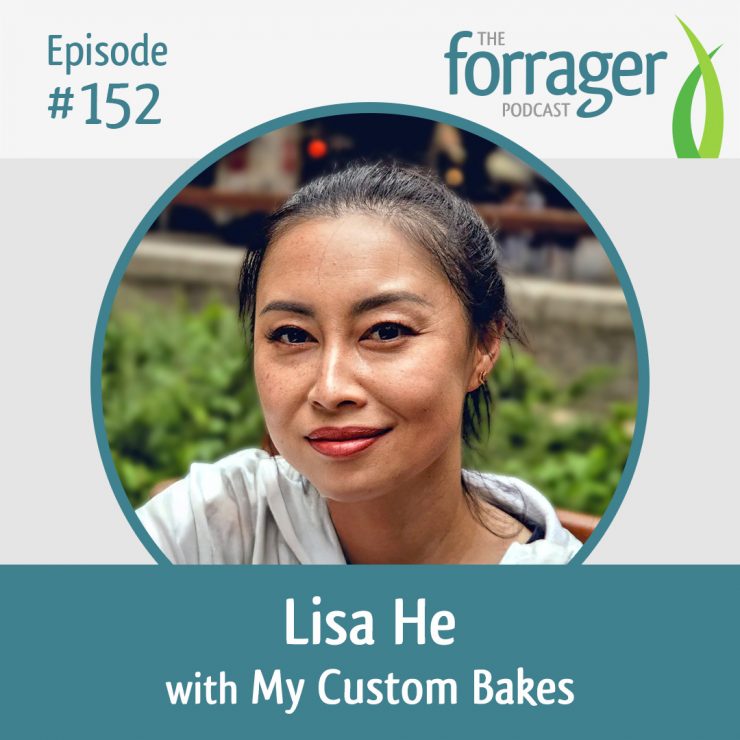
David Crabill: Welcome to the Forrager Podcast where I talk with cottage food entrepreneurs about their strategies for running a food business from home. I’m David Crabill, and today I am talking with Lisa He.
But first we need to talk about email and especially email marketing. If you’re not sending emails to your customers on a consistent basis, then I think you’re missing a big opportunity for sales. I really love using Kit to manage email for my fudge business, and they recently introduced the best free tier that I have ever seen on an email marketing platform, which allows you to send emails to up to 10,000 subscribers for free.
So if you still haven’t hopped on the email marketing bandwagon, now is a great time to do so. To get started and learn more, you can watch my free email marketing tutorial at forrager.com/email.
Alright, so once again, I have Lisa on the show today. This is the second part of my conversation with her.
If you haven’t listened to the first part yet, you can go back to the last episode and check that out.
In the last episode, Lisa shared how she started and grew her cottage food bakery. And in this episode, she shares a lot more social media tips and also how she turned her cottage food bakery success into multiple businesses that help support other cottage food bakers.
And with that, let’s jump right into part two of my conversation with Lisa.
Well, we do have to talk about Instagram. You’re the Instagram expert, I know you’ve got 175,000 on one account. You have more accounts than that, which have thousands of followers. So let’s just start with, what are some of the top things that you’ve noticed that have helped you grow to level?
[00:01:44] Lisa He: I think at the very foundation of all of this, you have to be authentic and genuine as you set out on this journey because people can feel that, and this is a generalization, right? This is not every single brand, but I really, really believe if you are genuine and authentic and you put out content that sounds like you, and you do it with good, positive energy, people will resonate with that and come to you.
So when I was building my Instagram, or when I became intentional about building my Instagram, my first goal was. I thought about the people that were following me. And at the time I had a good mix of people who were learning how to decorate cookies as well as other cottage bakers and people who wanted to just buy cookies.
So keeping those three demographics in mind, I thought about what kind of content would be highest value to them. If I were in their shoes, what kind of content would I want to see? And is that type of content something I wanna create? I really like creating educational videos, how tos, sharing my techniques, sharing where I get [00:03:00] products, sharing how I package things, sharing my process.
So a lot of that resonated with people who were learning and people who had their own cottage food businesses. And every once in a while, even the people who were there just to buy cookies found the process incredibly fascinating. So they stuck around and watched. And because they saw how much work went into everything, my customers, at the end of the day, they became more educated through this process and they develop a greater appreciation for the art and the process, which kind of encouraged them to buy it too.
So I was able to satisfy my audience with my content, and I was able to do it consistently, which I think is one of the key components of being successful in social media right now. With the, the algorithm the, the whole landscape of social media has changed so much in the last 10 years we’re, we’re in 20, 25, 20 15.
Instagram was a very different thing. And now consistency is still king. However, with your ability to post, you don’t have to post every single day, but if you can get on some kind of predictable schedule, the algorithms pick up on the fact that you are a reliable, consistent creator. And if you can demonstrate that for kind of longer ish period of time, a couple months, then you will start getting in front of eyes of new people.
So my advice to people is always be authentic. Create content you want to create. Consider the audience that you’re creating for, and also be as consistent as you can and get on a schedule that you can commit to.
[00:04:50] David Crabill: Is posting consistently once a week enough.
[00:04:55] Lisa He: It depends. Also for Instagram, in the old days I used to post consistently two to three times a week on my feed. But I would post stories every day because stories were very low lift, not, really formal or risky in, most ways. And that got me really good results. And that was just for Instagram.
On YouTube it’s a slightly different thing and on TikTok is a slightly different thing. But if I were creating for Instagram today, I don’t think once a week is enough, if you’re not doing anything else in between. So if you post it on your feed once a week and you created stories every day or every 24 hours, I think that’s enough. but it also depends on your goals. So if your goal is I need to get out in front of as much people as fast as possible, I think posting more frequently can be more beneficial. ’cause it just raises the odds of you being seen.
[00:05:56] David Crabill: Is there such a thing as posting too frequently?
[00:06:00] Lisa He: Ooh, this is kind of a, a touchy topic for some people because I’ve gotten feedback where people are like, oh my God, this person posts like eight times a day. This is so annoying. I don’t wanna see your posts anymore. I’m gonna put them on silent. Like, have you ever felt that about a brand?
[00:06:16] David Crabill: Personally, I don’t really use social media. Like I am not the person to talk to about social media. I actually outsource all my social media. So like I have never been into social media. I am not, I’m not the person you wanna ask that question to.
[00:06:31] Lisa He: your brain is probably better off. It’s a lot. but yeah, honestly it, it really just depends on what you want to get out of it. Some people literally are just like, Hey, if I, if I get out there and I, I take a, take an average cottage food business. If they’re trying to make 50 to $60,000 a year and they need their social media to generate that amount of revenue, if they can [00:07:00] post a couple times a week on their feed and stories a couple times a week, if they can be consistent with that and hold that pattern.
For an indefinite amount of time. I think they’re gonna do really great. It’s when they fall off the wagon that it’s really hard to get back on.
[00:07:15] David Crabill: You mentioned authenticity, but this kind of, the issue with consistency, right? Because say you say, okay, I’m gonna post two times a week, and initially you’ve got all these ideas about where you’re gonna cover, but then all of a sudden like, I have to post, I have to stay on schedule, but I don’t have any ideas.
Is that where some of the, lack of authenticity comes in?
[00:07:37] Lisa He: I think lack of authenticity can seep through anything, but I definitely think that’s one area where people really struggle because they feel like they have to be making new content all the time. And I think that’s one of the holes we dig ourselves into. You know, We don’t have to make new content all the time.
You can recycle old content and still [00:08:00] show up authentically or talk about the same thing again. Because I guarantee if you have a thousand followers, not a hundred percent of them will be looking at every piece of your content. And people have a short attention span, memory span right now. So if you.
Recycle content that will help reduce some of your posting fatigue. And you can still be authentic by posting in a way that feels real to you and talk about the same things over and over, and that that might be a little boring, but you’re not being inauthentic to yourself.
[00:08:42] David Crabill: What about for the person who’s like, recycled content would be great for someone like you, Lisa, but I don’t have a lot of recycled content to use. Like they need to know What to post? What content ideas can they come up with to build up their feed?
[00:08:56] Lisa He: Okay? So if somebody is struggling with [00:09:00] what to post or you know, they, they don’t have any idea of where even to start and they’re the average cottage baker, the first thing you can do, especially now with all of these, uh, AI tools at our disposal, talk to chat GPT and ask, Hey, so this is my business. I have a cottage bakery. I make these things, but I’m really struggling with coming up with content ideas for social media.
Can you give me a list of 100 content ideas and walk me through how I would achieve these content ideas and maybe even what equipment I need? Chat, GPT is great for things like that. And for those who prefer more of a human touch. Borderlands Bakery actually offers a 100 day social media challenge where we work with you in a group setting to set some guidelines in place to help you get more [00:10:00] consistent with your social media habits without applying too much pressure.
Cause we know a lot of things come up and there’s life. But if you need a little bit of structure and you want to be a part of a human led and managed community, we have that available for you guys.
[00:10:19] David Crabill: Awesome. I’ll put that link into the show notes, but that does lead into talking about sort of how you’ve helped entrepreneurs over the years. I know you’ve been running courses when did you start to like transition from just being a cottage food business? And I know you were also helping on Instagram, but when did you really intentionally start to be like, I’m gonna actually build a business coaching other entrepreneurs?
[00:10:45] Lisa He: in 2017, I had already sort of amassed a decent following on Instagram. I was kind of in that 40, 50 K range of followers and brands started to notice, and that was the first time I had like brand deals where they wanted me to create content to help advertise their dish soap or something like that, right?
That’s just an example. Or Intel wants me to make cookies of their people dressed up in the clean rooms and dancing around. So really fun stuff. And that was the beginning of content creation being monetized. At the same time, people were starting to ask me. What recipes are you using? Like, Can you show me how you made the dough, made the icing?
Can you teach me how to make French macarons because I’m really struggling. So I started typing up recipes and selling PDFs in that 20 17, 20 18 era. And that was kind of the first time digital recipes were actually available for sale. And it was like this big thing because people were very mad at me that I was selling recipes when they could just Google one and get it for free.
And I’m like, great, [00:12:00] Google one and get it for free. It’s whatever, right? Then do that. But people wanted to know what I was doing and my techniques and my processes. So as a result of selling recipes, I noticed that for a lot of people, getting the written word wasn’t enough. At the same time, I also noticed a gap in the industry as it relates to the tooling we were using.
So like piping bags, scribes and piping tips, and all these little accessories and tools. I felt like, there weren’t a lot of people out there offering these niche tools. So I developed us some supplies and on a whim started selling these piping bags that were a little higher quality than the worms that were already out there in the wild.
And people loved it. So I grew the supply side of the business alongside the digital recipe side of the business. And that was something that I enjoyed a lot because I got to [00:13:00] work on r and d product development. I got to work with manufacturers and suppliers from all around the world. I was taking the skills that I had learned at my corporate job when it comes to people management and relationship management and asset management, and was able to do that for Borderlands Bakery through the supplies and the digital side of the business.
And I loved it because I could impact more people at scale. And it was something that I hadn’t, I could have never guessed that this was something people wanted. so I slowly transitioned from being a cottage baker to selling baking supplies and digital products.
And when I was focusing more on supplies and digital products, people were telling me, Hey I’m a visual learner. I need videos. So I hired a media company and we produced a suite of cookie decorating educational videos where I [00:14:00] talk about the entire cookie decorating process from end to end. Nobody had done that before.
We launched that in 2020 and it went really, really well. And that’s kind of when I knew, I was like, wow, I could meet so many more people this way. And these are all my people. They get it. They love this cookie thing. We, we are nerding out about all the same things together. And I get to use the skills that I’ve learned through my cottage bakery as well as through my corporate career and help these people create lives that they are excited about living instead of lives that they, were dreading.
And that felt really good. And I think that really launched me into the next phase of the business where I took all of this a step further and saw that as we were utilizing more technologies in our small businesses, US cottage bakers [00:15:00] didn’t have anything made just for us, so that it was easier for us to manage our backend workflows, our quoting process, our ordering and designing process, and the communication process with our customers.
So I saw another gap and that’s when I moved. Further into the digital product space and founded my custom base, which is a software app for Cottage Bakers.
[00:15:27] David Crabill: Okay. We’re going to get into my custom bakes in a little bit, but I did want to dig a little bit more into the supply shop because I don’t know, I feel like most people would be like, there’s a ton of supply companies out there. Why would I start a cookie supply company?
[00:15:48] Lisa He: I definitely think that in 2025, the supply business is oversaturated. any supply you want, you can find anywhere and it’s easy to have access to [00:16:00] that. But in 2017 and 2018, it really didn’t look like this. There are a lot of supplies that exist today that were developed in that era that became a staple today.
A lot of the types of piping bags that we use, a lot of the scribing tools that we use, cake decorating tools. Are all things that were designed then. So I feel like timing is also really important in business. If you can ride waves of what’s popular, what’s trending, what’s missing, if you can fill a need, which I was doing at that time, that’s why it was so successful.
Because it really wasn’t that same level of accessibility during that time.
[00:16:44] David Crabill: Did you know at the time that you were riding a wave? Like Were you trying to ride the wave?
[00:16:51] Lisa He: Not intentionally. I knew that there was something missing, but when it comes to the way, I think I noticed [00:17:00] that I wasn’t very aware of trend patterns and the concept of writing a trend wave or writing the momentum of what’s popular. I just didn’t really have that concept. I always thought, I’m just gonna do the thing that I want to do, and hopefully people will wanna buy into it in some way or be a part of it in some way, but.
If it was too saturated or if the thing already existed, I wouldn’t have done it because what’s the point of just being another, the same thing out in, the sea of all the things you’re gonna get lost. So I got into it because I just felt like these are things I would want for myself and nobody has them yet, so let’s make them.
And I knew at that point, this is just life. Things are new until they’re not new. And then the next new thing comes along. And that’s all I was aware of at the time. Now I’m like more strategic when I see these trends and I’m [00:18:00] like, oh yeah, this might pop off. We should get into that if that’s what we wanna do.
But back then, no way.
[00:18:07] David Crabill: Because you also obviously rode the wave of the custom decorated cookie thing, which has been a, big wave for a long time. But, you know, you could have started doing cupcakes, which was a big thing back when you started, and then that, just totally tanked. So do you feel like you’ve gotten lucky in business?
[00:18:27] Lisa He: Oh, yeah. I always tell people business is a combination of luck, timing, hard work, opportunity, and there’s a lot of. And there are parts where you cannot control, but there are parts where you can control. And the only things that I could control for myself was my work ethic. And I knew I was passionate about something and I wanted to do it.
So I, did it more and I prepared myself in the sense that I became as knowledgeable as I can, [00:19:00] so that in case I got lucky and the opportunity arises for something else to come into my life, I would be ready for it. that was it.
[00:19:10] David Crabill: Well, As you said you rode a wave with the supply shop, and in fact, I just saw you earlier this year at Cookie Con selling your baking supplies. But I know that you’ve decided to close that down. Walk me through that decision.
[00:19:25] Lisa He: This is a pretty complex decision. I went through a lot of personal growth and change in the last four years. After I started going to therapy, I uncovered a lot of, childhood things that I needed to address, including rebuilding the relationship with my parents, rebuilding the relationship I had to my heritage.
Honestly, growing up, it, it was really difficult being that Chinese immigrant because, you’re made fun of. Kids are mean, you get [00:20:00] made fun of for every stupid thing. But I used to be called names. People would laugh at my lunch and I didn’t know how much all of that affected me until I grew up and became an adult and went to therapy.
And I don’t think people realize how much personal stuff affects the way that we show up in our professional lives or business lives, but it, really affects how we interact with the world around us when we have a lot of difficulties going on in the background.
So starting in 2021, I decided that I had to start prioritizing my relationships and my joy and energy in life more than my business in the sense that I can’t be tied to my phone and my computer all the time.
I needed to put some healthy boundaries in place or else I’m gonna die lonely and sick. That sounds really, really dramatic, right? But we do hear about this enough that I didn’t wanna be another statistic in that sense. And you know, it’s trade offs, right?
I, I always tell [00:21:00] people, you know, you can have everything you want, maybe not all at the same time. So I had my time making good money, hustling really, really hard, and I consciously decided that I’m moving into the season where I’m prioritizing my physical health, mental health, energy, and quality of relationships.
Because I made that decision, I had to take a look at my work and decide what I was going to keep and what had to go. I had already transitioned a lot of my cottage baking to more education. So teaching people online, doing consulting for their small businesses or cottage bakeries. And I had already had the supply shop for several years and it’s, very hard to let go of something that’s working and that is decently successful. But what was giving me the most stress in my life and what was taking away the most time and. It was the supply shop because, we are planning a year in advance and I’m [00:22:00] always living in the future. I’m always up late working with manufacturers from all over the world, mainly in China. And all of that was really starting to take a toll on me because it was all me doing that.
And then I have my friend who does fulfillment for me in California. I’m doing fulfillment in Orlando. We were dealing with customer service questions and David, you mentioned how you know you can find any supply now anywhere. We have so much at our fingertips right now. There really is no gap anymore in that sense.
I, I wasn’t really filling a gap. I need to feel more useful, I think personally, if that’s my ego talking or whatever. And it just wasn’t filling my cup anymore. And it was such a huge stressor and energy suck that I decided I had to give that up so that I could focus building the software side of the business and putting my energy into places where I feel the best, doing [00:23:00] what I like.
And it’s just changed a lot and evolved over the years.
[00:23:05] David Crabill: You know, I’ve heard that with a physical goods business like that, and especially when you’re getting stuff from overseas, inventory management is a nightmare and you’ve got capital wrapped up in it. And like how far out in advance where you’re having to get this stuff for like your big season
[00:23:25] Lisa He: we were working a year a whole calendar year ahead of time, and I was miserable when the holiday seasons actually came and because I had already done this a year ago, I’m so sick of seeing all this stuff and I couldn’t even enjoy the holidays because I was already working on the next year stuff . And it put me in a really bad mind space, I think. And when you’re in a bad mood, it kind of spreads to the people around you. And, I hate that. I don’t want that for the people in my life.
[00:23:53] David Crabill: but you’re saying you were dreading it, but you were also talking about how it was extremely difficult to let it go.
[00:24:00] Lisa He: [00:24:00] Borderlands Bakery is such a personal brand for me. I did not set out to make a business and like scale it. It is literally kind of me wrapped up in this small package. I’ve created a lot of friendships as a part of this, and we’ve built a reputation that I’m really proud of in our industry. And it was really hard to build that reputation.
It, took so much time and I had sacrificed a lot to get to where I was. So letting it go felt like killing off a part of myself in a way. And I still get to sell some physical products, but it scaled back hugely. But it really was I had to kill off a part of my soul. It’s so dramatic. But that’s kind of what it felt like,
[00:24:48] David Crabill: Do you feel like that’s part of the problem with, the overwhelm, the burnout, is that you just didn’t outsource enough, like you didn’t remove enough of yourself from the process while you were building it?
[00:25:01] Lisa He: [00:25:00] felt definitely. I became attached to every single part of the business because I touched everything. I had life in a choke hold in the sense that I was in control or seemingly so, and that led to that burnout too. The other part of it was I think lack of trust in other people in the sense that. Every time I tried to add a team member, it was hard because nobody is gonna take your business as seriously as you do. Nobody thinks like you, which could be a good thing too. But I do things the way I do them for a reason. And sometimes one of my big weaknesses is it’s very hard to describe to somebody else my entire thought process and all the little nuances of it, and arrive at a certain conclusion to do something a certain way.
And that’s really held me back. So when I build my next business, like my custom base I took that lesson with me and I started outsourcing things that either I was not good at or I did not want to do, or that I didn’t feel like it was something that aligned with how I wanted to spend my time.
So, yeah, of course. Huge lesson for the future.
[00:26:22] David Crabill: All right, so you feel like you could have been better at outsourcing. What do you feel like are your strengths that allowed your businesses to be so successful?
[00:26:33] Lisa He: I have a genuine curiosity for people, and I’m always curious to listen to what people wanna share, what their struggles are, and if they’re actually looking for a solution to that. I love being a part of that solution. I think what drives me is I am an optimist when it comes to humans. Even though we live in a very chaotic time right now, I’m still optimistic in that the way that we live is the most important thing.
And if I can be a little part of why somebody is living a better life or is happier, that really makes me feel like. I am fulfilled, and if I’m fulfilled, I’m happier. If I’m happier I do better work and I can be better for the people that I interact with. And I think for me, that’s my favorite quality about myself and, and I just wanna keep doing that.
[00:27:42] David Crabill: I wanted to ask you how you managed to keep everything afloat, because maybe you didn’t hire as much as you should have, but you did have help, but still, you know, you were selling decorated cookies, you’re selling baking supplies, you’re running my custom bakes, which, you know, this, order management software And then you, you know, you run courses and then of course you’re managing your social media for all this stuff.
So what do you feel has allowed you to keep all of those balls up in the air?
[00:28:18] Lisa He: When I’m actually going through the Daily Motions and life in general, I very infrequently think about how much is on my. My plate. I am very internally motivated. I had mentioned how I wanna make my parents proud, but the way that I honor their sacrifices is by living my fullest life. And my definition of a full life is going hard after the things that I wanna be doing.
So I put my blinders on, David, and I go hard, and I don’t have kids. I think it’s really important to note that, and that really affects my ability to show up in my business. So I do one thing at a time, I get it done, and I just keep moving and I’m very action oriented in that I will always put action behind my words if I can, to do all the little tasks that are necessary to help me achieve. My goal or the life I wanna live, it is a lot of balls when you step back and take a look at the breadth of things that I have to manage and all the tasks that I have to do.
But I am incredibly grateful to be able to do it because there are hundreds of people who would chop off an arm to be in my position. I know this and I know exactly where I came from and I understand what it takes to live the kind of life that I wanna live. So I do all this very, very happily, like most of the time, because I’m very purpose driven and I didn’t always feel like this.
It always felt like I’m just going with the flow, but I’m constantly in motion. I can’t be stagnant, which is it’s a blessing and a curse to always have to feel like you need to be doing something. And I’ve always had like an internal engine that drives me until I hit my breaking point, which is why I knew.
I’m like, oh, okay, I’m a human being too, and I, I need rest. But I’m very internally motivated. I am incredibly grateful for all the things that I’ve got to do, and I just wanna keep doing it for as long as I can. And that drives me.
[00:30:35] David Crabill: like you mentioned, you’ve achieved a level of success that many people dream of achieving, but along the way, do you feel like there was a point where you were like, wow, I did it.
[00:30:49] Lisa He: When I told my parents that I was quitting my Med Tech job in 2019, it was at the end of 2019 when they gave me their [00:31:00] blessing, is when I felt like I made it. you know, growing up with these Chinese parents, they’re very strict and you know, we don’t say, I love you to each other.
Nobody tells you that they’re proud of you. But very recently, my parents have started to say that they’re proud of me, and that’s when I knew I made it. Because most people cannot imagine the level of sacrifice that, immigrants make when they come here to build a life. And it makes me very happy, very proud that I’ve lived in a way that make my parents proud because not only have I been able to financially provide for myself, I’m able to help my parents out when they were having a really hard time Yeah, I made it
[00:31:43] David Crabill: So, you’ve already mentioned my custom bakes. I wanna dig into that a little bit more. why did you choose to start my custom bakes in the first place?
[00:31:52] Lisa He: When I was sort of at the height of my cottage food business, 2018 ish. I feel like I was really struggling to organize all my orders. I was using a combination of email, text messaging, Facebook, Instagram and people were like, calling me too. And I was like, this is out of control. And I would input everything into my Google calendar.
So I would have like, oh, I gotta bake for this today. I gotta deliver this today. This person’s picking up today. It got crazy, David. and a baker’s worst nightmare is if you forget an order And that happened. And then after that happened, I was like, okay, we have to reassess the whole way we’re doing this.
I will never let this happen again. So how do I prevent myself from forgetting things? And how do I consolidate the way that I take orders so that I am not spending all this extra time, chasing people down for deposits and payments and answering questions and going back and forth on pricing and then giving them a quote and them ghosting and so many issues.
Were coming up for me on the order management side of my business that I was like, I need a website. So I started looking at websites. We had our Wix, our Squares, our Shopifys. A lot of the e-commerce solutions out there are not designed to handle cottage baker workflows. They don’t understand the quoting process, the custom design process specifically, and the back and forth negotiation process.
Sometimes that comes up for custom orders and the quoting and the deposits and the scheduling and the availability, like it was just a mess. I had a chat with my ex ex-husband and with his software development skills and my product management background, we built my custom bakes to streamline the way that cottage baker’s approach the order management side of their business.
[00:33:55] David Crabill: I noticed that it was in development for like two years before you launched it. Is that right?
[00:34:01] Lisa He: Mm-hmm.
[00:34:03] David Crabill: It seems like the opposite of what you should do, right? Like you should just launch, see if there’s demand for something. Why did you spend so long developing the product before you launched it?
[00:34:16] Lisa He: Because I needed it to be at a certain level of done before I was satisfied enough for people to look at it, which is not typical for any tech startup and it was really lack of knowledge and stubbornness and ego. I think it was like, I know people want this. I absolutely know there is nothing out there like this today and I know it’s going to solve a lot of problems for a lot of people, so let’s just do it.
And I was so adamant about building it from scratch instead of using what a lot of like the base e-commerce tools out there and then building on top of that, because I was very particular about the way the backend works for the baker and how all these different workflows needed to look, feel, and behave. So I was stubborn and I don’t recommend this as a uh, practice that founders should have. They should build quick, get the MVP out there, get the feedback and iterate, do that. But we took the two years ’cause they were just one person doing all the dev and. I had no extra money to pay other devs.
I needed this to be built by people who were passionate and who were intimately involved with the industry because this wasn’t something I was going to build, scale and sell. This was something that I wanted to build, iterate, and continue to maintain for our community. And in a way, I would, uh, I would say my custom bakes is like a love letter to the cookie decorating community.
A thank you in a sense for bringing me this far and in my career and allowing me to get to where I am. So I, it was a way to also pay it back and to build it the way I wanted to build it. That was the most important part.
[00:36:05] David Crabill: Well, It’s been out for four years now. I know you’ve got a lot of users now. What was it like when you launched? It? Did people come rushing in, like opening the floodgates? what was your hope or expectation while this idea was incubating for two years and what actually happened?
[00:36:27] Lisa He: I think one pattern you’ll find with me is I am not. Ultra, like I don’t have a strategy in place for making money or for scaling or for becoming this profitable giant. My primary driving motivation is to be helpful and to add value. So in those two years, I was just thinking, man, if we could get a couple of people on this, I’d be so happy. And by the time we launched November, 2021, I think we had 500 signups within the first week. And it was a really interesting time because one of our competitors that I, I didn’t even know about, had launched, I think the week prior. So I was like, oh, crap. But because of the reputation and the trust that I had built in my community in last uh, almost 10 years, at that point, I think people felt you know, they, they were like, oh, she is in it to help.
She’s not in it to just make money off of us. We’ll give this a shot. And I, I had no. Long goals for it. I was like, if this could help even in the short term, that’d be great. I never expected it to be one of the preferred platforms for cottage bakers and definitely Could not have guessed that today. We’re sitting at about six to 7,000 free users and almost 1300 paying users. And now we have other problems and challenges with scaling that we are addressing.
[00:38:08] David Crabill: I noticed that you’re removing the free users entirely, right?
[00:38:13] Lisa He: Yes, the free tier is going away.
[00:38:16] David Crabill: Was that a tough choice? Because as you said, your primary motivation was to help people, so that’s 7,000 people you’re helping.
[00:38:25] Lisa He: Yep. So the other big lesson that I had to learn was I can only help people if I take care of myself and I take care of the people who are trying to help people. And my custom bakes is useless if we can’t take care of the people behind my custom banks financially. I had put in 200 grand into my custom personally.
I could have bought a house with that. When, When you look back on it, like it’s, it’s actually a really uh, strange decision. Like objectively, why would I do this? I was so passionate about the community, but I am a firm believer that people are more willing to sacrifice what they can to build something bigger, like all of us get lifted up and society will be better because of it.
And I think as a human being, there is a duty to improve things and leave it better than when you came here, but you hit a point where now it costs more to maintain than to run it.
And this is not cool. So many people behind the scenes have volunteered their time to bring this app to life. And two years ago when I went through my divorce and. I took on my custom bakes solely by myself. I was left without technical assistance. So people from the community, fellow Cottage Bakers, who also had software development skills stepped up and offered to keep it alive in the interim to basically buy us some time so that we can find a more longer term solution.
And my custom bake was free for two years, from 2021 to 2023. And I think in 2024 we implemented our pro tier at $10 a month. And it was free because one help people where they can, two, use it as a way to refine the app and to make it better. So we were getting a ton of user feedback and we were implementing changes to make the app more useful for people.
But even then, if we’re not charging our worth, which we are still not doing today, but we are trying to get there, we were not able to keep up with all the things that we wanted to do. We were very, very financially strapped. So we cannot continue to serve the community well if we’re not taking care of.
And it’s a very hard thing to acknowledge and to say out loud. So we’re getting rid of the free tier so that. One, we need to pour back into ourselves so that we can continue giving, and two, continue serving the people who are also actively supporting the platform.
[00:41:12] David Crabill: You’re obviously talking about my custom bakes, but it really ties into a lot of what we talked about through this interview, right? Charging what you’re worth, taking care of yourself. Like all of this is directly applicable to an individual cottage food entrepreneur
[00:41:28] Lisa He: Mm-hmm. Totally.
[00:41:30] David Crabill: so obviously this is a big transition for you removing the free tier with my custom bakes, but what are your hopes for the platform moving forward?
[00:41:41] Lisa He: thought about this very recently and I think I would love, like from a numbers or metrics perspective, I would love for us to have 5,000 paying users that allows us to hire two [00:42:00] full-time employees, a full-time developer, and a full-time. Community management or customer service management person, and a couple of part-time developers, so that one, we can keep the software up and maintained and modern.
What people don’t realize in software development is that just to have an app up requires a lot of maintenance because the backend tool sets will expire and we have to update it. So just keeping it at where it is today is a maintenance effort. And then if we want to continue to improve the features and functions, it’s another additional effort.
And software development talent is not very, not cheap, right? We have to pay these people a livable wage and they, they should make that. So 5,000 users on my custom banks is my ultimate goal. We’ve been approached to be bought out and or collaborate with other businesses or similar services and we’ve said [00:43:00] no.
Mainly because I would love this to be a community funded service for as long as possible because only this way can we truly get the will of the community and continue to put the community first instead of having to worry about investors or shareholder opinions. So 5,000 users and continuously to add enhancements and new features, only if they are value add.
We’re not gonna do things for the sake of doing things. And as a part of this, we also get to collaborate with other small technology companies that have similar values with us to provide services like email marketing and directory and things like that. So I really hope that it will become a self-sustaining thing.
[00:43:49] David Crabill: What do you think causes you to keep chasing new things? Right? Because a lot of people, they have a super successful cookie decorating business and they’re gonna build it up, [00:44:00] right? But then you like started a supply company and some people would have this really successful supply company and they build it up, and then you started the software company.
So why do you feel like you keep. Adding something new.
[00:44:14] Lisa He: I would not have described it this way in the past, but I do think I like a challenge in the sense that if I’ve done it, I’ve proven that I can do it. I’m ready to try something new. Part of it might be boredom, part of it might be. If I don’t stretch, there is a fear that I might become complacent and I might fall back into, having to live in a garage apartment for the rest of my life.
That’s an extreme trauma-informed reaction to the situation. But I think there is a little bit of fear in there of, I, I don’t wanna get too freaking comfortable. I always wanna be learning new things, trying new things, trying to solve new problems that I see to keep myself engaged with life.
[00:45:07] David Crabill: Well, Along this line of trying new things, I know less than a year ago you published a book for the first time,
[00:45:13] Lisa He: Mm-hmm.
[00:45:14] David Crabill: So why did you decide to do that?
[00:45:17] Lisa He: Uh, that this also was an opportunity that kind of, came along and I said yes to. In the podcast, we’ve talked about how I think success is a combination of factors, including luck and opportunity, but the parts where you can control is that hard work and just being prepared for when the opportunity comes. And I think because I was prepared, I had put myself out there in other ways.
I had developed all these skills I had a reputation in the industry. a book agent saw my Food Network episode and there was something about me that she was curious about. So she looked me up [00:46:00] online and saw that I did all these things in the banking community and was also like technically talented.
She sent an email pitched an idea for a book. And at the time that was in 2020, I was a little suspicious because I was like, writing a book was never on my list of to-dos in this lifetime. But after speaking with this agent, I felt like, hey, if my goal is to. Get my story out there to inspire people to go after what they want to do, to potentially help in bridging cultural gaps and to show other people that they can do it too.
I didn’t come from anything. We didn’t have any money here. My dad came here with a hundred dollars in his pocket. That was it. So to come from that type of background and to get to where I was, if somebody can interact with my content and the stuff that I put out there and they feel inclined to take action towards the kind of life they want, I’m going to say yes to an opportunity to share my story.
So I saw that as a way to spread the word to more people and to, people that may not i may not reach otherwise. we worked on it for the next two years and many concepts later, matcha macaron was born.
[00:47:25] David Crabill: So I know a lot of people think, oh, I’m gonna write a book and it’ll sell millions of copies, and then I’ll be rich. It sounds like money had nothing to do with your decision to start a book.
[00:47:37] Lisa He: If I’m be very candid with you, David. For 99% of us writing a book is probably gonna cost you more than it makes you as a, as like a normal person everybody has to get paid. And even if you self-publish, you know you have to distribute yourself, which is a whole challenge in of itself. So people shouldn’t get into writing books just in general for the money because you’re probably gambling at like a 1% chance of making a big, but you should do it because you want, to do it and you feel like you have value and you can contribute.
[00:48:14] David Crabill: Well, I’m aware that writing books is not really a moneymaking endeavor, but it is a way of increasing your authority in a space, and it’s also a way of marketing your other businesses or whatever you sell. So was that part of it? Did you, Did you want to have that authority? Was this like a marketing experiment or did you really just do it because you wanted to do it?
[00:48:41] Lisa He: Absolutely. Marketing played into it and I wanted to be more visible to an audience that I normally would not have been visible to at all. I think another part of this is. Saying yes to an opportunity, even if you don’t know how it’ll pan out, because they were very clear with me.
They’re like, we don’t know how this is gonna go. We don’t even know if any publishers would want this, because it’s a little bit different than what’s available right now. We don’t know if the timing is right. Like There were so many reasons to, not do it. And in addition to the marketing side and the potentially, adding another notch to my belt or adding another line item to my resume, this was also an opportunity to try to get more representation out there for my culture.
[00:49:33] David Crabill: You said that you had no ambitions to start a book, but you definitely had plenty of experience writing. ’cause you’ve been doing newsletters for a long time, right?
[00:49:46] Lisa He: Mm-hmm. Newsletters and blogging as well.
[00:49:48] David Crabill: Yep. And blogging, and one thing I noticed. From your writing and also from pretty much everything you do is that you are an amazing storyteller. Definitely with your writing ability, you are able to tell a story in a very captivating way. And I was thinking it really relates to everything you’ve done right?
Because if you’re a good storyteller, then you’re a better communicator. You’re better at, reaching people and getting them to buy a cookie or buy a a cookie decorating product or get on national television, Or get them to, adopt a, a piece of website software.
And I feel like that storytelling piece and that communication piece is such a critical aspect of your success. That sounds like you’ve never really thought of it that way.
[00:50:37] Lisa He: I don’t think I’ve thought of it that way, but as you talk through it, I do think about some of the feedback that I’ve received professionally in my med tech career and how. A lot of managers have told me that the, that they find me to be an effective employee in the sense that I can bridge a lot of organizational gaps and relieve tension across different organizations, which is why I was always in a hybrid role everywhere I worked.
if you can get people to not necessarily like you, but to relate to you and to give them a safe space to be themselves, they are more willing to open up with you and you are more able to have a conversation at that point and then hopefully get what you need. Both of you get what you need in that situation.
And I think communication is a part of that. So I’ve received the whole, you can communicate and work and collaborate with people thing, but I’ve never gotten the, awesome compliment about storytelling. So I feel really good about myself. Thank you.
[00:51:55] David Crabill: Well, you know, it’s, it’s interesting because most people in your position would just, you know, they, they have this baking passion and they would, follow it, maybe start a business, maybe grow it, maybe start a supply company, right? Maybe go through all the steps that you’ve gone through, but they might not take the time to document it all and share what they’ve learned from it.
And that’s something that you have consistently done since the very beginning of being very transparent and being very open and sharing your successes and your failures. What do you think caused you to do that?
[00:52:35] Lisa He: This makes me super emotional because I wish I had this kind of resource to lean into when I was young growing up and I didn’t know how to navigate the world and I didn’t have a relationship with my family or anyone else around me to lean into them and discuss these things with them. So in a way, I am [00:53:00] behaving in ways that. Are kind of healing my inner child and supportive to the, the little girl who really needed help at the time and, and didn’t have it. And I know that if I feel like this, I’m not special and that I know that I’m one in many billions of people and a lot of people are in a similar position. So if I feel this way, there are other people who are going to feel this way.
And if I have the capacity to show up like this online, through the videos, through blogging, I’m gonna do it because I wish it was there for me when I was growing.
[00:53:37] David Crabill: What drives you to pursue having your own business? Obviously, you’ve had a very successful career. You like that career, but why do you care about having your own business?
[00:53:49] Lisa He: I think having my own business is one way I could live out my values and be in control of the decisions that I make and also facing the consequences of those decisions and to give me autonomy and freedom of time. A lot of those things you can’t really get with a typical nine to five or a lot of other jobs.
You’re kind of at somebody else’s beck and call and. Having my own small business, while it is the hardest thing that I have ever done, I do think it’s rewarding because you get to enjoy the flexibility that comes along with running your own business. It can also be a trap if you do it wrong, which I’ve also been there, but I think autonomy and freedom of time are a big deal for me.
[00:54:41] David Crabill: Alright. Well you’ve done so much over the last, 13 years or whatever it’s been. Where do you see yourself going in the future?
[00:54:51] Lisa He: I think anything is possible at this rate because life has shown me that even if you have a plan and you have some expectations, it doesn’t really always go the way that we expect it to go. So. if it were up to me, I would love to continue growing my custom bake and have it be one of the preferred cottage bakery platforms out there in the wild.
And maybe to expand it to other geographies. I would love to be more involved in the cottage food industry as a whole instead of just in my baking niche. I think I have a lot of ideas and implementation strategies that can be really beneficial for other people who are trying to build their own cottage bakeries or even other creative small businesses.
So in the same vein, I hope to be involved with national cottage food events, like the cottage food econ that we are hosting for the first time in 2026. And to build that into a community of people who can lean into each other and help each other grow so that we can all rise together and that, is my ideal future.
[00:56:01] David Crabill: Yes, I definitely wanted to ask about Cottage Foodiecon. As you said, you are co-hosting it. How did that come about?
[00:56:10] Lisa He: So one of the biggest joys of doing the work that I do is meeting people in unexpected ways. Matt, who was on a previous episode of the Forrager podcast, he owns a cottage bakery specializing in shortbread, and he started developing a cottage food directory for cottage food operators nationwide.
And he reached out to us, us and wanted to collaborate with My Custom Bakes to potentially see if there’s any synergies there with, the work that we’re doing to help support our cottage bakers. So we started out working together to improve visibility for cottage food operators across the nation and to make it easier for people to order from them and for them to be discovered and as a result of our work together.
Matt is incredible. He has amazing ideas and he is like, why don’t we have a cottage food conference? It can be national. We will have all these very useful topics and guest speakers. And, you know, I’ve been a part of things like Cookie Con before where a thousand attendees are there doing cookie decorating classes.
And so we know that there is a need for something like this for a community to really be built around cottage food operations as a whole. So when he pitched this idea, he was like, I need some help. Would you be down to help? And of course. Said yes, because this is right up my alley in a lot of ways.
Matt has been leading the charge for Cottage Foodiecon, and I’ve been uh, basically helping him on the backend and helping him build out the infrastructure of the convention. And we are super, super excited for our first convention in April, 2026.
[00:58:02] David Crabill: Yeah, I’m very excited too. I have wanted to see an in-person National Cottage food conference come for quite some time, but I’ve never really had the resources to put it on myself, so I’m really grateful to both you and Matt for kind of leading the charge and, and making it happen.
I’m very excited to see what it’s like. I’m sure it’s gonna be amazing.
[00:58:23] Lisa He: And, uh, we’re super stoked that you’re gonna be there. Very, Very excited.
[00:58:27] David Crabill: Yeah. I’m looking forward to it.
Well, thank you so much, Lisa. Now, if somebody would like to learn more about you, where can they find you or how can they reach out?
[00:58:37] Lisa He: You can find us at borderlandsbakery.com and if you want to send us a note, feel free to reach out to me personally on Instagram at Borderlands Bakery, and I answer all of my DMs. So don’t be shy. No question is too quote dumb. And I’m very approachable and very happy to help. So please [00:59:00] do reach out actually.
[00:59:02] David Crabill: Well, Thank you so much for coming on the show and sharing with us today.
[00:59:06] Lisa He: Thanks David. Really uh, thank you for giving me this platform to share a little bit about myself and my businesses.
[00:59:16] David Crabill: That wraps up another episode of the Forrager Podcast.
For more information about this episode, go to forrager.com/podcast/152.
And if you feel like you’ve gotten a lot of value from this podcast, I have a favorite to ask you. Could you take a quick moment right now and leave me either a review on Apple Podcasts or a rating on Spotify. It’s truly the best way to support this show and help others like you find this podcast.
And finally, if you’re thinking about selling your own homemade food, check out my free mini course where I walk you through the steps you need to take to get a cottage food business off the ground To get the course, go to cottagefoodcourse.com.
Thanks for listening, and I’ll see you in the next episode.